Genovesi Elisa, Yao Yuan Ishtar, Mitchell Emily, Arad Michal, Diamant Victoria, Panju Areej, Hanlon Charlotte, Tekola Bethlehem, Hoekstra Rosa A
Department of Psychology, Institute of Psychiatry, Psychology and Neuroscience (IoPPN), King's College London, Addison House, Guy's Campus, London, SE11UL, UK.
Centre for Global Mental Health, Department of Health Services and Population Research and WHO Collaborating Centre for Mental Health Research and Training, Institute of Psychiatry, Psychology and Neuroscience (IoPPN), King's College London, 16 De Crespigny Park, London, SE58AB, UK.
Int J Ment Health Syst. 2024 Feb 24;18(1):10. doi: 10.1186/s13033-024-00627-9.
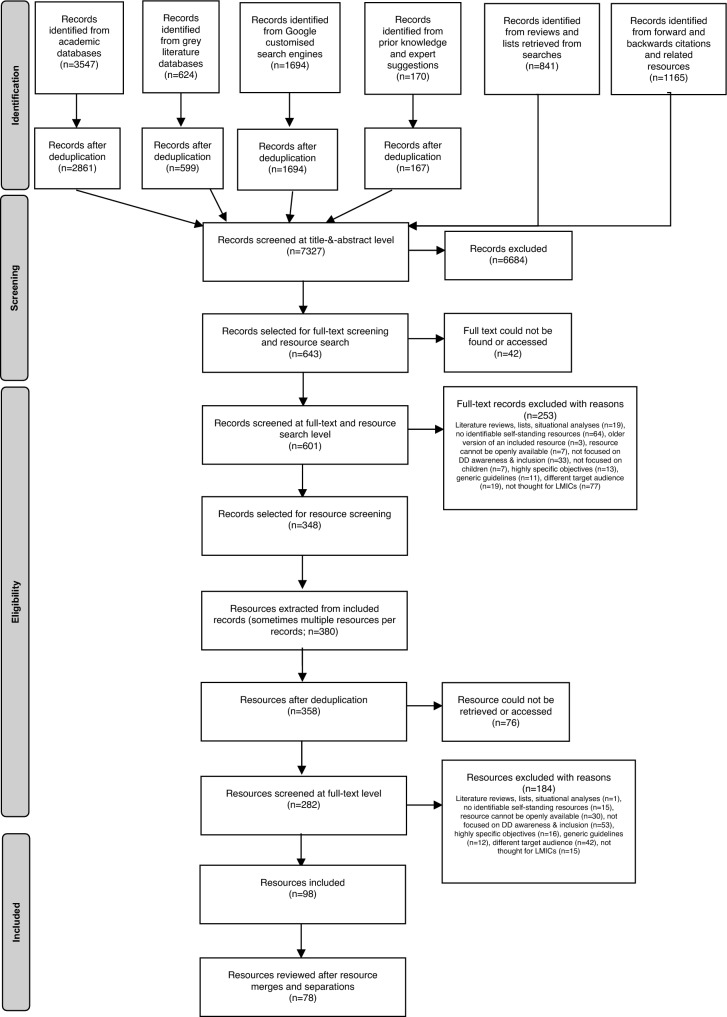
Most children with developmental disabilities (DD), such as intellectual disabilities and autism, live in low- and middle-income countries (LMICs), where services are usually limited. Various governmental, non-governmental and research organisations in LMICs have developed awareness-raising campaigns and training and education resources on DD in childhood relevant to LMICs. This study aimed to comprehensively search and review freely available materials in the academic and grey literature, aimed at awareness raising, training and education on DD among non-specialist professionals and community members in LMICs. We consulted 183 experts, conducted key-word searches in five academic databases, four grey-literature databases and seventeen customised Google search engines. Following initial screening, we manually searched relevant systematic reviews and lists of resources and conducted forwards and backwards citation checks of included articles. We identified 7327 articles and resources after deduplication. We then used a rigorous multi-step screening process to select 78 training resources on DD relevant to LMICs, of which 43 aimed at informing and/or raising awareness DD, 16 highlighted specific strategies for staff in health settings and 19 in education settings. Our mapping analysis revealed that a wealth of materials is available for both global and local use, including comics, children's books, flyers, posters, fact sheets, blogs, videos, websites pages, social media channels, handbooks and self-education guides, and training programmes or sessions. Twelve resources were developed for cross-continental or global use in LMICs, 19 were developed for and/or used in Africa, 23 in Asia, 24 in Latin America. Most resources were developed within the context where they were intended to be used. Identified gaps included a limited range of resources on intellectual disabilities, manuals for actively delivering training to staff in education settings and resources targeted at eastern European LMICs: future intervention development and adaptation efforts should address such gaps, to ensure capacity building materials exist for a sufficient variety of DD, settings and geographical areas. Beyond identifying these gaps, the value of the review lies in the compilation of summary tables of information on all freely available resources found, to support their selection and use in wider contexts. Information on the resource content, country of original development and copyright is provided to facilitate resource sharing and uptake.
大多数患有发育障碍(DD)的儿童,如智力障碍和自闭症患者,生活在低收入和中等收入国家(LMICs),而这些国家的服务通常有限。LMICs的各种政府、非政府和研究组织开展了提高认识运动,并开发了与LMICs相关的儿童发育障碍方面的培训和教育资源。本研究旨在全面检索和审查学术文献和灰色文献中免费提供的材料,旨在提高LMICs非专业专业人员和社区成员对发育障碍的认识、培训和教育。我们咨询了183位专家,在五个学术数据库、四个灰色文献数据库和十七个定制的谷歌搜索引擎中进行了关键词搜索。在初步筛选之后,我们手动搜索了相关的系统评价和资源列表,并对纳入文章进行了向前和向后的引文检查。去重后,我们识别出7327篇文章和资源。然后,我们使用严格的多步骤筛选过程,选择了78份与LMICs相关的发育障碍培训资源,其中43份旨在宣传和/或提高对发育障碍的认识,16份突出了卫生环境中工作人员的具体策略,19份针对教育环境。我们的映射分析表明,有大量材料可供全球和本地使用,包括漫画、儿童书籍、传单、海报、情况说明书、博客、视频、网页、社交媒体渠道、手册和自我教育指南,以及培训计划或课程。有12份资源是为LMICs的跨大陆或全球使用而开发的,19份是为非洲开发和/或在非洲使用的,23份在亚洲,24份在拉丁美洲。大多数资源是在其预期使用的背景下开发的。已确定的差距包括关于智力障碍的资源范围有限、为教育环境中的工作人员积极提供培训的手册以及针对东欧LMICs的资源:未来的干预开发和调整工作应解决这些差距,以确保存在针对足够多种发育障碍、环境和地理区域的能力建设材料。除了识别这些差距之外,该综述的价值还在于汇编了所找到的所有免费资源的信息汇总表,以支持它们在更广泛背景下的选择和使用。提供了有关资源内容、原始开发国家和版权的信息,以促进资源共享和采用。