Gao Mengqin, Guo Dayou, Wang Jiahao, Tan Yizhou, Liu Kaiyuan, Gao Lei, Zhang Yulei, Ding Zhihua, Gu Ying, Li Peng
State Key Lab of Modern Optical Instrumentation, College of Optical Science and Engineering, Zhejiang University, Hangzhou, Zhejiang 310027, China.
Department of Laser Medicine, First Medical Center of PLA General Hospital, Beijing 100853, China.
Biomed Opt Express. 2024 Jan 24;15(2):991-1003. doi: 10.1364/BOE.506092. eCollection 2024 Feb 1.
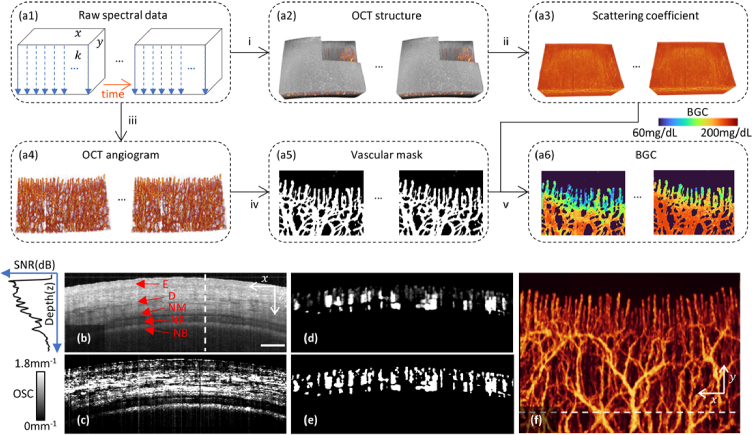
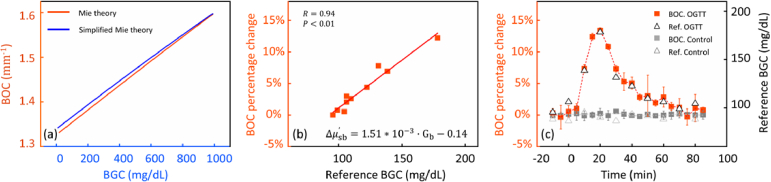
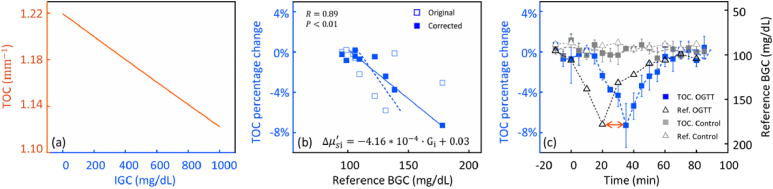
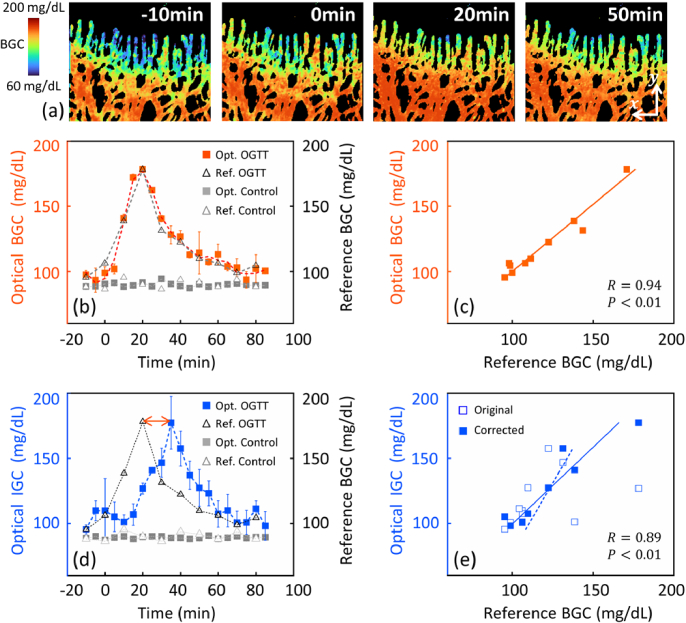
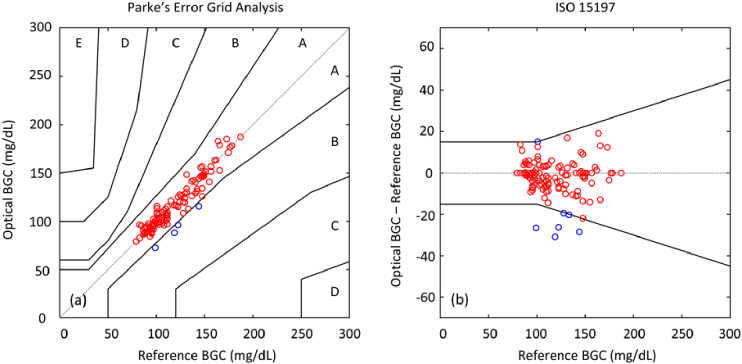
The accuracy of noninvasive continuous glucose monitoring (CGM) through near-infrared scattering is challenged by mixed scattering signals from different compartments, where glucose has a positive correlation with a blood scattering coefficient but a negative correlation with a tissue scattering coefficient. In this study, we developed a high-accuracy noninvasive CGM based on OCT angiography (OCTA)-purified blood scattering signals. The blood optical scattering coefficient (BOC) was initially extracted from the depth attenuation of backscattered light in OCT and then purified by eliminating the scattering signals from the surrounding tissues under the guidance of a 3D OCTA vascular map in human skin. The purified BOC was used to estimate the optical blood glucose concentration (BGC) through a linear calibration. The optical and reference BGC measurements were highly correlated (R = 0.94) without apparent time delay. The mean absolute relative difference was 6.09%. All optical BGC measurements were within the clinically acceptable Zones A + B, with 96.69% falling in Zone A on Parke's error grids. The blood glucose response during OGTT was mapped with a high spatiotemporal resolution of the single vessel and 5 seconds. This noninvasive OCTA-based CGM shows promising accuracy for clinical use. Future research will involve larger sample sizes and diabetic participants to confirm these preliminary findings.
通过近红外散射进行的无创连续血糖监测(CGM)的准确性受到来自不同组织层的混合散射信号的挑战,其中葡萄糖与血液散射系数呈正相关,但与组织散射系数呈负相关。在本研究中,我们基于光学相干断层扫描血管造影(OCTA)纯化的血液散射信号开发了一种高精度无创CGM。血液光学散射系数(BOC)最初是从光学相干断层扫描中背向散射光的深度衰减中提取的,然后在人体皮肤的三维OCTA血管图的引导下,通过消除周围组织的散射信号进行纯化。纯化后的BOC通过线性校准用于估计光学血糖浓度(BGC)。光学和参考BGC测量高度相关(R = 0.94),且无明显时间延迟。平均绝对相对差异为6.09%。所有光学BGC测量值均在临床可接受的A + B区内,96.69%落在帕克误差网格的A区内。口服葡萄糖耐量试验期间的血糖反应以单个血管的高时空分辨率和5秒的时间分辨率进行映射。这种基于OCTA的无创CGM在临床应用中显示出有前景的准确性。未来的研究将涉及更大的样本量和糖尿病参与者,以证实这些初步发现。