Department of Hematology, The Second Affiliated Hospital and Yuying Children's Hospital of Wenzhou Medical University, Wenzhou, China.
Department of Endocrinology, The Second Affiliated Hospital and Yuying Children's Hospital of Wenzhou Medical University, Wenzhou, China.
J Diabetes Investig. 2024 Jun;15(6):762-771. doi: 10.1111/jdi.14170. Epub 2024 Feb 26.
Previous studies have demonstrated a correlation between the serum uric acid-to-high-density lipoprotein cholesterol ratio (UHR) and insulin resistance (IR) in individuals with type 2 diabetes mellitus. However, no existing studies have investigated the relationship between IR and UHR in the general population. Therefore, the primary objective of this study was to investigate the correlation between UHR and IR in the general American population.
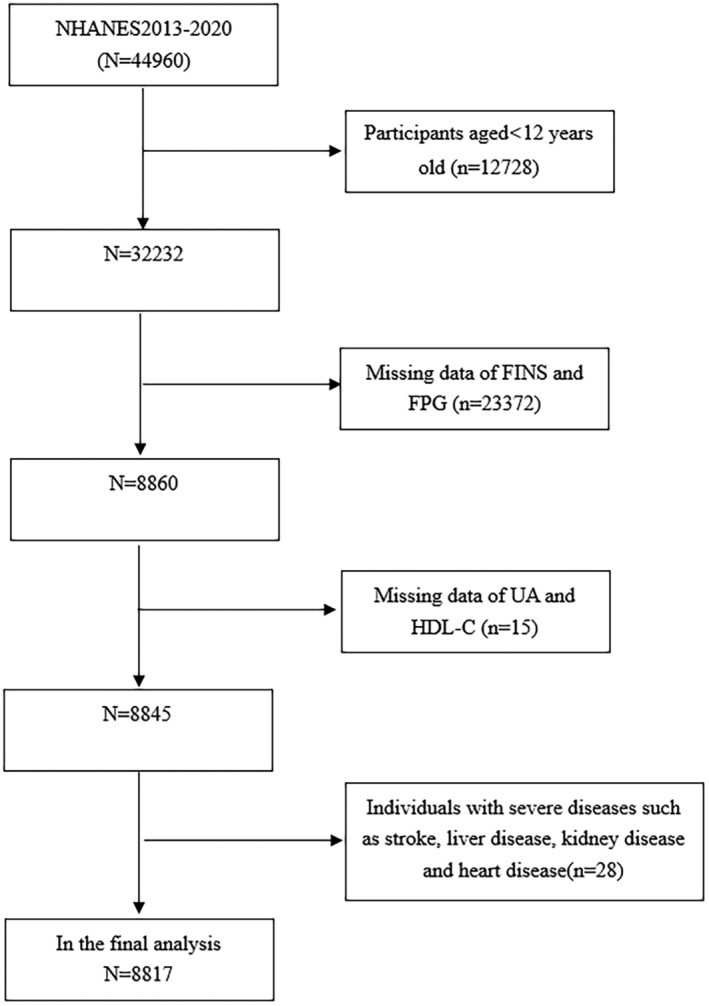
A sample of 8,817 participants was selected from the 2013 to 2020 National Health and Nutrition Examination Survey (NHANES). Homeostatic model assessment of insulin resistance (HOMA-IR) was used to assess insulin resistance. Multiple logistic regression, generalized smooth curve fitting, and subgroup analysis were used to assess the association between IR and UHR.
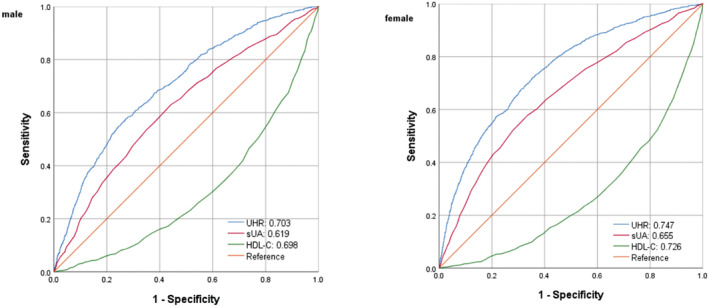
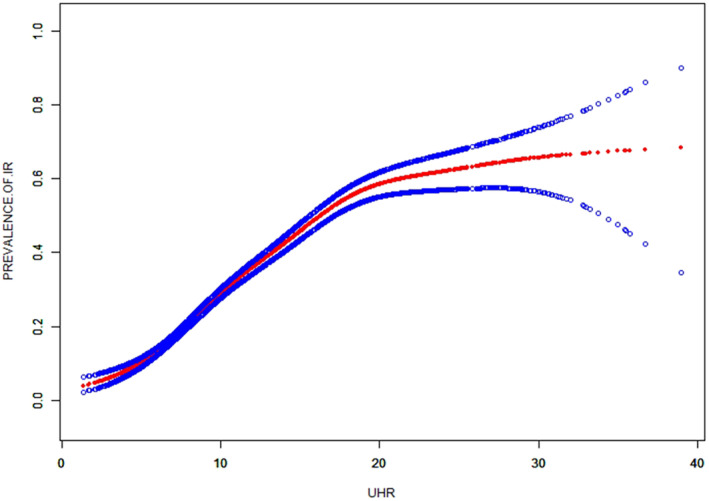
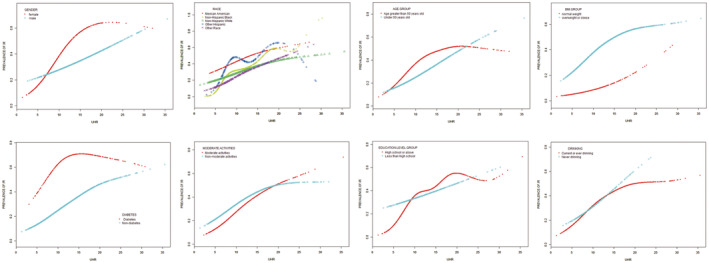
Multiple logistic regression analysis indicated a significant correlation between insulin resistance and UHR, with odds ratios (OR) of 1.07 (95% CI = 1.03-1.11) in males and 1.18 (95% CI = 1.13-1.25) in females. A non-linear relationship and saturation effect between IR risk and UHR were observed, characterized by an inverted L-shaped curve and a critical inflection point at 8.82. It was found that the area under the ROC curve (AUC) of UHR was significantly larger (AUC = 0.703 for males and 0.747 for females, all P < 0.01) compared with the use of UA or HDL-C alone. Subgroup analysis showed that this independent association remain consistent regardless of race, age, BMI, diabetes, moderate activities, education level, alcohol drinking, and gender.
Elevated UHR demonstrates a significant correlation with insulin resistance, so it can be used as a potential indicator of insulin resistance within the American population.
先前的研究表明,在 2 型糖尿病患者中,血清尿酸与高密度脂蛋白胆固醇比值(UHR)与胰岛素抵抗(IR)之间存在相关性。然而,目前尚无研究探讨一般人群中 IR 与 UHR 之间的关系。因此,本研究的主要目的是探讨一般美国人群中 UHR 与 IR 之间的相关性。
从 2013 年至 2020 年的国家健康和营养检查调查(NHANES)中选择了 8817 名参与者作为样本。使用稳态模型评估胰岛素抵抗(HOMA-IR)来评估胰岛素抵抗。采用多因素逻辑回归、广义平滑曲线拟合和亚组分析来评估 IR 与 UHR 之间的关联。
多因素逻辑回归分析表明,IR 与 UHR 之间存在显著相关性,男性的比值比(OR)为 1.07(95%CI=1.03-1.11),女性为 1.18(95%CI=1.13-1.25)。IR 风险与 UHR 之间存在非线性关系和饱和效应,表现为倒 L 形曲线和 8.82 处的临界拐点。结果发现,UHR 的 ROC 曲线下面积(AUC)明显更大(男性 AUC=0.703,女性 AUC=0.747,均 P<0.01),优于单独使用 UA 或 HDL-C。亚组分析表明,这种独立相关性在不同种族、年龄、BMI、糖尿病、适度活动、教育程度、饮酒和性别中均保持一致。
UHR 升高与 IR 显著相关,因此可作为美国人群中 IR 的潜在指标。