Cognitive and Affective Neuroscience Unit, Department of Psychology, University of Zurich, Zurich 8050, Switzerland.
Neuroscience Center Zurich, University of Zurich and ETH Zurich, Zurich 8057, Switzerland.
Proc Natl Acad Sci U S A. 2024 Mar 5;121(10):e2316306121. doi: 10.1073/pnas.2316306121. Epub 2024 Feb 26.
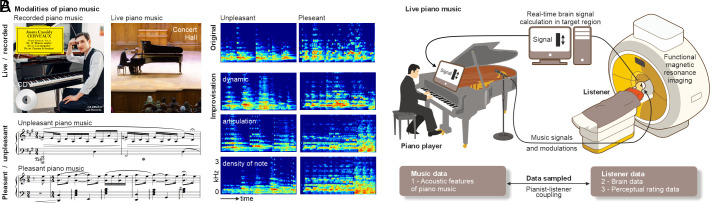
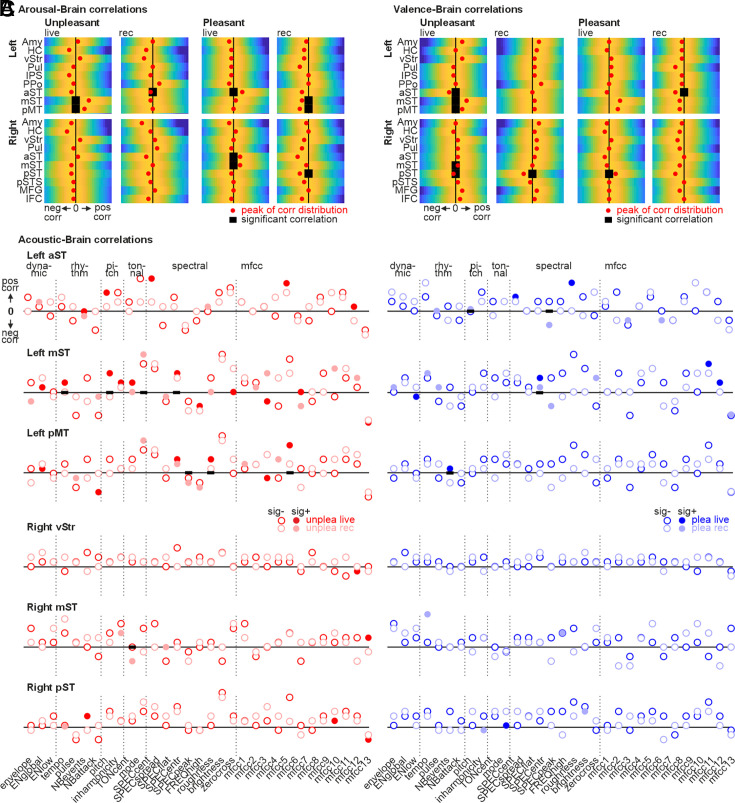
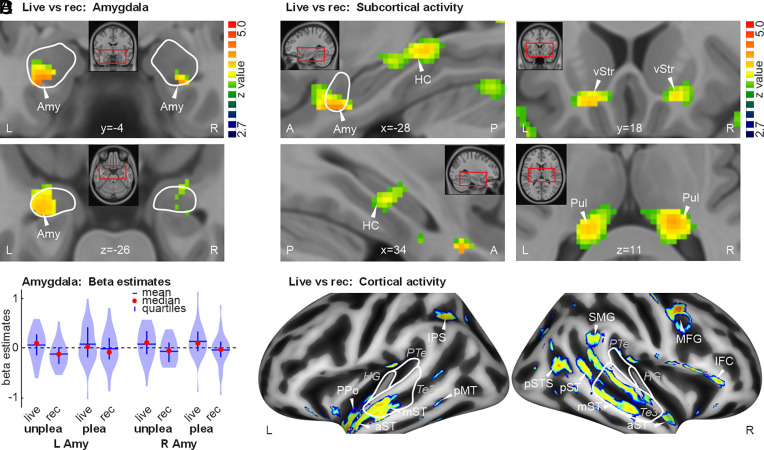
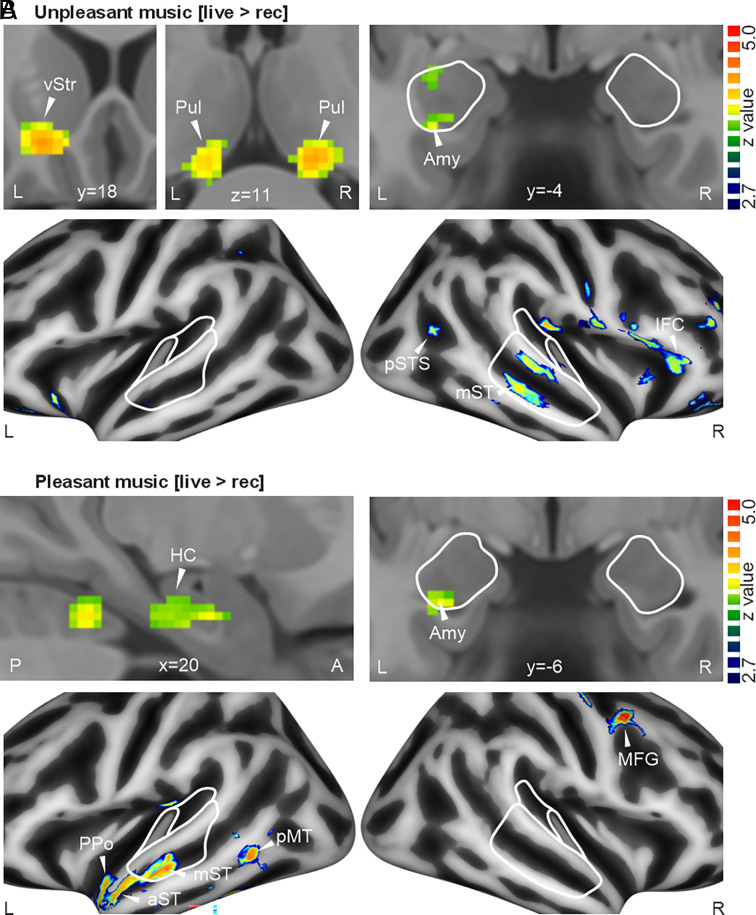
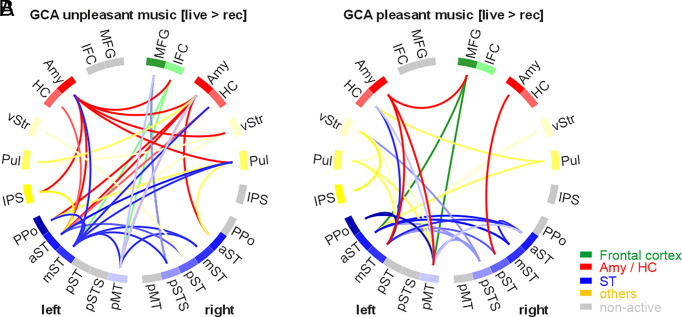
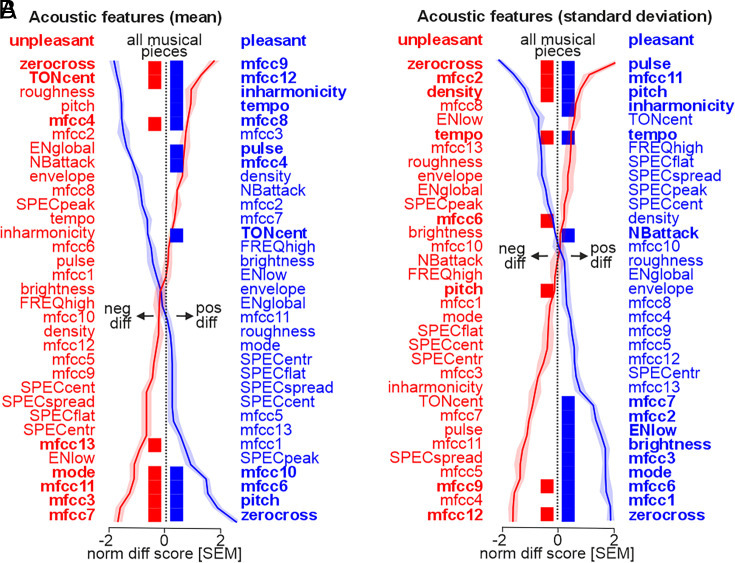
Music is powerful in conveying emotions and triggering affective brain mechanisms. Affective brain responses in previous studies were however rather inconsistent, potentially because of the non-adaptive nature of recorded music used so far. Live music instead can be dynamic and adaptive and is often modulated in response to audience feedback to maximize emotional responses in listeners. Here, we introduce a setup for studying emotional responses to live music in a closed-loop neurofeedback setup. This setup linked live performances by musicians to neural processing in listeners, with listeners' amygdala activity was displayed to musicians in real time. Brain activity was measured using functional MRI, and especially amygdala activity was quantified in real time for the neurofeedback signal. Live pleasant and unpleasant piano music performed in response to amygdala neurofeedback from listeners was acoustically very different from comparable recorded music and elicited significantly higher and more consistent amygdala activity. Higher activity was also found in a broader neural network for emotion processing during live compared to recorded music. This finding included observations of the predominance for aversive coding in the ventral striatum while listening to unpleasant music, and involvement of the thalamic pulvinar nucleus, presumably for regulating attentional and cortical flow mechanisms. Live music also stimulated a dense functional neural network with the amygdala as a central node influencing other brain systems. Finally, only live music showed a strong and positive coupling between features of the musical performance and brain activity in listeners pointing to real-time and dynamic entrainment processes.
音乐在传达情感和触发情感大脑机制方面具有强大的作用。然而,以前的研究中的情感大脑反应却相当不一致,这可能是因为迄今为止使用的录制音乐不具有适应性。现场音乐则可以是动态和自适应的,并且通常会根据观众的反馈进行调整,以最大限度地提高听众的情感反应。在这里,我们引入了一种在闭环神经反馈设置中研究现场音乐情感反应的设置。该设置将音乐家的现场表演与听众的神经处理联系起来,听众的杏仁核活动实时显示给音乐家。使用功能磁共振成像测量大脑活动,特别是实时量化神经反馈信号中的杏仁核活动。现场演奏的令人愉快和不愉快的钢琴音乐是根据听众的杏仁核神经反馈做出反应的,与可比的录制音乐相比,现场音乐在声音上有很大的不同,并且引起的杏仁核活动明显更高且更一致。与录制音乐相比,在现场音乐中还发现了更广泛的情感处理神经网络的更高活动。这一发现包括观察到在听不愉快音乐时,腹侧纹状体中厌恶编码的优势,以及丘脑枕核的参与,可能是为了调节注意力和皮质流机制。现场音乐还刺激了一个密集的功能神经网络,杏仁核作为中央节点影响其他大脑系统。最后,只有现场音乐显示出音乐表演特征与听众大脑活动之间的强烈正耦合,这表明存在实时和动态的同步过程。