Sidney Kimmel Medical College, Thomas Jefferson University, Philadelphia, Pennsylvania, USA.
Dornsife School of Public Health, Drexel University, Philadelphia, Pennsylvania, USA.
J Viral Hepat. 2024 May;31(5):248-254. doi: 10.1111/jvh.13932. Epub 2024 Feb 26.
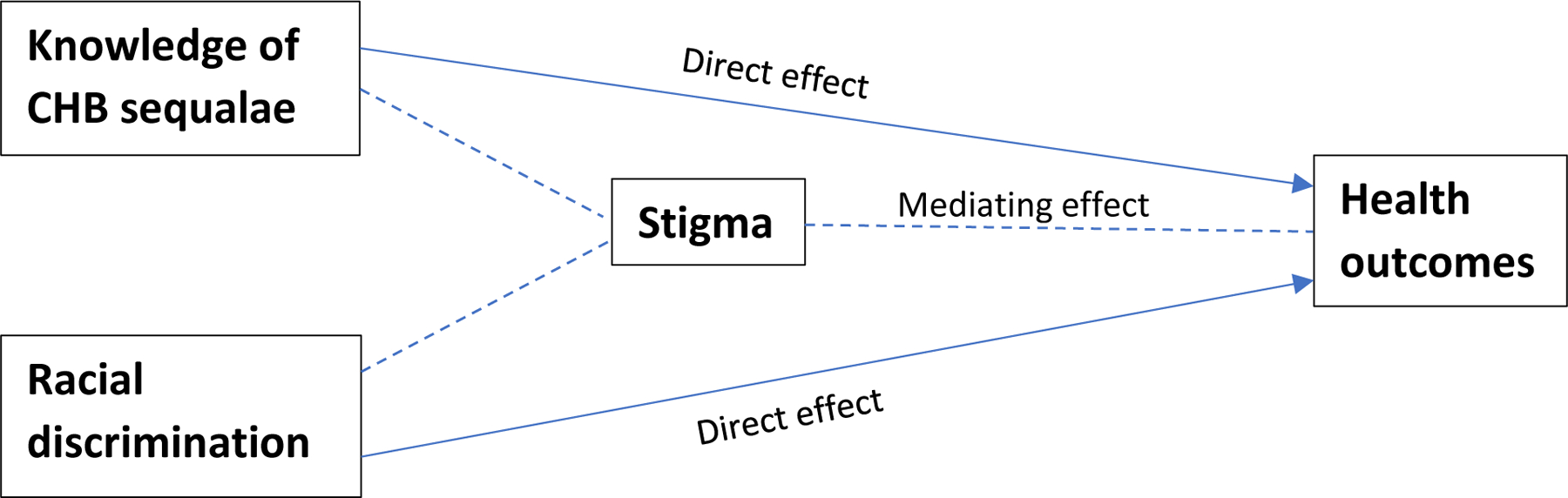
It is well described in current literature that Hepatitis B virus (HBV) affects Asian Americans more than any other racial group in the United States and that there is a stigma attached to this condition. The effects of stigma can be lasting, penetrating physiologically and psychologically, yet few studies have focused on the consequences of this phenomenon. The purpose of this study was to examine the mediating role of stigma in the effect of racial discrimination and knowledge (of HBV sequelae) on health status of Korean Americans with chronic hepatitis B (CHB). Three hundred sixty-five CHB patients were recruited and enrolled from two clinics in Philadelphia and Los Angeles. Depressive symptoms were measured using the Patient Health Question-9 (PHQ-9), physical health via self-rated health survey and stigma via hepatitis B quality of life (HBQOL)-stigma survey. Perceived racial discrimination and knowledge of CHB sequelae were independent variables. The cohort had an average age of 60.1 years (range 19-84, SD 10.7), 56% were male and 94% were born in South Korea. Mediational analysis found that stigma was a significant mediator between both racial discrimination (indirect effect = .037, Bootstrap 95% CI = [.010-.064]) and sequelae knowledge (indirect effect = .097, Bootstrap 95% CI = [.018-.176]) and depressive symptoms. Stigma also had a direct effect on depressive symptoms (β = .136, p < .01) and self-rated health (β = .018, p < .05). In addition, age, gender, education and employment were related to health outcomes. The findings of this study indicate that HBV-related stigma is an important mediator of mental health outcomes in this population. Future studies should identify other psychosocial factors to develop effective intervention programs to reduce stigma and improve quality of life among CHB patients.
当前文献中已有充分的描述,乙型肝炎病毒(HBV)对亚裔美国人的影响比美国任何其他种族群体都要大,而且这种情况带有污名。污名的影响可能是持久的,会在生理和心理上产生影响,但很少有研究关注这种现象的后果。本研究的目的是检查污名在种族歧视和(对 HBV 后遗症的)知识对慢性乙型肝炎(CHB)的韩裔美国人健康状况的影响中的中介作用。从费城和洛杉矶的两家诊所招募并纳入了 365 名 CHB 患者。使用患者健康问卷-9(PHQ-9)测量抑郁症状,通过自我评估健康调查测量身体健康,通过乙型肝炎生活质量(HBQOL)-污名调查测量污名。感知的种族歧视和 CHB 后遗症的知识是自变量。该队列的平均年龄为 60.1 岁(范围 19-84,标准差 10.7),56%为男性,94%出生于韩国。中介分析发现,污名是种族歧视(间接效应=0.037,Bootstrap 95%置信区间=[0.010-.064])和后遗症知识(间接效应=0.097,Bootstrap 95%置信区间=[0.018-.176])与抑郁症状之间的重要中介。污名对抑郁症状(β=0.136,p<0.01)和自我评估健康(β=0.018,p<0.05)也有直接影响。此外,年龄、性别、教育和就业与健康结果有关。本研究的结果表明,HBV 相关污名是该人群心理健康结果的一个重要中介。未来的研究应该确定其他社会心理因素,以制定有效的干预计划,减少 CHB 患者的污名和提高生活质量。