Department of Immunology, St. Jude Children's Research Hospital, Memphis, TN, USA.
J Exp Med. 2024 Mar 4;221(3). doi: 10.1084/jem.20221839. Epub 2024 Feb 27.
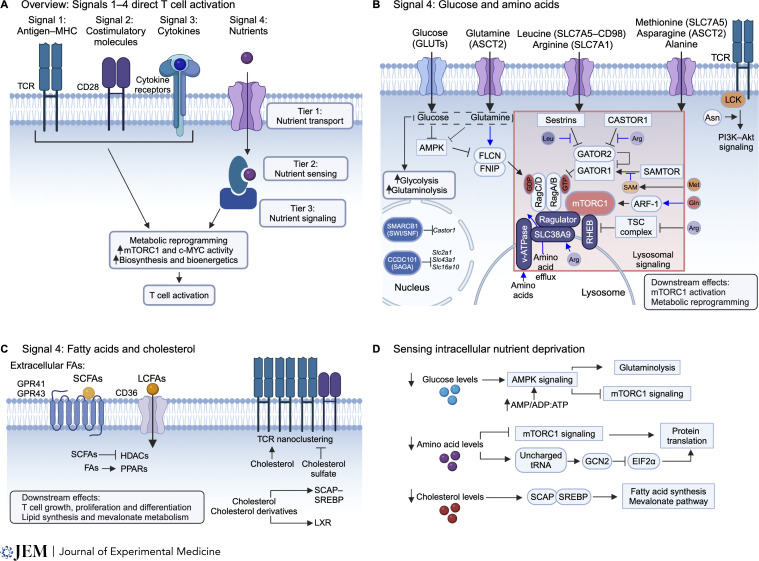
T cells are integral in mediating adaptive immunity to infection, autoimmunity, and cancer. Upon immune challenge, T cells exit from a quiescent state, followed by clonal expansion and effector differentiation. These processes are shaped by three established immune signals, namely antigen stimulation (Signal 1), costimulation (Signal 2), and cytokines (Signal 3). Emerging findings reveal that nutrients, including glucose, amino acids, and lipids, are crucial regulators of T cell responses and interplay with Signals 1-3, highlighting nutrients as Signal 4 to license T cell immunity. Here, we first summarize the functional importance of Signal 4 and the underlying mechanisms of nutrient transport, sensing, and signaling in orchestrating T cell activation and quiescence exit. We also discuss the roles of nutrients in programming T cell differentiation and functional fitness and how nutrients can be targeted to improve disease therapy. Understanding how T cells respond to Signal 4 nutrients in microenvironments will provide insights into context-dependent functions of adaptive immunity and therapeutic interventions.
T 细胞在介导感染、自身免疫和癌症的适应性免疫中起着重要作用。在免疫挑战时,T 细胞从静止状态中退出,随后进行克隆扩增和效应细胞分化。这三个过程受到三种已建立的免疫信号的影响,即抗原刺激(信号 1)、共刺激(信号 2)和细胞因子(信号 3)。新发现表明,营养物质(包括葡萄糖、氨基酸和脂质)是 T 细胞反应的关键调节剂,与信号 1-3 相互作用,突出了营养物质作为许可 T 细胞免疫的信号 4。在这里,我们首先总结了信号 4 的功能重要性以及营养物质在运输、感知和信号转导方面的潜在机制,这些机制在协调 T 细胞激活和静止状态退出中起着重要作用。我们还讨论了营养物质在编程 T 细胞分化和功能适应性方面的作用,以及如何针对营养物质进行治疗以改善疾病。了解 T 细胞如何在微环境中对信号 4 营养物质做出反应,将为理解适应性免疫的上下文相关功能和治疗干预提供深入的见解。