Department of Nutrition and Food Hygiene, School of Public Health, Chongqing Medical University, Chongqing, China.
Department of Epidemiology and Biostatistics, School of Public Health, Zhejiang University School of Medicine, Hangzhou, Zhejiang, China.
Nutr Diabetes. 2024 Feb 27;14(1):5. doi: 10.1038/s41387-024-00266-6.
To investigate the association of timing, frequency, and food quality of night eating with all-cause, cancer, and diabetes mortality.
This study included 41,744 participants from the US National Health and Nutrition Examination Survey (2002-2018). Night eating information was collected by 24-h dietary recall and the exposures were timing, frequency, and food quality of night eating. Food quality was assessed by latent class analysis. The outcomes were all-cause, cancer, and diabetes mortality, which were identified by the National Death Index and the International Classification of Diseases 10th Revision. Adjusted hazard ratios [aHR] with 95% confidence intervals [CI] were computed by Cox regression.
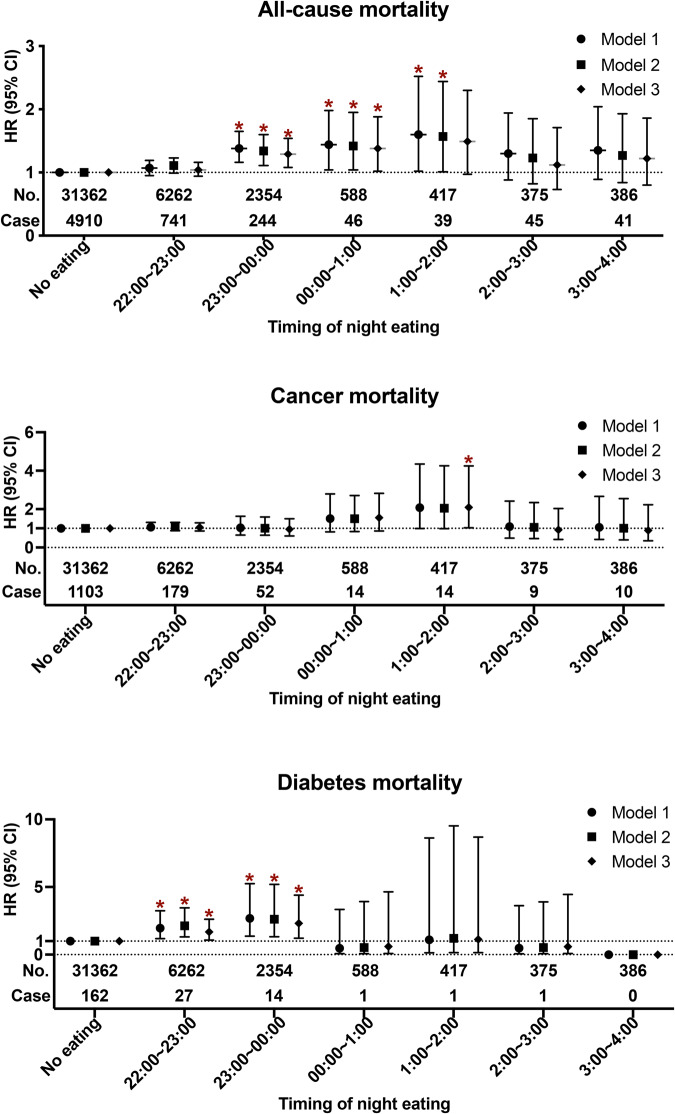
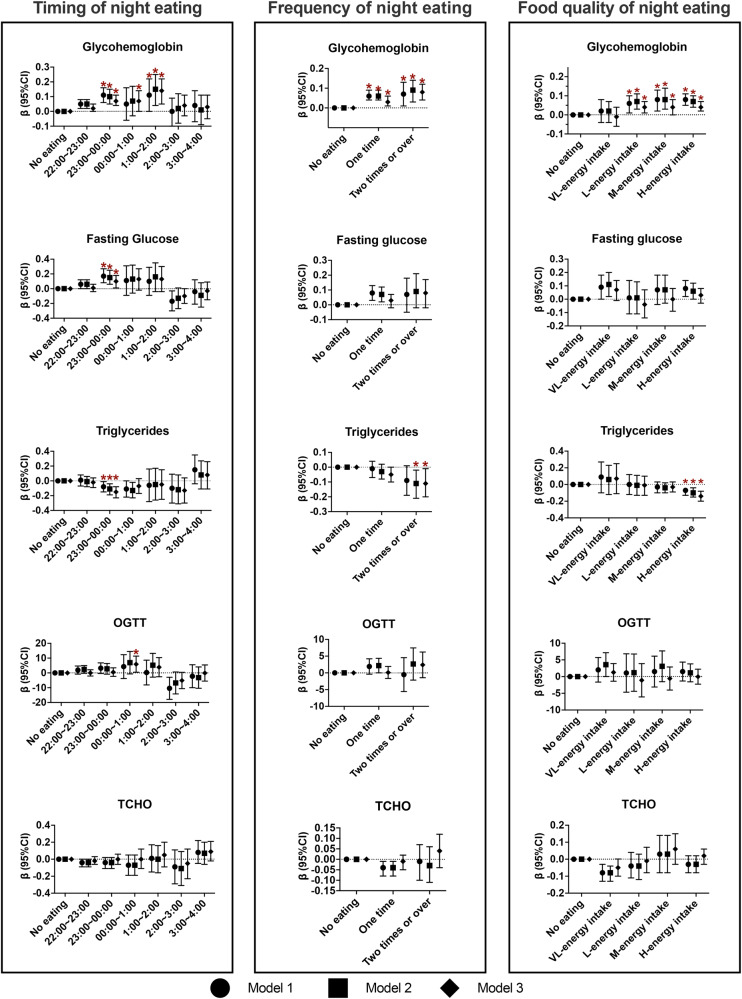
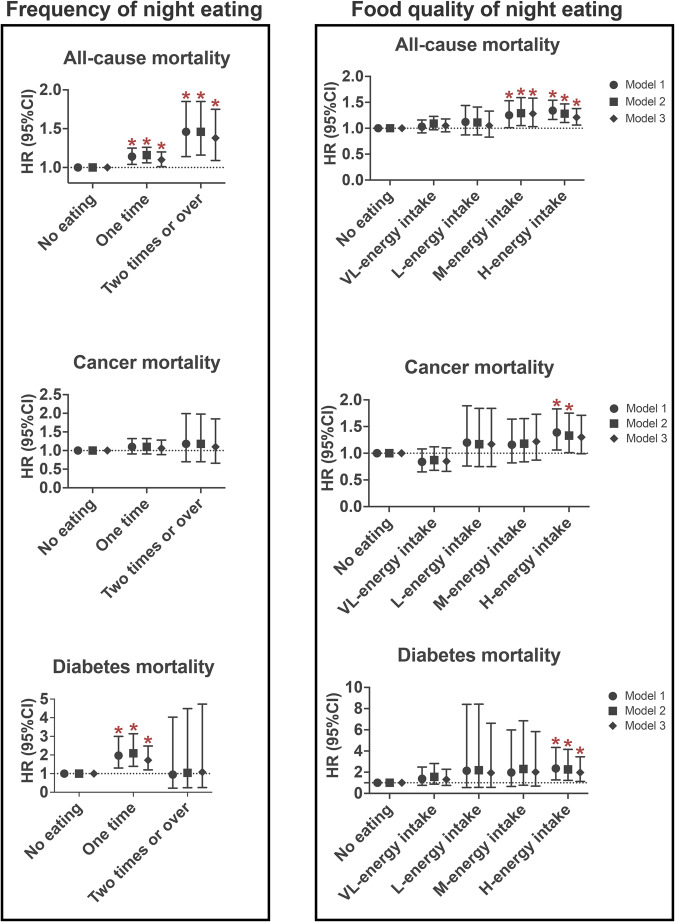
During a median follow-up of 8.7 years, 6066 deaths were documented, including 1381 from cancer and 206 from diabetes. Compared with no night eating (eating before 22:00), the later timing of night eating was associated with higher risk of all-cause and diabetes mortality (each P-trend <0.05) rather than cancer mortality, with the highest risk of eating being 00:00-1:00 (aHR 1.38, 95% CI 1.02-1.88) and being 23:00-00:00 (aHR 2.31, 95% CI 1.21-4.40), respectively. However, the increased risks were not observed for 22:00-23:00. Likewise, one time or over frequency of night eating was associated with higher all-cause and diabetes mortality (each P < 0.05). That risks were further observed in high-dietary-energy-density group of night eating (all-cause mortality: aHR 1.21 [95% CI 1.06-1.38]; diabetes mortality: aHR 1.97 [95% CI 1.13-3.45]), but not in low-dietary-energy-density group. Finally, correlation analysis found positive associations of night eating with glycohemoglobin, fasting glucose, and OGTT.
Night eating was associated with increased all-cause, cancer and diabetes mortality; however, reduction of excess mortality risk was observed when eating before 23:00 or low-dietary-energy-density foods.
探讨夜间进食的时间、频率和食物质量与全因、癌症和糖尿病死亡的关系。
本研究纳入了美国国家健康和营养调查(2002-2018 年)中的 41744 名参与者。夜间进食信息通过 24 小时膳食回顾收集,暴露因素为夜间进食的时间、频率和食物质量。食物质量通过潜在类别分析进行评估。全因、癌症和糖尿病死亡是通过国家死亡索引和国际疾病分类第 10 版确定的。使用 Cox 回归计算调整后的危险比(aHR)及其 95%置信区间(CI)。
在中位随访 8.7 年期间,记录了 6066 例死亡,包括 1381 例癌症死亡和 206 例糖尿病死亡。与无夜间进食(22:00 前进食)相比,较晚的夜间进食时间与全因和糖尿病死亡风险增加相关(各 P 趋势<0.05),而与癌症死亡风险无关,进食时间最晚为 00:00-1:00 时风险最高(aHR 1.38,95%CI 1.02-1.88),23:00-00:00 时风险最高(aHR 2.31,95%CI 1.21-4.40)。然而,22:00-23:00 时并未观察到风险增加。同样,夜间进食一次或以上的频率与全因和糖尿病死亡风险增加相关(各 P<0.05)。在夜间进食高膳食能量密度组中进一步观察到这些风险(全因死亡率:aHR 1.21[95%CI 1.06-1.38];糖尿病死亡率:aHR 1.97[95%CI 1.13-3.45]),但在低膳食能量密度组中未观察到。最后,相关性分析发现夜间进食与糖化血红蛋白、空腹血糖和 OGTT 呈正相关。
夜间进食与全因、癌症和糖尿病死亡风险增加有关;然而,当进食时间在 23:00 前或进食低膳食能量密度食物时,可降低额外的死亡风险。