Faculty of Epidemiology and Population Health, London School of Hygiene & Tropical Medicine, London, United Kingdom.
School of Tropical Medicine and Global Health, Nagasaki University, Nagasaki, Japan.
Int J Popul Data Sci. 2023 Oct 23;8(1):2156. doi: 10.23889/ijpds.v8i1.2156. eCollection 2023.
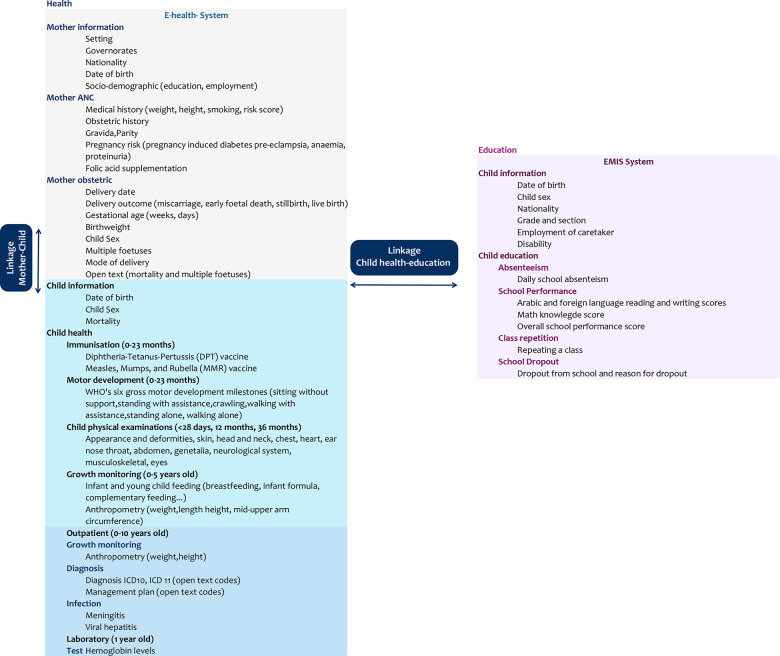
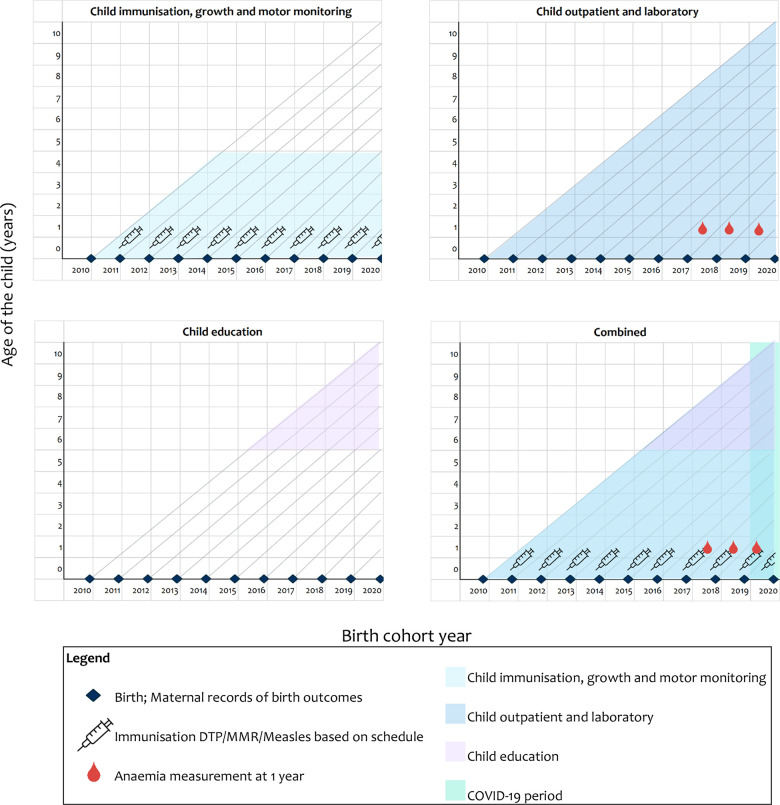
By linking datasets, electronic records can be used to build large birth-cohorts, enabling researchers to cost-effectively answer questions relevant to populations over the life-course. Currently, around 5.8 million Palestinian refugees live in five settings: Jordan, Lebanon, Syria, West Bank, and Gaza Strip. The United Nations Relief and Works Agency for Palestine Refugees in the Near East (UNRWA) provides them with free primary health and elementary-school services. It maintains electronic records to do so.We aimed to establish a birth cohort of Palestinian refugees born between 1st January 2010 and 31st December 2020 living in five settings by linking mother obstetric records with child health and education records and to describe some of the cohort characteristics. In future, we plan to assess effects of size-at-birth on growth, health and educational attainment, among other questions.
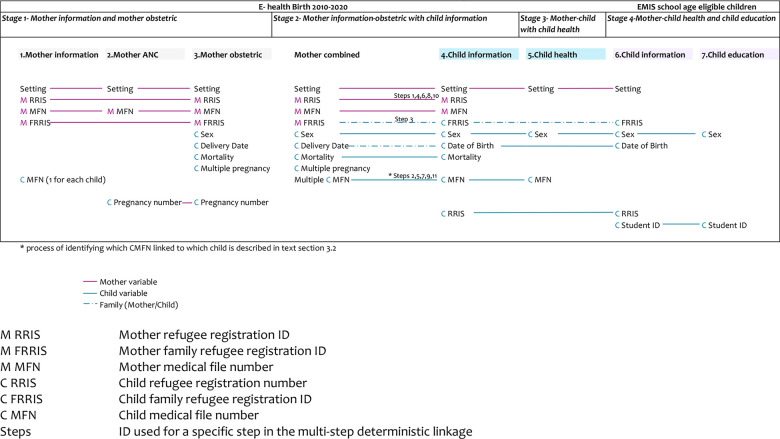
We extracted all available data from 140 health centres and 702 schools across five settings, i.e. all UNRWA service users. Creating the cohort involved examining IDs and other data, preparing data, de-duplicating records, and identifying live-births, linking the mothers' and children's data using different deterministic linking algorithms, and understanding reasons for non-linkage.
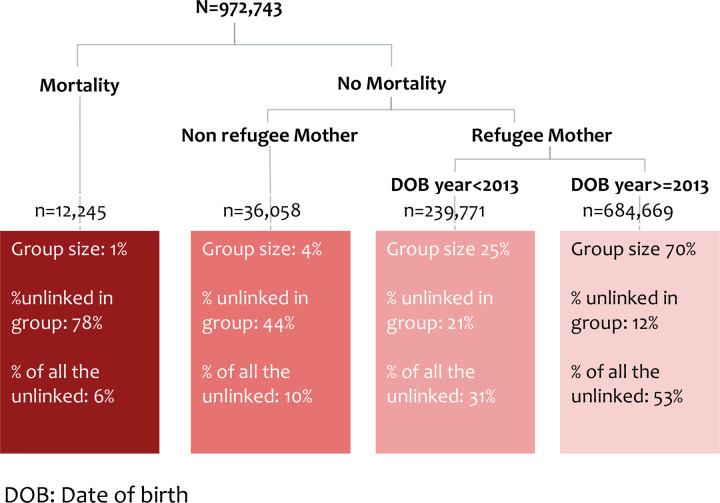
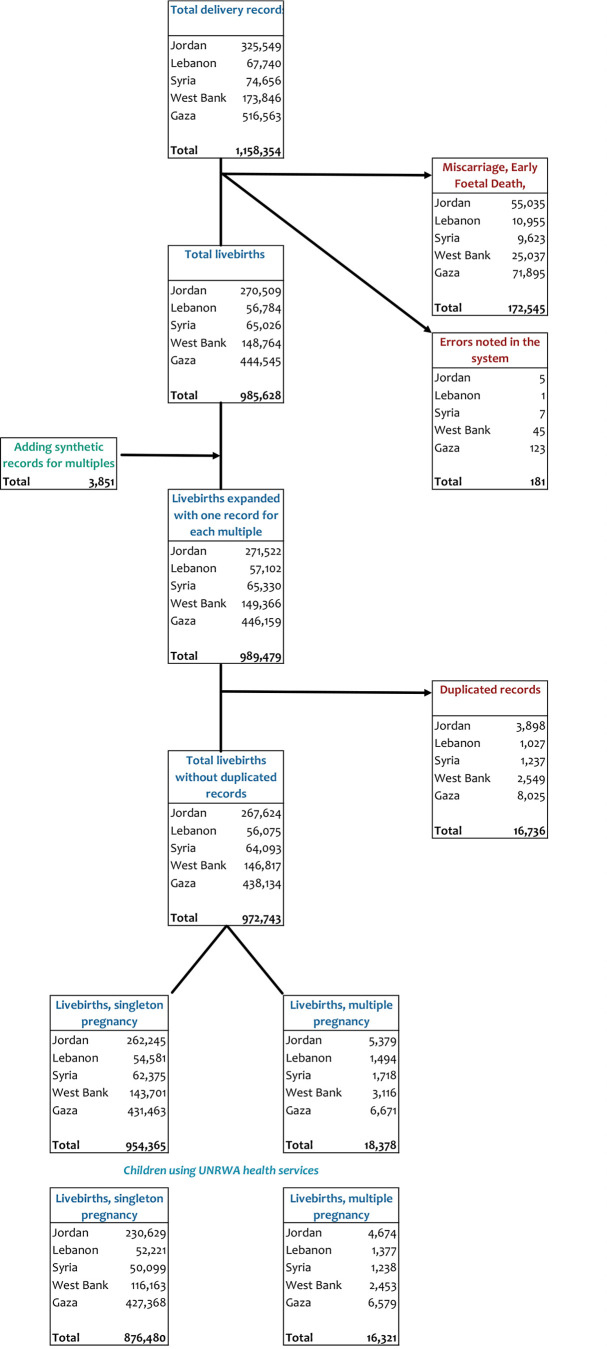
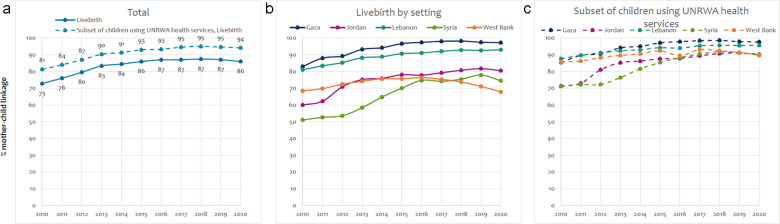
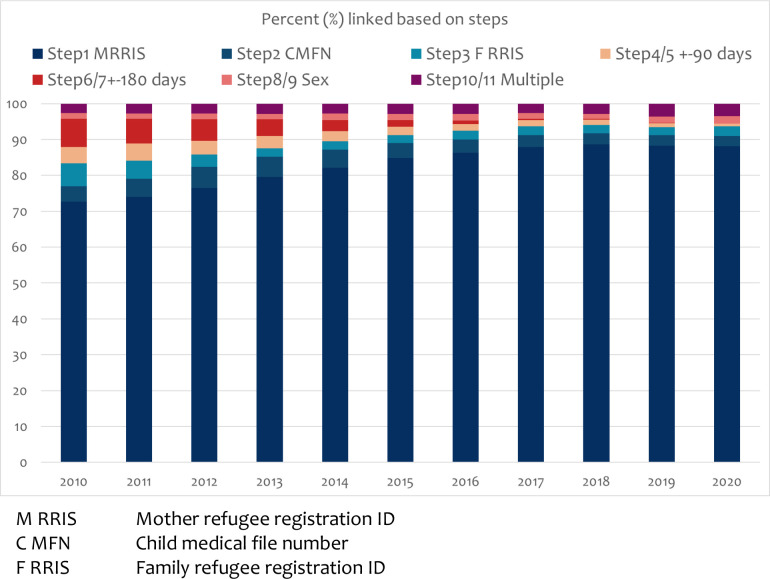
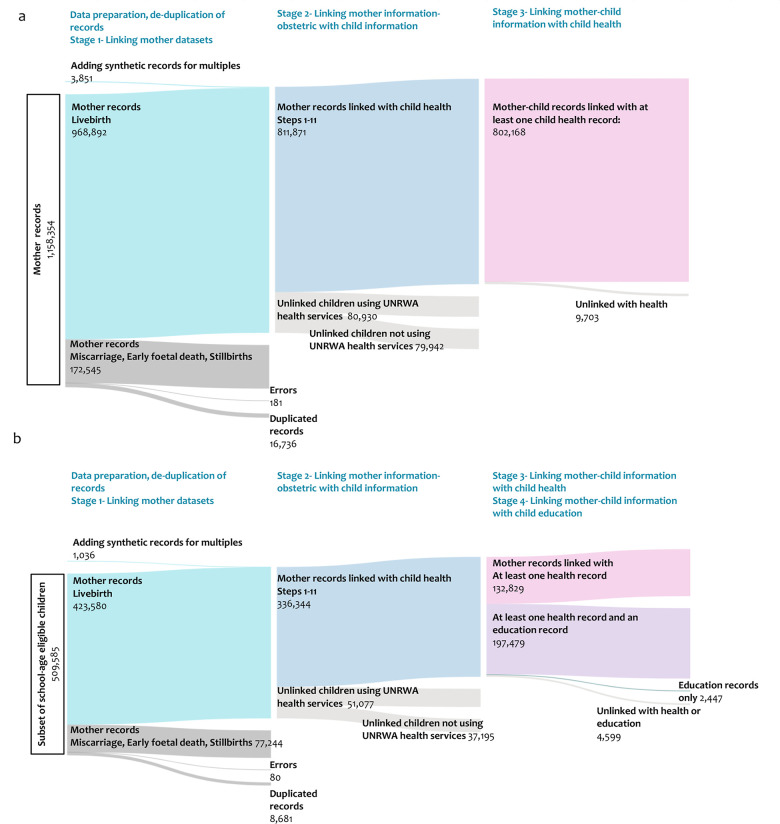
We established a birth cohort of Palestinian refugees using electronic records of 972,743 live births. We found high levels of linkage to health records overall (83%), which improved over time (from 73% to 86%), and variations in linkage rates by setting: these averaged 93% in Gaza, 89% in Lebanon, 75% in Jordan, 73% in West Bank and 68% in Syria. Of the 423,580 children age-eligible to go to school, 47% went to UNRWA schools and comprised of 197,479 children with both health and education records, and 2,447 children with only education records. In addition to year and setting, other factors associated with non-linkage included mortality and having a non-refugee mother. Misclassification errors were minimal.
This linked open birth-cohort is unique for refugees and the Arab region and forms the basis for many future studies, including to elucidate pathways for improved health and education in this vulnerable, understudied population. Our characterization of the cohort leads us to recommend using different sub-sets of the cohort depending on the research question and analytic purposes.
通过数据集的链接,电子记录可用于构建大型出生队列,使研究人员能够以具有成本效益的方式回答与整个人生过程中的人群相关的问题。目前,约有 580 万巴勒斯坦难民居住在五个地区:约旦、黎巴嫩、叙利亚、西岸和加沙地带。联合国近东巴勒斯坦难民救济和工程处(近东救济工程处)为他们提供免费的小学初级保健和小学教育服务。它通过维护电子记录来做到这一点。我们旨在通过将产妇记录与儿童健康和教育记录相链接,建立一个由 2010 年 1 月 1 日至 2020 年 12 月 31 日期间出生的生活在五个地区的巴勒斯坦难民出生队列,并描述该队列的一些特征。将来,我们计划评估出生时的大小对生长、健康和教育成就等问题的影响。
我们从五个地区的 140 个保健中心和 702 所学校中提取了所有可用数据,即所有近东救济工程处的服务用户。建立队列涉及检查 ID 和其他数据、准备数据、去重记录以及识别活产,使用不同的确定性链接算法链接母亲和儿童的数据,并了解无法链接的原因。
我们使用电子记录建立了一个由 972743 例活产组成的巴勒斯坦难民出生队列。我们发现健康记录的整体链接率很高(83%),并且随着时间的推移有所提高(从 73%提高到 86%),而且不同地区的链接率存在差异:加沙地带平均为 93%,黎巴嫩为 89%,约旦为 75%,西岸为 73%,叙利亚为 68%。在年龄适合上学的 423580 名儿童中,有 47%就读于近东救济工程处学校,其中有 197479 名儿童既有健康记录又有教育记录,还有 2447 名儿童只有教育记录。除了年份和地区外,其他与无法链接相关的因素还包括死亡率和有非难民母亲。分类错误很小。
这个链接的开放式出生队列对于难民和阿拉伯地区来说是独一无二的,它为许多未来的研究奠定了基础,包括阐明改善这一脆弱、研究不足的人群健康和教育的途径。我们对队列的特征分析使我们建议根据研究问题和分析目的使用队列的不同子集。