Division of Infectious Diseases and Vaccinology, School of Public Health, University of California, Berkeley, Berkeley, California, United States of America.
Division of Epidemiology and Biostatistics, School of Public Health, University of California, Berkeley, Berkeley, California, United States of America.
PLoS Negl Trop Dis. 2024 Feb 28;18(2):e0011948. doi: 10.1371/journal.pntd.0011948. eCollection 2024 Feb.
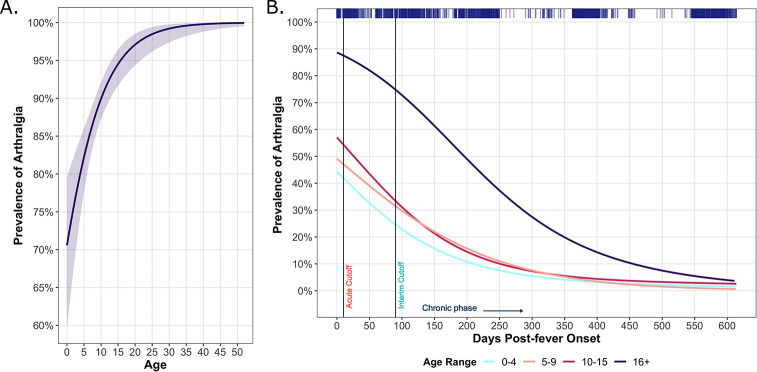
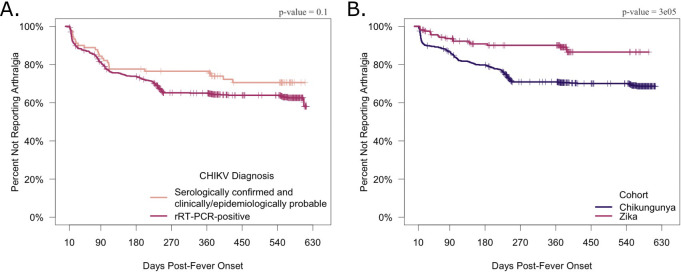
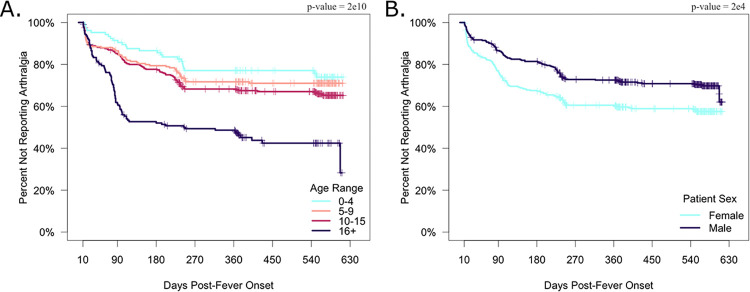
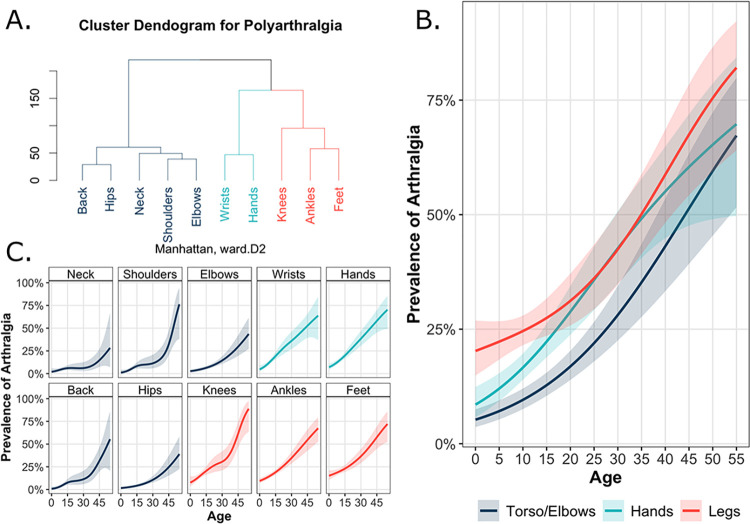
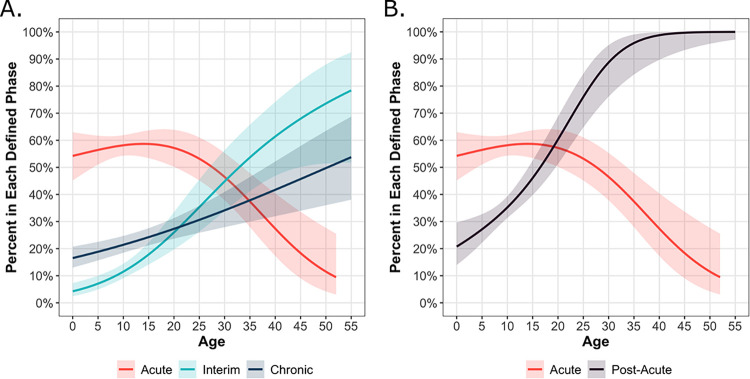
Chikungunya can result in debilitating arthralgia, often presenting as acute, self-limited pain, but occasionally manifesting chronically. Little is known about differences in chikungunya-associated arthralgia comparing children to adults over time. To characterize long-term chikungunya-associated arthralgia, we recruited 770 patients (105 0-4 years old [y/o], 200 5-9 y/o, 307 10-15 y/o, and 158 16+ y/o) with symptomatic chikungunya virus infections in Managua, Nicaragua, during two consecutive chikungunya epidemics (2014-2015). Participants were assessed at ~15 days and 1, 3, 6, 12, and 18 months post-fever onset. Following clinical guidelines, we defined participants by their last reported instance of arthralgia as acute (≤10 days post-fever onset), interim (>10 and <90 days), or chronic (≥90 days) cases. We observed a high prevalence of arthralgia (80-95%) across all ages over the study period. Overall, the odds of acute arthralgia increased in an age-dependent manner, with the lowest odds of arthralgia in the 0-4 y/o group (odds ratio [OR]: 0.27, 95% confidence interval [CI]: 0.14-0.51) and the highest odds of arthralgia in the 16+ y/o participants (OR: 4.91, 95% CI: 1.42-30.95) relative to 10-15 y/o participants. Females had higher odds of acute arthralgia than males (OR: 1.63, 95% CI: 1.01-2.65) across all ages. We found that 23-36% of pediatric and 53% of adult participants reported an instance of post-acute arthralgia. Children exhibited the highest prevalence of post-acute polyarthralgia in their legs, followed by the hands and torso - a pattern not seen among adult participants. Further, we observed pediatric chikungunya presenting in two distinct phases: the acute phase and the subsequent interim/chronic phases. Thus, differences in the presentation of arthralgia were observed across age, sex, and disease phase in this longitudinal chikungunya cohort. Our results elucidate the long-term burden of chikungunya-associated arthralgia among pediatric and adult populations.
基孔肯雅热可导致关节严重疼痛,通常表现为急性、自限性疼痛,但偶尔也会表现为慢性疼痛。关于儿童和成人随时间推移的基孔肯雅热相关关节痛的差异,人们知之甚少。为了描述长期的基孔肯雅热相关关节痛,我们招募了 770 名在尼加拉瓜马那瓜经历两次连续基孔肯雅热流行(2014-2015 年)的有症状的基孔肯雅病毒感染者(105 名 0-4 岁[岁]、200 名 5-9 岁、307 名 10-15 岁和 158 名 16 岁及以上)。参与者在发热后约 15 天和 1、3、6、12 和 18 个月进行评估。根据临床指南,我们根据最后一次报告的关节痛情况将参与者定义为急性(发热后≤10 天)、中期(发热后 10-90 天)或慢性(发热后≥90 天)病例。在整个研究期间,所有年龄段的关节痛发生率均较高(80-95%)。总体而言,急性关节痛的发生几率随年龄增长呈依赖性增加,0-4 岁年龄组发生关节痛的几率最低(比值比[OR]:0.27,95%置信区间[CI]:0.14-0.51),16 岁及以上年龄组发生关节痛的几率最高(OR:4.91,95%CI:1.42-30.95),与 10-15 岁年龄组相比。女性发生急性关节痛的几率高于男性(OR:1.63,95%CI:1.01-2.65),在所有年龄段中均如此。我们发现,23-36%的儿科和 53%的成年参与者报告有急性后关节痛。儿童腿部关节痛的发生率最高,其次是手部和躯干,而成年参与者则没有这种模式。此外,我们观察到儿童基孔肯雅热呈现出两个不同的阶段:急性阶段和随后的中期/慢性阶段。因此,在这项纵向基孔肯雅热队列研究中,我们观察到年龄、性别和疾病阶段在关节痛表现方面存在差异。我们的研究结果阐明了儿童和成年人群中基孔肯雅热相关关节痛的长期负担。