School of Animal Technology and Innovation, Institute of Agricultural Technology, Suranaree University of Technology, 111 University Avenue, Muang, Nakhon Ratchasima, 30000, Thailand.
Aquatic Animal Health Research Center, Charoen Pokphand Co. Ltd., Rama 2 Rd., Km 41.5, Bangtorat, Muang Samutsakorn, Samutsakorn, 74000, Thailand.
Sci Rep. 2024 Feb 29;14(1):4957. doi: 10.1038/s41598-024-54349-6.
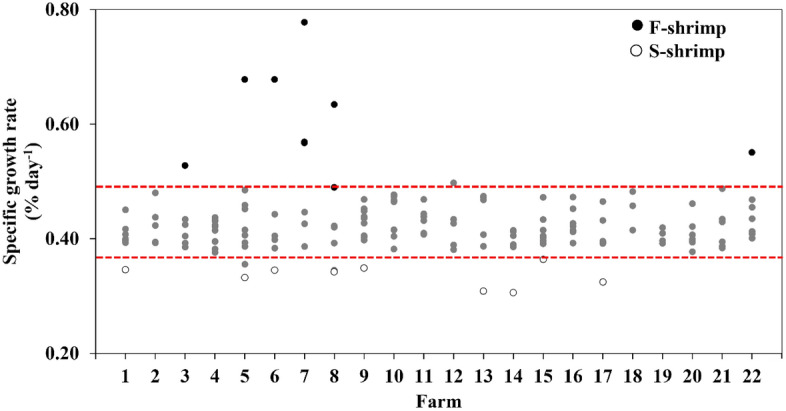
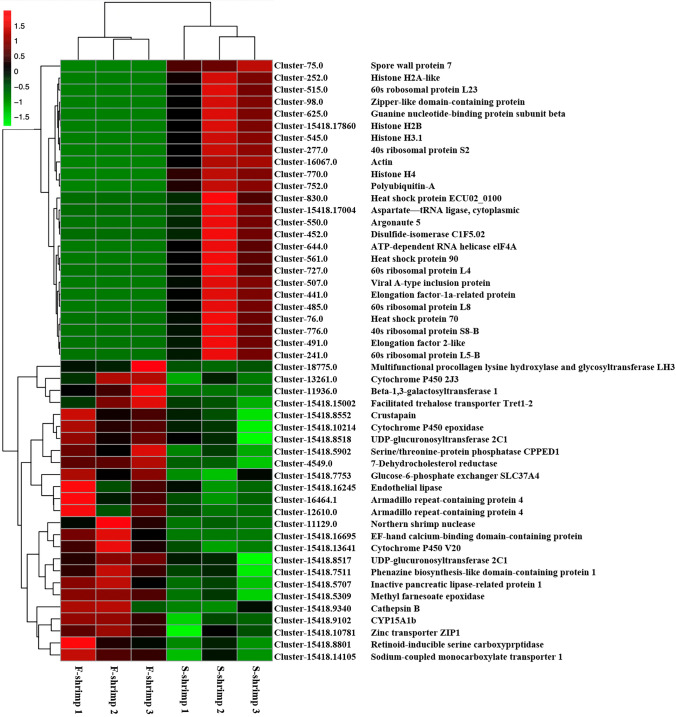
Efficient utilisation of plant-based diets in the giant freshwater prawn, Marcrobrachium rosenbergii, varies according to individual, suggesting that it might be associated with differences in physiological and metabolic responses. Therefore, we aimed to investigate the individual differences in the growth response of shrimp fed to a soybean-based diet (SBM). Two hundred shrimp were fed SBM for 90 days, and specific growth rate (SGR) was determined individually. Fast- and slow-growing shrimp (F-shrimp vs. S-shrimp), with the highest and lowest 5% SGRs, respectively, were sampled to determine haemolymph chemistry and carcass composition. The hepatopancreas of these shrimps were used for transcriptome analysis through RNA sequencing (RNA-Seq). The results showed no significant differences in haemolymph chemistry parameters. In terms of carcass proximate composition, F-shrimp exhibited higher protein composition than did S-shrimp, suggesting that F-shrimp have higher protein anabolism. Using RNA-seq and real-time reverse transcription polymerase chain reaction (qRT-PCR), the expression levels of several genes encoding physiologic and metabolic enzymes were found to be upregulated in F-shrimp compared to in S-shrimp, suggesting that these enzymes/proteins mediated the efficient use of SBM-based diets for growth promotion in shrimp. Various DEGs associated with the immune system were observed, indicating a difference in immune processes between F- and S-shrimp. The expression of several housekeeping genes was found to be upregulated in S-shrimp. Collectively, the upregulated expression of several enzymes associated with physiological and/or metabolic processes and increased protein anabolism may be attributed to the efficient use of SBM for maximal growth in shrimp.
植物性饲料在罗氏沼虾中的有效利用因个体而异,这表明它可能与生理和代谢反应的差异有关。因此,我们旨在研究罗氏沼虾个体对大豆基础饲料(SBM)生长反应的差异。将 200 只虾用 SBM 喂养 90 天,并单独确定特定生长率(SGR)。快速生长虾(F-shrimp)和慢速生长虾(S-shrimp)分别为 SGR 最高和最低的 5%的虾,用于测定血淋巴化学和体组成。这些虾的肝胰腺用于通过 RNA 测序(RNA-Seq)进行转录组分析。结果表明,血淋巴化学参数无显著差异。就体组成分而言,F-shrimp 的蛋白质组成高于 S-shrimp,表明 F-shrimp 具有更高的蛋白质合成能力。使用 RNA-seq 和实时反转录聚合酶链反应(qRT-PCR),发现 F-shrimp 中几种编码生理和代谢酶的基因表达水平高于 S-shrimp,表明这些酶/蛋白介导了 SBM 基饲料在虾生长促进方面的有效利用。观察到与免疫系统相关的各种差异表达基因(DEGs),表明 F-和 S-shrimp 之间的免疫过程存在差异。发现几种管家基因在 S-shrimp 中的表达上调。总的来说,与生理和/或代谢过程相关的几种酶的上调表达以及蛋白质合成能力的增强可能归因于虾对 SBM 的有效利用,以实现最大生长。