Health Science Center, Ningbo University, Ningbo, 315211, China.
Department of Gastroenterology, The First Affiliated Hospital of Ningbo University, Ningbo, 315020, China.
Sci Rep. 2024 Feb 28;14(1):4912. doi: 10.1038/s41598-024-55589-2.
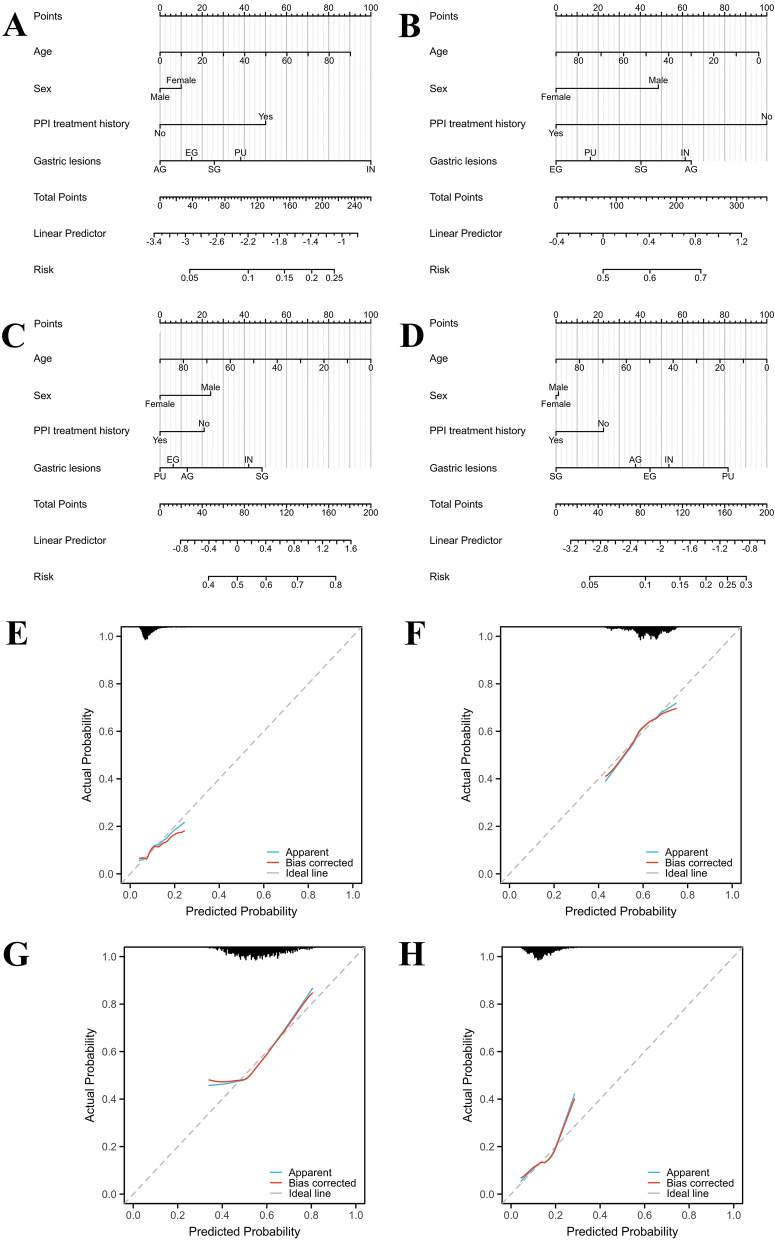
Helicobacter pylori (H. pylori) resistance is the most important risk factor for eradication failure. However, in most regions, antibiotic resistance rates of H. pylori in patients with different types of gastric mucosal lesions are still unclear. An 8-year clinical retrospective cohort study involving 2847 patients was performed. In this study, we first summarized and compared the resistance status of H. pylori in different years, ages, sexes, and gastric diseases. The resistance profiles of amoxicillin (AMX), clarithromycin (CLR), levofloxacin (LVX) and furazolidone (FR) and their changing trends in the clinic were described. Then, multiple antibiotic resistance in different gastric diseases and years were described and compared. The relationship between proton pump inhibitor (PPI) medication history and antibiotic resistance in H. pylori was also explored. Finally, an antibiotic resistance risk model was constructed for clinical resistance risk prediction. The overall resistance rates of AMX, CLR, LVX and FR in gastric diseases were 8.18%, 38.11%, 43.98%, and 13.73%, respectively. The mono resistance, double resistance, triple resistance, and quadruple resistance rates were 30.17%, 25.96%, 6.46%, and 0.63%, respectively. Compared with the period from 2014 to 2016, the rates of mono-resistance and multiple resistance all showed relatively downward trends in the past 5 years. Factors including age, sex, type of gastric lesions and recent PPI treatment history are associated with the antibiotic resistance rate of H. pylori. Atrophic gastritis is an important clinical feature of high-risk antibiotic resistance in H. pylori-infected patients. Patients with atrophic gastritis have higher risk of resistant strains infection. In this study, our data provide the association between antibiotic resistance of H. pylori and gastritis pattern, which indicate the higher risk of resistant strain infection if the patients with atrophic gastritis, PPI history and older age.
幽门螺杆菌(H. pylori)耐药性是根除失败的最重要危险因素。然而,在大多数地区,不同类型胃黏膜病变患者的 H. pylori 抗生素耐药率仍不清楚。进行了一项涉及 2847 例患者的 8 年临床回顾性队列研究。在这项研究中,我们首先总结和比较了不同年份、年龄、性别和胃部疾病中 H. pylori 的耐药状况。描述了阿莫西林(AMX)、克拉霉素(CLR)、左氧氟沙星(LVX)和呋喃唑酮(FR)的耐药谱及其在临床上的变化趋势。然后,描述和比较了不同胃部疾病和年份的多重耐药性。还探讨了质子泵抑制剂(PPI)用药史与 H. pylori 抗生素耐药性之间的关系。最后,构建了一个抗生素耐药风险模型,用于临床耐药风险预测。胃部疾病中 AMX、CLR、LVX 和 FR 的总耐药率分别为 8.18%、38.11%、43.98%和 13.73%。单耐药、双耐药、三耐药和四耐药率分别为 30.17%、25.96%、6.46%和 0.63%。与 2014 年至 2016 年期间相比,过去 5 年中,单耐药和多重耐药的比率均呈相对下降趋势。年龄、性别、胃部病变类型和近期 PPI 治疗史等因素与 H. pylori 的抗生素耐药率相关。萎缩性胃炎是 H. pylori 感染患者抗生素耐药的重要临床特征。患有萎缩性胃炎的患者感染耐药菌株的风险更高。在这项研究中,我们的数据提供了 H. pylori 抗生素耐药性与胃炎模式之间的关联,表明如果患者患有萎缩性胃炎、PPI 病史和年龄较大,感染耐药菌株的风险更高。