Buschermöhle Yvonne, Höltershinken Malte B, Erdbrügger Tim, Radecke Jan-Ole, Sprenger Andreas, Schneider Till R, Lencer Rebekka, Gross Joachim, Wolters Carsten H
Institute for Biomagnetism and Biosignalanalysis, University of Münster, 48149 Münster, Germany.
Otto Creutzfeldt Center for Cognitive and Behavioral Neuroscience, University of Münster, 48149 Münster, Germany.
iScience. 2024 Feb 6;27(3):109150. doi: 10.1016/j.isci.2024.109150. eCollection 2024 Mar 15.
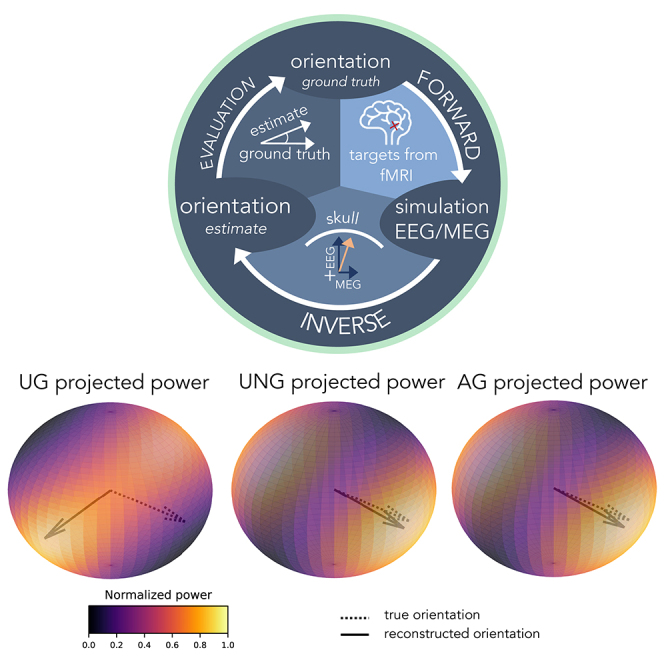
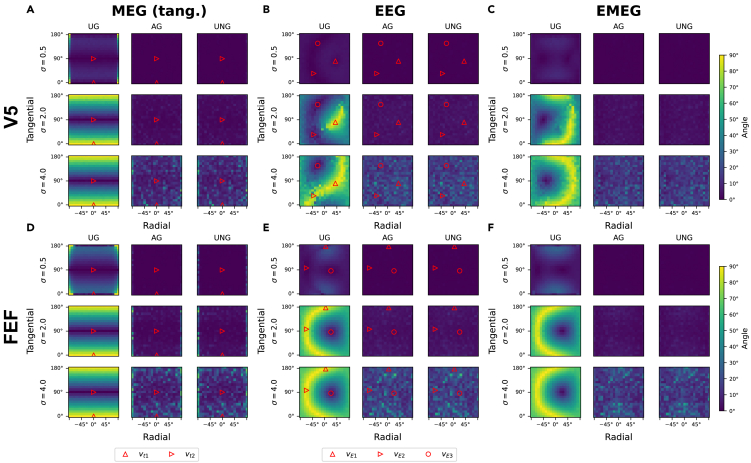
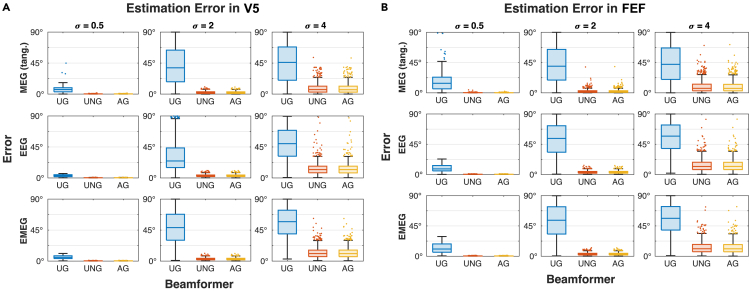
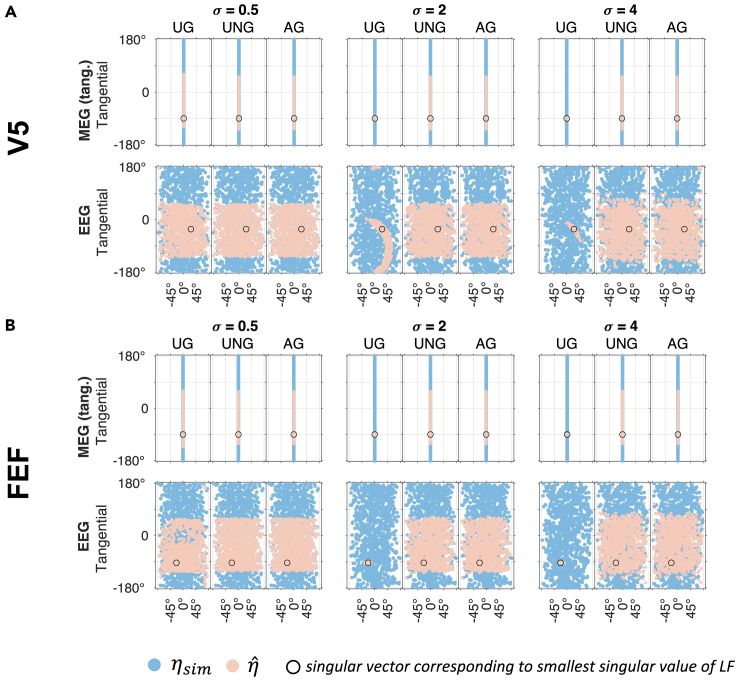
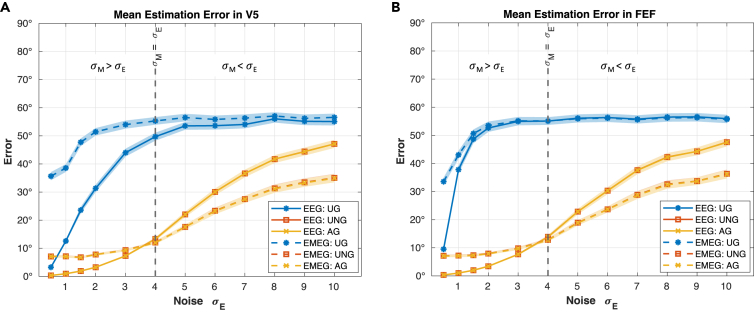
The efficacy of transcranial electric stimulation (tES) to effectively modulate neuronal activity depends critically on the spatial orientation of the targeted neuronal population. Therefore, precise estimation of target orientation is of utmost importance. Different beamforming algorithms provide orientation estimates; however, a systematic analysis of their performance is still lacking. For fixed brain locations, EEG and MEG data from sources with randomized orientations were simulated. The orientation was then estimated (1) with an EEG and (2) with a combined EEG-MEG approach. Three commonly used beamformer algorithms were evaluated with respect to their abilities to estimate the correct orientation: Unit-Gain (UG), Unit-Noise-Gain (UNG), and Array-Gain (AG) beamformer. Performance depends on the signal-to-noise ratios for the modalities and on the chosen beamformer. Overall, the UNG and AG beamformers appear as the most reliable. With increasing noise, the UG estimate converges to a vector determined by the leadfield, thus leading to insufficient orientation estimates.
经颅电刺激(tES)有效调节神经元活动的功效关键取决于目标神经元群体的空间取向。因此,精确估计目标取向至关重要。不同的波束形成算法可提供取向估计;然而,对其性能的系统分析仍然缺乏。对于固定的脑区位置,模拟了来自随机取向源的脑电图(EEG)和脑磁图(MEG)数据。然后分别使用(1)脑电图和(2)脑电图 - 脑磁图联合方法估计取向。针对三种常用的波束形成算法估计正确取向的能力进行了评估:单位增益(UG)、单位噪声增益(UNG)和阵列增益(AG)波束形成器。性能取决于各模态的信噪比以及所选的波束形成器。总体而言,UNG和AG波束形成器似乎是最可靠的。随着噪声增加,UG估计收敛于由导联场确定的向量,从而导致取向估计不足。