Bernardo Lorena, Ibarra-Meneses Ana Victoria, Douanne Noelie, Corbeil Audrey, Solana Jose Carlos, Beaudry Francis, Carrillo Eugenia, Moreno Javier, Fernandez-Prada Christopher
WHO Collaborating Centre for Leishmaniasis, Spanish National Center for Microbiology, Instituto de Salud Carlos III (ISCIII), Majadahonda, Madrid, Spain.
Centro de Investigación Biomédica en Red de Enfermedades Infecciosas (CIBERINFEC), ISCIII, Madrid, Spain.
PLoS Negl Trop Dis. 2024 Feb 29;18(2):e0012015. doi: 10.1371/journal.pntd.0012015. eCollection 2024 Feb.
Visceral leishmaniasis (VL) resolution depends on a wide range of factors, including the instauration of an effective treatment coupled to a functional host immune system. Patients with a depressed immune system, like the ones receiving methotrexate (MTX), are at higher risk of developing VL and refusing antileishmanial drugs. Moreover, the alarmingly growing levels of antimicrobial resistance, especially in endemic areas, contribute to the increasing the burden of this complex zoonotic disease.
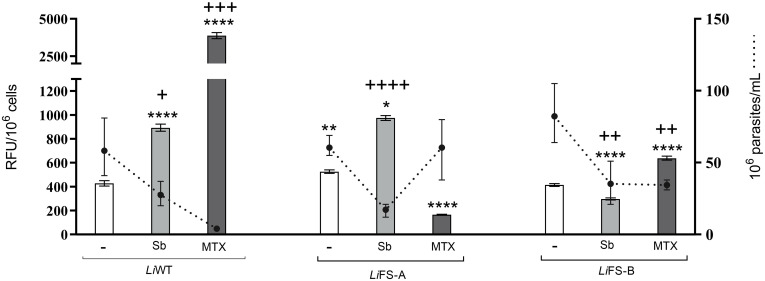
To understand the potential links between immunosuppressants and antileishmanial drugs, we have studied the interaction of antimony (Sb) and MTX in a Leishmania infantum reference strain (LiWT) and in two L. infantum clinical strains (LiFS-A and LiFS-B) naturally circulating in non-treated VL dogs in Spain. The LiFS-A strain was isolated before Sb treatment in a case that responded positively to the treatment, while the LiFS-B strain was recovered from a dog before Sb treatment, with the dog later relapsing after the treatment. Our results show that, exposure to Sb or MTX leads to an increase in the production of reactive oxygen species (ROS) in LiWT which correlates with a sensitive phenotype against both drugs in promastigotes and intracellular amastigotes. LiFS-A was sensitive against Sb but resistant against MTX, displaying high levels of protection against ROS when exposed to MTX. LiFS-B was resistant to both drugs. Evaluation of the melting proteomes of the two LiFS, in the presence and absence of Sb and MTX, showed a differential enrichment of direct and indirect targets for both drugs, including common and unique pathways.
Our results show the potential selection of Sb-MTX cross-resistant parasites in the field, pointing to the possibility to undermine antileishmanial treatment of those patients being treated with immunosuppressant drugs in Leishmania endemic areas.
内脏利什曼病(VL)的治愈取决于多种因素,包括有效治疗的实施以及宿主免疫系统的正常功能。免疫系统低下的患者,如接受甲氨蝶呤(MTX)治疗的患者,发生VL以及拒绝使用抗利什曼原虫药物的风险更高。此外,抗菌药物耐药性水平的惊人增长,尤其是在流行地区,加重了这种复杂人畜共患病的负担。
为了解免疫抑制剂与抗利什曼原虫药物之间的潜在联系,我们研究了锑(Sb)与MTX在婴儿利什曼原虫参考菌株(LiWT)以及在西班牙未经治疗的VL犬中自然传播的两株婴儿利什曼原虫临床菌株(LiFS - A和LiFS - B)中的相互作用。LiFS - A菌株是在一例对锑治疗反应阳性的病例中,在锑治疗前分离得到的,而LiFS - B菌株是在一只犬锑治疗前分离得到的,该犬在治疗后复发。我们的结果表明,暴露于Sb或MTX会导致LiWT中活性氧(ROS)的产生增加,这与前鞭毛体和细胞内无鞭毛体对两种药物的敏感表型相关。LiFS - A对Sb敏感但对MTX耐药,在暴露于MTX时表现出对ROS的高水平保护。LiFS - B对两种药物均耐药。在有和没有Sb和MTX的情况下,对两种LiFS的解链蛋白质组进行评估,结果显示两种药物的直接和间接靶点存在差异富集,包括共同和独特的途径。
我们的结果表明,在野外可能会选择出对Sb - MTX具有交叉耐药性的寄生虫,这表明在利什曼原虫流行地区,使用免疫抑制剂治疗的患者的抗利什曼原虫治疗可能会受到影响。