Nuber Silke, Zhang Xiaoqun, McCaffery Thomas D, Moors Tim E, Adom Marie-Alexandre, Hahn Wolf N, Martin Dylan, Ericsson Maria, Tripathi Arati, Dettmer Ulf, Svenningsson Per, Selkoe Dennis J
Ann Romney Center for Neurologic Diseases, Brigham and Women's Hospital and Harvard Medical School, Boston, MA, 02115, USA.
Neuro Svenningsson, Department of Clinical Neuroscience, Karolinska Institutet, 17176, Stockholm, Sweden.
NPJ Parkinsons Dis. 2024 Feb 29;10(1):47. doi: 10.1038/s41531-024-00662-w.
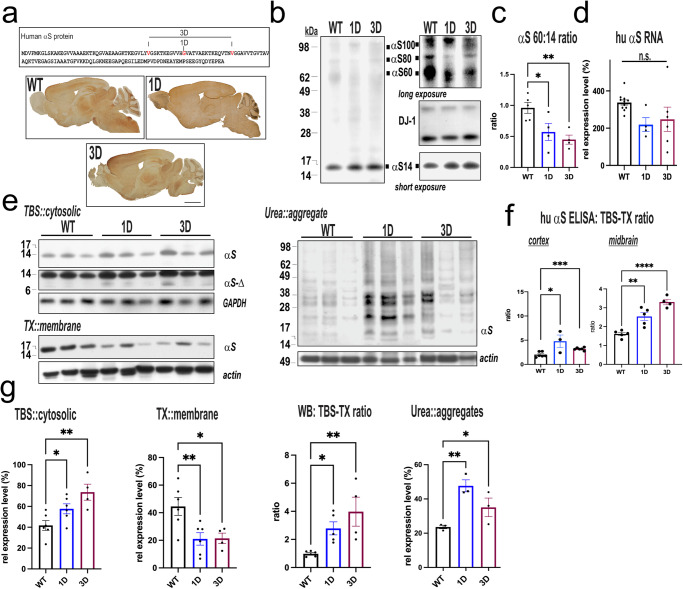
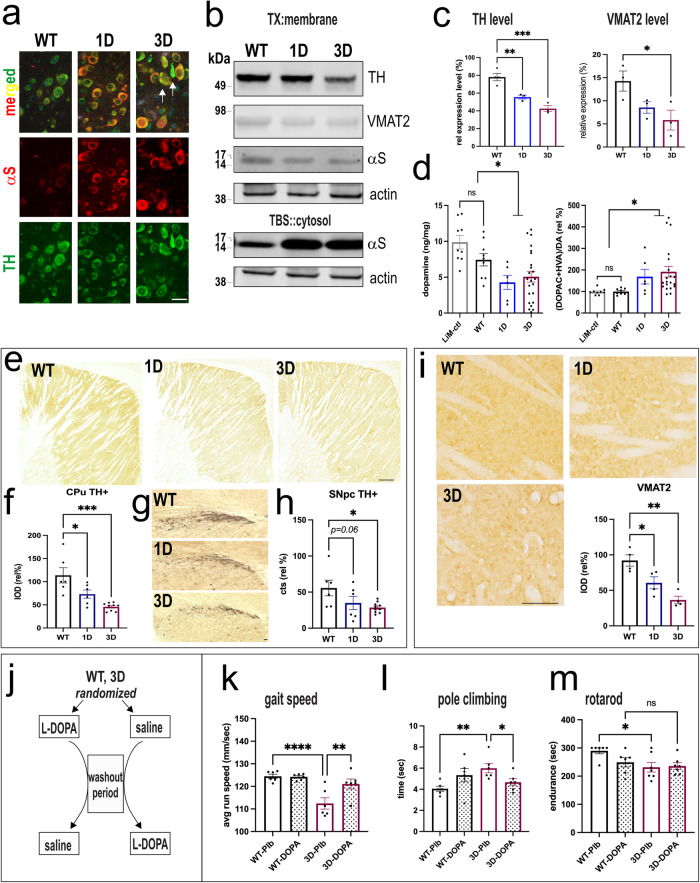
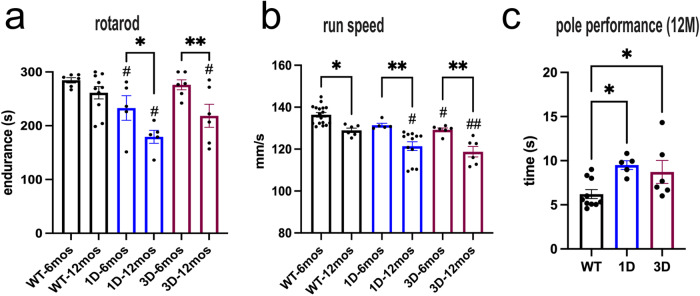
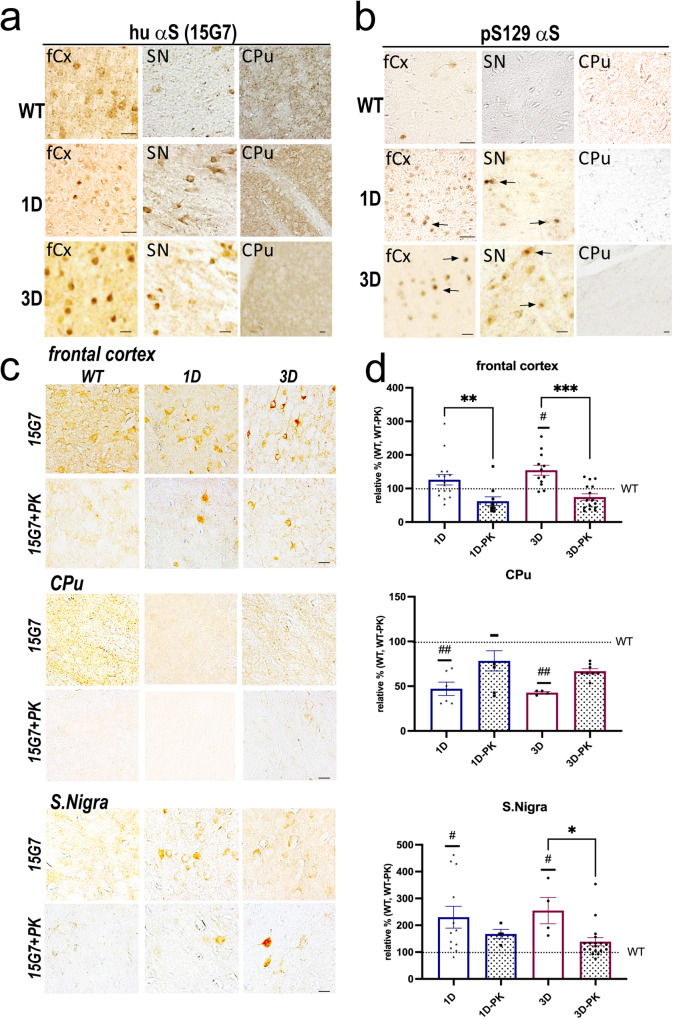
Mutations in the α-Synuclein (αS) gene promote αS monomer aggregation that causes neurodegeneration in familial Parkinson's disease (fPD). However, most mouse models expressing single-mutant αS transgenes develop neuronal aggregates very slowly, and few have dopaminergic cell loss, both key characteristics of PD. To accelerate neurotoxic aggregation, we previously generated fPD αS E46K mutant mice with rationally designed triple mutations based on the α-helical repeat motif structure of αS (fPD E46K→3 K). The 3 K variant increased αS membrane association and decreased the physiological tetramer:monomer ratio, causing lipid- and vesicle-rich inclusions and robust tremor-predominant, L-DOPA responsive PD-like phenotypes. Here, we applied an analogous approach to the G51D fPD mutation and its rational amplification (G51D → 3D) to generate mutant mice. In contrast to 3 K mice, G51D and 3D mice accumulate monomers almost exclusively in the cytosol while also showing decreased αS tetramer:monomer ratios. Both 1D and 3D mutant mice gradually accumulate insoluble, higher-molecular weight αS oligomers. Round αS neuronal deposits at 12 mos immunolabel for ubiquitin and pSer129 αS, with limited proteinase K resistance. Both 1D and 3D mice undergo loss of striatal TH+ fibers and midbrain dopaminergic neurons by 12 mos and a bradykinesia responsive to L-DOPA. The 3D αS mice have decreased tetramer:monomer equilibria and recapitulate major features of PD. These fPD G51D and 3D mutant mice should be useful models to study neuronal αS-toxicity associated with bradykinetic motor phenotypes.
α-突触核蛋白(αS)基因突变会促进αS单体聚集,进而导致家族性帕金森病(fPD)中的神经退行性变。然而,大多数表达单突变αS转基因的小鼠模型中,神经元聚集体的形成非常缓慢,并且很少有多巴胺能细胞丢失,而这两者都是帕金森病的关键特征。为了加速神经毒性聚集,我们之前基于αS的α-螺旋重复基序结构,通过合理设计的三重突变,构建了fPD αS E46K突变小鼠(fPD E46K→3K)。3K变体增加了αS与膜的结合,并降低了生理四聚体:单体比例,导致富含脂质和囊泡的包涵体形成以及以震颤为主、对左旋多巴有反应的类似帕金森病的强健表型。在此,我们对G51D fPD突变及其合理扩增(G51D→3D)采用类似方法来构建突变小鼠。与3K小鼠不同,G51D和3D小鼠几乎只在细胞质中积累单体,同时也表现出αS四聚体:单体比例降低。G51D和3D突变小鼠均逐渐积累不溶性、高分子量的αS寡聚体。12个月大时,圆形的αS神经元沉积物可被泛素和pSer129 αS免疫标记,对蛋白酶K的抗性有限。G51D和3D小鼠在12个月大时均出现纹状体TH+纤维和中脑多巴胺能神经元丢失,以及对左旋多巴有反应的运动迟缓。3D αS小鼠的四聚体:单体平衡降低,并概括了帕金森病的主要特征。这些fPD G51D和3D突变小鼠应是研究与运动迟缓运动表型相关的神经元αS毒性的有用模型。