• 文献检索
  • 文档翻译
  • 深度研究
  • 学术资讯
  • Suppr Zotero 插件Zotero 插件
  • 邀请有礼
  • 套餐&价格
  • 历史记录
应用&插件
Suppr Zotero 插件Zotero 插件浏览器插件Mac 客户端Windows 客户端微信小程序
定价
高级版会员购买积分包购买API积分包
服务
文献检索文档翻译深度研究API 文档MCP 服务
关于我们
关于 Suppr公司介绍联系我们用户协议隐私条款
关注我们

Suppr 超能文献

核心技术专利:CN118964589B侵权必究
粤ICP备2023148730 号-1Suppr @ 2026

文献检索

告别复杂PubMed语法,用中文像聊天一样搜索,搜遍4000万医学文献。AI智能推荐,让科研检索更轻松。

立即免费搜索

文件翻译

保留排版,准确专业,支持PDF/Word/PPT等文件格式,支持 12+语言互译。

免费翻译文档

深度研究

AI帮你快速写综述,25分钟生成高质量综述,智能提取关键信息,辅助科研写作。

立即免费体验

埃塞俄比亚 6-23 个月儿童最低可接受饮食及其相关因素:系统评价和荟萃分析。

Minimum acceptable diet and associated factors among children aged 6-23 months in Ethiopia: a systematic review and meta-analysis.

机构信息

Caring Futures Institute, College of Nursing and Health Sciences, Flinders University, Adelaide, SA, Australia.

Department of Human Nutrition, Institute of Public Health, College of Medicine and Health Sciences, University of Gondar, P. O. Box 196, Gondar, Ethiopia.

出版信息

BMC Pediatr. 2024 Feb 29;24(1):151. doi: 10.1186/s12887-024-04635-z.

DOI:10.1186/s12887-024-04635-z
PMID:38424574
原文链接:https://pmc.ncbi.nlm.nih.gov/articles/PMC10903031/
Abstract

BACKGROUND

To ensure a child's full growth, health, and development during infancy and the early years, adequate nutrition is crucial. A crucial window of opportunity for ensuring children's proper growth and development through adequate eating exists during the first two years of life. According to the evidence of the efficacy of interventions, achieving universal coverage of optimal breastfeeding could prevent 13% of deaths in children under the age of 5 worldwide, and using complementary feeding methods appropriately would lead to an additional 6% decrease in under-five mortality.

METHODS

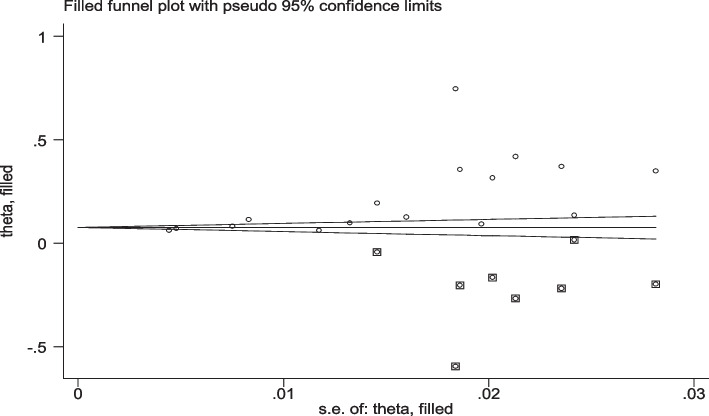
From several electronic databases, all published, unpublished, and gray literature was extracted and exported into EndNote version X20. For further analysis of the review, the retrieved data from the excel sheet were imported into the statistical software program Stata version. Metanalysis was used to determine the prevalence of MAD, and a random effects model was used to estimate the pooled prevalence of MAD. The DerSimonian-Laird Random effects model (REM) was used to combine the determinant factors from all qualifying papers for the meta-analysis, and the heterogeneity was independently assessed using a χ2 test, Q statistics, and matching I2 statistics. To retrieve the extent of publication bias, funnel plots were scattered and tested for asymmetry and, additionally, Egger's test was computed with the user-written "meta bias" command in Stata (version 11) software. To end, sensitivity analyses with trim and fill were performed.

RESULTS

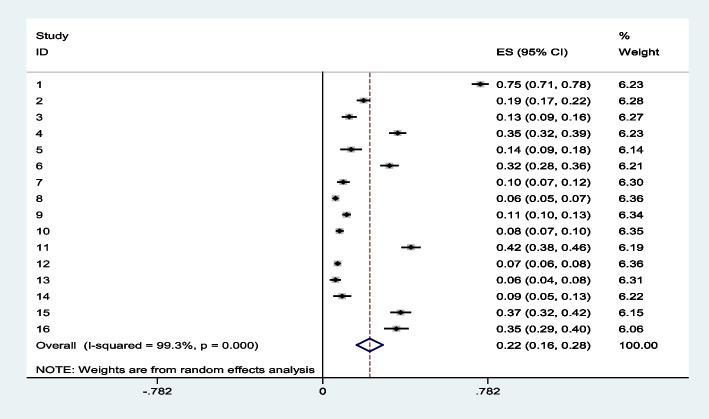
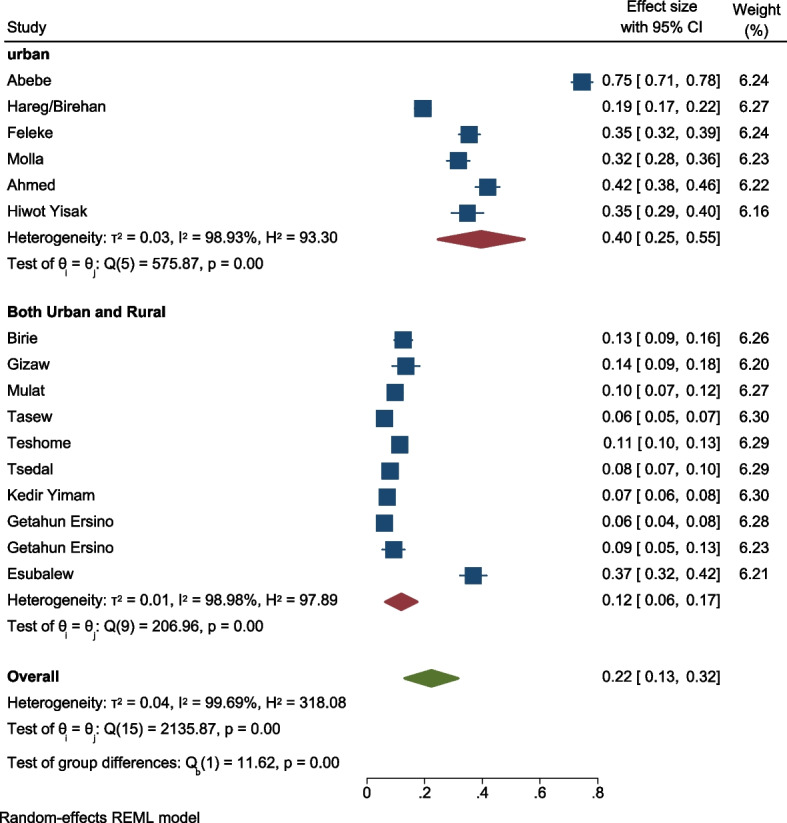
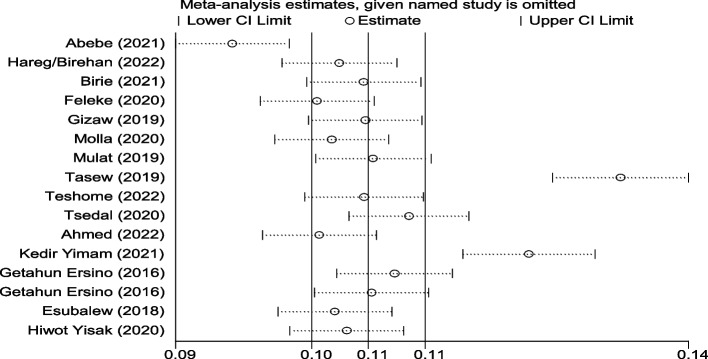
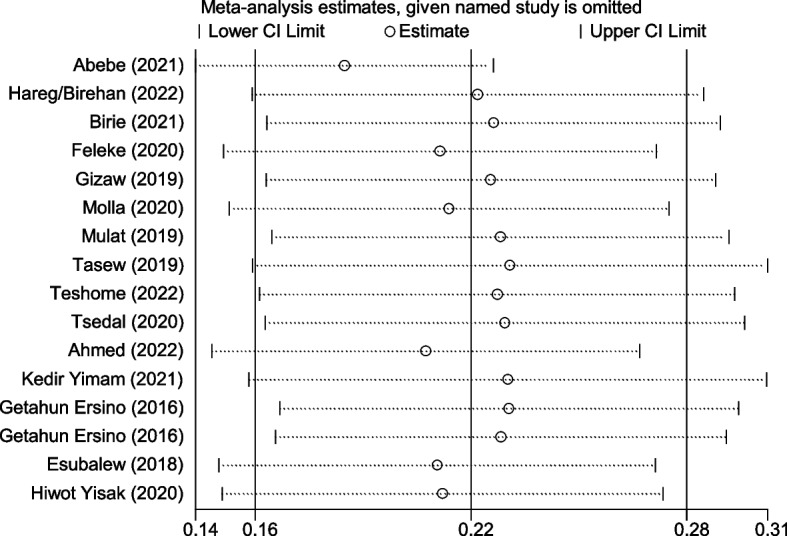
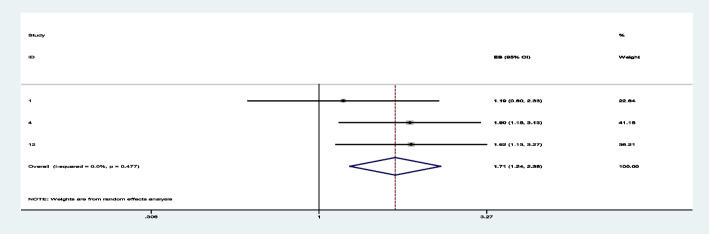
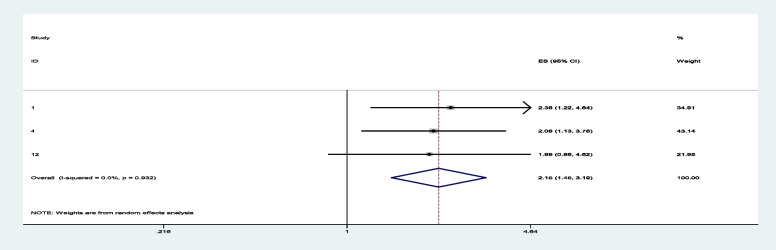
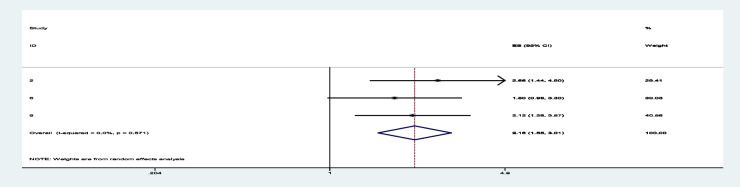
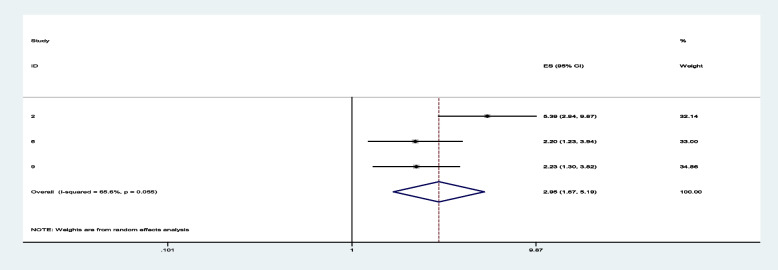
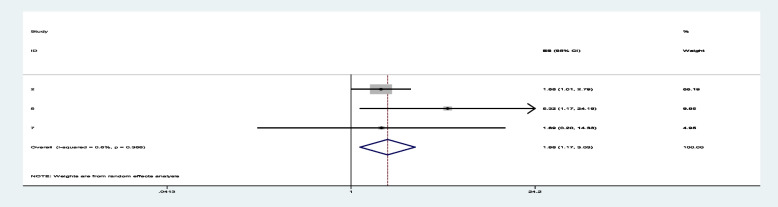
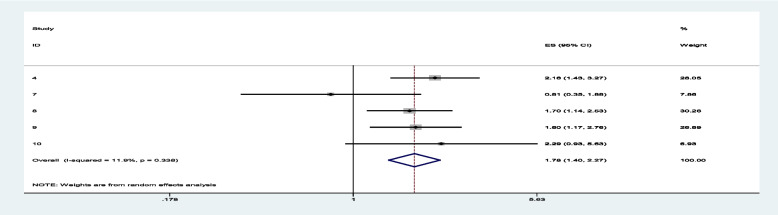
The pooled estimate of the overall prevalence of minimum acceptable diet in 16 studies in Ethiopia was 22% with (95% CI: 16, 28%) with a random effect model. However, eight papers were filled during trim and fill in order to counteract the small study effect. The overall filled pooled estimate was 7.9% with (95%CI: 11, 14.8%). Maternal education (primary and secondary) is 1.714 (95% CI 1.244,2.363) and 2.150(95% CI: 1.449,3.190), respectively, Ages of children with range of 12-17 months (2.158 (95% CI 1. 9,3.006) and 18-23 months 2.948(95% CI: 1.675,5.190)), Nutrition information ((1.883 (95% CI 1.169,3.032)) media exposure (1.778(95% CI: 1.396,2.265), and maternal knowledge (2.449 (95% CI 1.232, 5.027) were significantly associated with MAD.

CONCLUSION

The pooled estimate of the overall prevalence of minimum acceptable diet in 16 studies in Ethiopia were low. Maternal education (primary and secondary), ages of child with range of 12-17 month and 18-23 months, mothers having nutrition information, mothers who have media exposure,and mothers having good knowledge were significantly associated with Minimum acceptable diet. The government, NGO, and other stakeholders should focus on improving Minimum acceptable diet among 6 to 23 months of children through promoting with mass media, focuses on nutrition council during critical contact point in health facility, and doing capacity building for the mothers/caregivers.

摘要

背景

为了确保儿童在婴儿期和幼儿期全面成长、健康和发展,充足的营养至关重要。生命最初两年是通过适当饮食确保儿童正常生长和发育的关键机会窗口。根据干预措施效果的证据,实现普遍母乳喂养可预防全世界 5 岁以下儿童 13%的死亡,而适当使用补充喂养方法可使 5 岁以下儿童死亡率再降低 6%。

方法

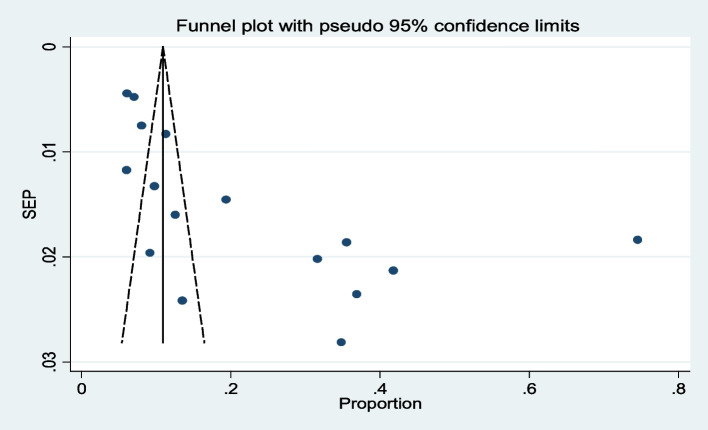
从多个电子数据库中提取并导出所有已发表、未发表和灰色文献到 EndNote 版本 X20。为了进一步分析综述,从 Excel 工作表中检索的数据被导入到统计软件程序 Stata 版本中。使用荟萃分析确定 MAD 的患病率,使用随机效应模型估计 MAD 的汇总患病率。使用 DerSimonian-Laird 随机效应模型 (REM) 将所有符合条件的论文的决定因素组合在一起,并使用 χ2 检验、Q 统计量和匹配的 I2 统计量独立评估异质性。为了检索出版偏倚的程度,绘制了漏斗图并进行了不对称检验,此外,还使用 Stata(版本 11)软件中的用户编写的“meta bias”命令计算了 Egger 检验。最后,进行了敏感性分析,使用修剪和填充。

结果

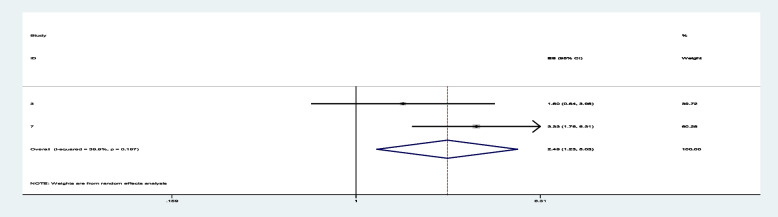
16 项埃塞俄比亚研究的汇总估计,最小可接受饮食的总体患病率为 22%,采用随机效应模型。然而,为了抵消小研究效应,有 8 篇论文在修剪和填充过程中被填补。总体填充汇总估计为 7.9%,95%CI:11,14.8%。母亲的教育(小学和中学)分别为 1.714(95%CI 1.244,2.363)和 2.150(95%CI:1.449,3.190),儿童年龄在 12-17 个月(2.158(95%CI 1.9,3.006)和 18-23 个月 2.948(95%CI:1.675,5.190))、营养信息(1.883(95%CI 1.169,3.032))媒体接触(1.778(95%CI 1.396,2.265)和母亲知识(2.449(95%CI 1.232,5.027))与 MAD 显著相关。

结论

埃塞俄比亚 16 项研究的最小可接受饮食总体患病率的汇总估计较低。母亲的教育(小学和中学)、12-17 个月和 18-23 个月儿童的年龄、有营养信息的母亲、有媒体接触的母亲和有良好知识的母亲与最小可接受饮食显著相关。政府、非政府组织和其他利益攸关方应通过促进大众媒体、关注卫生机构关键接触点的营养委员会以及为母亲/照顾者提供能力建设,重点关注 6 至 23 个月儿童的最低可接受饮食。
https://cdn.ncbi.nlm.nih.gov/pmc/blobs/46f2/10903031/80305beb16db/12887_2024_4635_Fig15_HTML.jpg
https://cdn.ncbi.nlm.nih.gov/pmc/blobs/46f2/10903031/2b9a700068c4/12887_2024_4635_Fig1_HTML.jpg
https://cdn.ncbi.nlm.nih.gov/pmc/blobs/46f2/10903031/9b9aab8677e4/12887_2024_4635_Fig2_HTML.jpg
https://cdn.ncbi.nlm.nih.gov/pmc/blobs/46f2/10903031/27d14e391477/12887_2024_4635_Fig3_HTML.jpg
https://cdn.ncbi.nlm.nih.gov/pmc/blobs/46f2/10903031/7cb6fa6cb61b/12887_2024_4635_Fig4_HTML.jpg
https://cdn.ncbi.nlm.nih.gov/pmc/blobs/46f2/10903031/f5e0aad2a378/12887_2024_4635_Fig5_HTML.jpg
https://cdn.ncbi.nlm.nih.gov/pmc/blobs/46f2/10903031/bdd77c747d73/12887_2024_4635_Fig6_HTML.jpg
https://cdn.ncbi.nlm.nih.gov/pmc/blobs/46f2/10903031/efca5171edcc/12887_2024_4635_Fig7_HTML.jpg
https://cdn.ncbi.nlm.nih.gov/pmc/blobs/46f2/10903031/8edda03cb8a9/12887_2024_4635_Fig8_HTML.jpg
https://cdn.ncbi.nlm.nih.gov/pmc/blobs/46f2/10903031/5974e9e6d604/12887_2024_4635_Fig9_HTML.jpg
https://cdn.ncbi.nlm.nih.gov/pmc/blobs/46f2/10903031/34a61907f4e3/12887_2024_4635_Fig10_HTML.jpg
https://cdn.ncbi.nlm.nih.gov/pmc/blobs/46f2/10903031/ac8def6b5263/12887_2024_4635_Fig11_HTML.jpg
https://cdn.ncbi.nlm.nih.gov/pmc/blobs/46f2/10903031/a0ef5df90d67/12887_2024_4635_Fig12_HTML.jpg
https://cdn.ncbi.nlm.nih.gov/pmc/blobs/46f2/10903031/7d373b7e5b17/12887_2024_4635_Fig13_HTML.jpg
https://cdn.ncbi.nlm.nih.gov/pmc/blobs/46f2/10903031/152a28fe48cc/12887_2024_4635_Fig14_HTML.jpg
https://cdn.ncbi.nlm.nih.gov/pmc/blobs/46f2/10903031/80305beb16db/12887_2024_4635_Fig15_HTML.jpg
https://cdn.ncbi.nlm.nih.gov/pmc/blobs/46f2/10903031/2b9a700068c4/12887_2024_4635_Fig1_HTML.jpg
https://cdn.ncbi.nlm.nih.gov/pmc/blobs/46f2/10903031/9b9aab8677e4/12887_2024_4635_Fig2_HTML.jpg
https://cdn.ncbi.nlm.nih.gov/pmc/blobs/46f2/10903031/27d14e391477/12887_2024_4635_Fig3_HTML.jpg
https://cdn.ncbi.nlm.nih.gov/pmc/blobs/46f2/10903031/7cb6fa6cb61b/12887_2024_4635_Fig4_HTML.jpg
https://cdn.ncbi.nlm.nih.gov/pmc/blobs/46f2/10903031/f5e0aad2a378/12887_2024_4635_Fig5_HTML.jpg
https://cdn.ncbi.nlm.nih.gov/pmc/blobs/46f2/10903031/bdd77c747d73/12887_2024_4635_Fig6_HTML.jpg
https://cdn.ncbi.nlm.nih.gov/pmc/blobs/46f2/10903031/efca5171edcc/12887_2024_4635_Fig7_HTML.jpg
https://cdn.ncbi.nlm.nih.gov/pmc/blobs/46f2/10903031/8edda03cb8a9/12887_2024_4635_Fig8_HTML.jpg
https://cdn.ncbi.nlm.nih.gov/pmc/blobs/46f2/10903031/5974e9e6d604/12887_2024_4635_Fig9_HTML.jpg
https://cdn.ncbi.nlm.nih.gov/pmc/blobs/46f2/10903031/34a61907f4e3/12887_2024_4635_Fig10_HTML.jpg
https://cdn.ncbi.nlm.nih.gov/pmc/blobs/46f2/10903031/ac8def6b5263/12887_2024_4635_Fig11_HTML.jpg
https://cdn.ncbi.nlm.nih.gov/pmc/blobs/46f2/10903031/a0ef5df90d67/12887_2024_4635_Fig12_HTML.jpg
https://cdn.ncbi.nlm.nih.gov/pmc/blobs/46f2/10903031/7d373b7e5b17/12887_2024_4635_Fig13_HTML.jpg
https://cdn.ncbi.nlm.nih.gov/pmc/blobs/46f2/10903031/152a28fe48cc/12887_2024_4635_Fig14_HTML.jpg
https://cdn.ncbi.nlm.nih.gov/pmc/blobs/46f2/10903031/80305beb16db/12887_2024_4635_Fig15_HTML.jpg

相似文献

1
Minimum acceptable diet and associated factors among children aged 6-23 months in Ethiopia: a systematic review and meta-analysis.埃塞俄比亚 6-23 个月儿童最低可接受饮食及其相关因素:系统评价和荟萃分析。
BMC Pediatr. 2024 Feb 29;24(1):151. doi: 10.1186/s12887-024-04635-z.
2
Folic acid supplementation and malaria susceptibility and severity among people taking antifolate antimalarial drugs in endemic areas.在流行地区,服用抗叶酸抗疟药物的人群中,叶酸补充剂与疟疾易感性和严重程度的关系。
Cochrane Database Syst Rev. 2022 Feb 1;2(2022):CD014217. doi: 10.1002/14651858.CD014217.
3
Dietary Diversity and Associated Factors among Children 6-23 Months Old in Ethiopia: Systematic Review and Meta-Analysis.埃塞俄比亚 6-23 个月龄儿童的饮食多样性及其相关因素:系统评价和荟萃分析。
Discov Med. 2024 Jul;36(186):1527-1543. doi: 10.24976/Discov.Med.202436186.141.
4
Minimum acceptable dietary intake among children aged 6-23 months in Ethiopia: A systematic review and meta-analysis.埃塞俄比亚 6-23 月龄儿童最低可接受膳食摄入量:系统评价和荟萃分析。
PLoS One. 2023 Jun 29;18(6):e0287247. doi: 10.1371/journal.pone.0287247. eCollection 2023.
5
Minimum acceptable diet and associated factors among 6-23 months old children enrolled in outpatient therapeutic program in the Tulla district, Sidama region, Ethiopia: a community-based cross-sectional study.埃塞俄比亚锡达马地区图拉区门诊治疗方案中 6-23 个月大儿童最低可接受饮食及其相关因素:一项基于社区的横断面研究。
J Health Popul Nutr. 2024 Jul 8;43(1):106. doi: 10.1186/s41043-024-00581-9.
6
Magnitude of postpartum hemorrhage and its associated factors in Ethiopia: a systematic review and meta-analysis.埃塞俄比亚产后出血的严重程度及其相关因素:系统评价和荟萃分析。
Reprod Health. 2022 Mar 9;19(1):63. doi: 10.1186/s12978-022-01360-7.
7
Dietary diversity feeding practice and its associated factors among children age 6-23 months in Ethiopia from 2011 up to 2018: a systematic review and meta-analysis.2011 年至 2018 年埃塞俄比亚 6-23 月龄儿童饮食多样性喂养实践及其相关因素的系统评价和荟萃分析。
Ital J Pediatr. 2018 Sep 17;44(1):109. doi: 10.1186/s13052-018-0567-9.
8
The effect of unemployment and post-natal care on the exclusive breast-feeding practice of women in Ethiopia: a systematic review and meta-analysis.失业和产后护理对埃塞俄比亚妇女纯母乳喂养行为的影响:一项系统评价与荟萃分析
Reprod Health. 2022 Apr 15;19(1):94. doi: 10.1186/s12978-022-01404-y.
9
Minimum acceptable diet and its associated factors among children aged 6-23 months in Lalibela, northeast Ethiopia: a community-based cross-sectional study.埃塞俄比亚东北拉拉贝拉地区 6-23 月龄儿童最低可接受饮食及其相关因素:一项基于社区的横断面研究。
J Nutr Sci. 2023 Mar 31;12:e41. doi: 10.1017/jns.2023.24. eCollection 2023.
10
Pooled prevalence and its determinants of stunting among children during their critical period in Ethiopia: A systematic review and meta-analysis.埃塞俄比亚儿童关键期生长迟缓的患病率及其决定因素的系统评价和荟萃分析。
PLoS One. 2023 Nov 29;18(11):e0294689. doi: 10.1371/journal.pone.0294689. eCollection 2023.

引用本文的文献

1
Effect of single-parent versus dual-parent households on dietary intake and growth among under-five children in Rwanda: an analysis using directed acyclic graph.卢旺达单亲家庭与双亲家庭对五岁以下儿童饮食摄入和生长的影响:一项使用有向无环图的分析
BMC Nutr. 2025 Jul 4;11(1):128. doi: 10.1186/s40795-025-01084-4.
2
Minimum acceptable diet and contributing factors among children aged 6-23 months in Afghanistan: insights from the 2022-2023 Multiple Indicator Cluster Survey.阿富汗6至23个月儿童的最低可接受饮食及影响因素:来自2022 - 2023年多指标类集调查的见解
BMC Nutr. 2025 Jan 14;11(1):10. doi: 10.1186/s40795-025-00996-5.
3

本文引用的文献

1
Predictors of Minimum Acceptable Diet among Children Aged 6-23 Months in Nepal: A Multilevel Analysis of Nepal Multiple Indicator Cluster Survey 2019.尼泊尔 2019 年多指标类集调查:6-23 月龄儿童最低可接受饮食的预测因素:多水平分析。
Nutrients. 2022 Sep 5;14(17):3669. doi: 10.3390/nu14173669.
2
Minimum acceptable diet and associated factors among children aged 6-23 months during fasting days of orthodox Christian mothers in Gondar city, North West Ethiopia.埃塞俄比亚西北部贡德尔市东正教母亲斋戒期间6至23个月儿童的最低可接受饮食及相关因素
BMC Nutr. 2022 Aug 10;8(1):76. doi: 10.1186/s40795-022-00558-z.
3
Trends and determinants of minimum acceptable diet intake among infant and young children aged 6-23 months in Ethiopia: a multilevel analysis of Ethiopian demographic and health survey.
Micronutrient intake inadequacies in Northwest Ethiopian children aged 6-23 months.
西北埃塞俄比亚 6-23 月龄儿童微量营养素摄入不足。
Sci Rep. 2024 Sep 5;14(1):20732. doi: 10.1038/s41598-024-68381-z.
4
Minimum acceptable diet and associated factors among 6-23 months old children enrolled in outpatient therapeutic program in the Tulla district, Sidama region, Ethiopia: a community-based cross-sectional study.埃塞俄比亚锡达马地区图拉区门诊治疗方案中 6-23 个月大儿童最低可接受饮食及其相关因素:一项基于社区的横断面研究。
J Health Popul Nutr. 2024 Jul 8;43(1):106. doi: 10.1186/s41043-024-00581-9.
埃塞俄比亚6至23个月婴幼儿最低可接受饮食摄入量的趋势及决定因素:基于埃塞俄比亚人口与健康调查的多层次分析
BMC Nutr. 2022 May 5;8(1):44. doi: 10.1186/s40795-022-00533-8.
4
Minimum acceptable diet feeding practice and associated factors among children aged 6-23 months in east Africa: a multilevel binary logistic regression analysis of 2008-2018 demographic health survey data.东非6至23个月儿童的最低可接受饮食喂养方式及相关因素:对2008 - 2018年人口与健康调查数据的多层次二元逻辑回归分析
Arch Public Health. 2022 Apr 28;80(1):127. doi: 10.1186/s13690-022-00882-7.
5
Minimum acceptable diet intake and its associated factors among children age at 6-23 months in sub-Saharan Africa: a multilevel analysis of the sub-Saharan Africa demographic and health survey.撒哈拉以南非洲6至23个月儿童的最低可接受饮食摄入量及其相关因素:撒哈拉以南非洲人口与健康调查的多层次分析
BMC Public Health. 2022 Apr 7;22(1):684. doi: 10.1186/s12889-022-12966-8.
6
Minimum acceptable diet and associated factors among children aged 6-23 months in Ethiopia.埃塞俄比亚 6-23 个月大儿童最低可接受饮食及相关因素。
Ital J Pediatr. 2021 Oct 30;47(1):215. doi: 10.1186/s13052-021-01169-3.
7
Minimum acceptable diet practice and its associated factors among children aged 6-23 months in rural communities of Goncha district, north West Ethiopia.埃塞俄比亚西北部贡查区农村社区6至23个月儿童的最低可接受饮食实践及其相关因素。
BMC Nutr. 2021 Jul 20;7(1):40. doi: 10.1186/s40795-021-00444-0.
8
Determinants of minimum acceptable diet feeding among children aged 6-23 months in Odisha, India.印度奥里萨邦 6-23 个月儿童最低可接受饮食喂养的决定因素。
Public Health Nutr. 2021 Aug;24(12):3834-3844. doi: 10.1017/S1368980021002172. Epub 2021 May 26.
9
Minimum acceptable diet and associated factors among infants and young children aged 6-23 months in Amhara region, Central Ethiopia: community-based cross-sectional study.埃塞俄比亚中部阿姆哈拉地区 6-23 月龄婴幼儿最低可接受膳食及相关因素:基于社区的横断面研究。
BMJ Open. 2021 May 10;11(5):e044284. doi: 10.1136/bmjopen-2020-044284.
10
The PRISMA 2020 statement: an updated guideline for reporting systematic reviews.《PRISMA 2020声明:报告系统评价的更新指南》
Syst Rev. 2021 Mar 29;10(1):89. doi: 10.1186/s13643-021-01626-4.