W. Harry Feinstone Department of Molecular Microbiology and Immunology, Johns Hopkins University Bloomberg School of Public Health, Baltimore, Maryland, USA.
Department of Pathology, Division of Medical Microbiology, Johns Hopkins University School of Medicine, Baltimore, Maryland, USA.
mSphere. 2024 Mar 26;9(3):e0081223. doi: 10.1128/msphere.00812-23. Epub 2024 Mar 1.
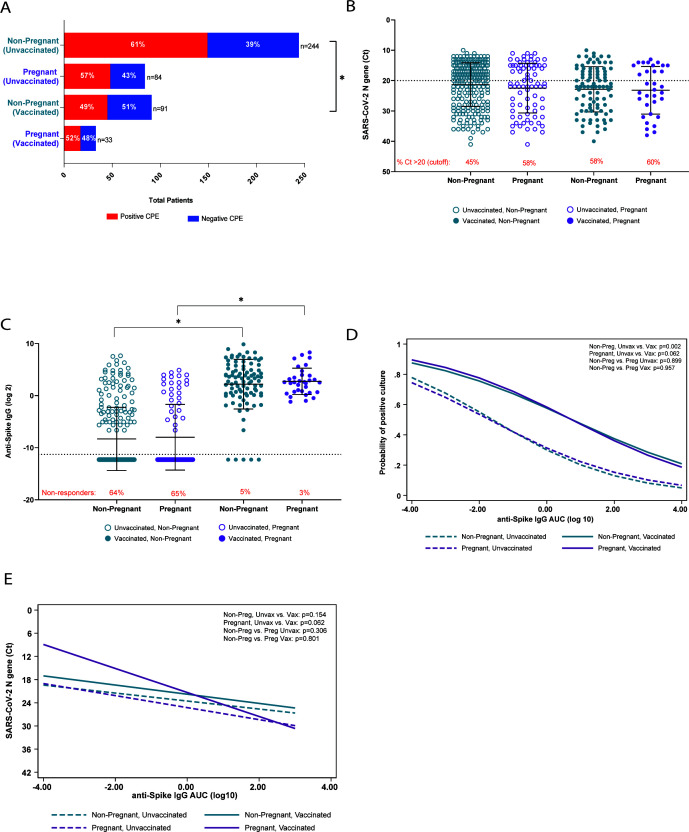
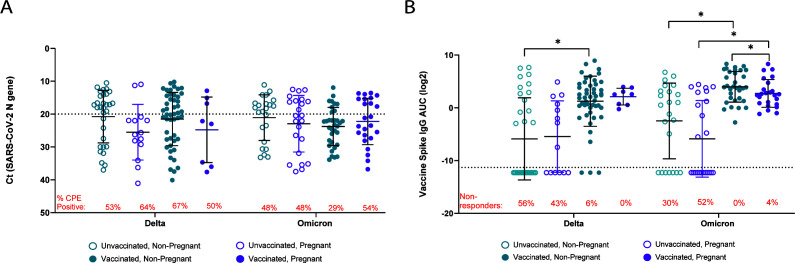
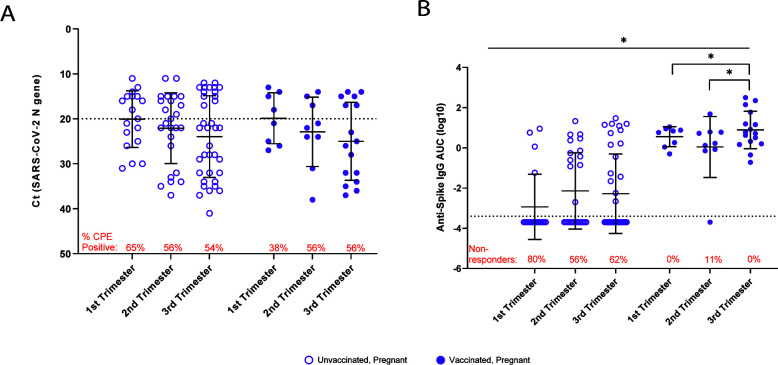
Pregnant patients are at greater risk of hospitalization with severe COVID-19 than non-pregnant people. This was a retrospective observational cohort study of remnant clinical specimens from patients who visited acute care hospitals within the Johns Hopkins Health System in the Baltimore, MD-Washington DC, area between October 2020 and May 2022. Participants included confirmed severe acute respiratory syndrome coronavirus 2 (SARS-CoV-2)-infected pregnant people and matched non-pregnant people (the matching criteria included age, race/ethnicity, area deprivation index, insurance status, and vaccination status to ensure matched demographics). The primary dependent measures were clinical COVID-19 outcomes, infectious virus recovery, viral RNA levels, and mucosal anti-spike (S) IgG titers from upper respiratory tract samples. A total of 452 individuals (117 pregnant and 335 non-pregnant) were included in the study, with both vaccinated and unvaccinated individuals represented. Pregnant patients were at increased risk of hospitalization (odds ratio [OR] = 4.2; confidence interval [CI] = 2.0-8.6), intensive care unit admittance (OR = 4.5; CI = 1.2-14.2), and being placed on supplemental oxygen therapy (OR = 3.1; CI = 1.3-6.9). Individuals infected during their third trimester had higher mucosal anti-S IgG titers and lower viral RNA levels ( < 0.05) than those infected during their first or second trimesters. Pregnant individuals experiencing breakthrough infections due to the Omicron variant had reduced anti-S IgG compared to non-pregnant patients ( < 0.05). The observed increased severity of COVID-19 and reduced mucosal antibody responses particularly among pregnant participants infected with the Omicron variant suggest that maintaining high levels of SARS-CoV-2 immunity through booster vaccines may be important for the protection of this at-risk population.IMPORTANCEIn this retrospective observational cohort study, we analyzed remnant clinical samples from non-pregnant and pregnant individuals with confirmed severe acute respiratory syndrome coronavirus 2 (SARS-CoV-2) infections who visited the Johns Hopkins Hospital System between October 2020 and May 2022. Disease severity, including intensive care unit admission, was greater among pregnant than non-pregnant patients. Vaccination reduced recovery of infectious virus and viral RNA levels in non-pregnant patients, but not in pregnant patients. In pregnant patients, increased nasopharyngeal viral RNA levels and recovery of infectious virus were associated with reduced mucosal IgG antibody responses, especially among women in their first trimester of pregnancy or experiencing breakthrough infections from Omicron variants. Taken together, this study provides insights into how pregnant patients are at greater risk of severe COVID-19. The novelty of this study is that it focuses on the relationship between the mucosal antibody response and its association with virus load and disease outcomes in pregnant people, whereas previous studies have focused on serological immunity. Vaccination status, gestational age, and SARS-CoV-2 omicron variant impact mucosal antibody responses and recovery of infectious virus from pregnant patients.
孕妇因 COVID-19 住院的风险比非孕妇更高。这是一项回顾性观察性队列研究,研究对象为 2020 年 10 月至 2022 年 5 月期间在马里兰州巴尔的摩市至华盛顿特区地区的约翰霍普金斯卫生系统内急性护理医院就诊的患者的剩余临床标本。参与者包括确诊为严重急性呼吸综合征冠状病毒 2(SARS-CoV-2)感染的孕妇和匹配的非孕妇(匹配标准包括年龄、种族/族裔、地区贫困指数、保险状况和疫苗接种状况,以确保匹配的人口统计学特征)。主要的依赖指标是临床 COVID-19 结局、传染性病毒恢复、病毒 RNA 水平以及上呼吸道样本中粘膜抗刺突(S)IgG 滴度。共有 452 人(117 名孕妇和 335 名非孕妇)纳入研究,其中包括接种疫苗和未接种疫苗的个体。孕妇住院(优势比[OR] = 4.2;置信区间[CI] = 2.0-8.6)、入住重症监护病房(OR = 4.5;CI = 1.2-14.2)和接受补充氧气治疗(OR = 3.1;CI = 1.3-6.9)的风险增加。在第三个三个月感染的个体的粘膜抗 S IgG 滴度较高,病毒 RNA 水平较低(<0.05),而在第一个或第二个三个月感染的个体则较低。由于 Omicron 变体而突破性感染的孕妇与非孕妇相比,抗 S IgG 减少(<0.05)。观察到 COVID-19 的严重程度增加,以及特别是在 Omicron 变体感染的孕妇中粘膜抗体反应降低,这表明通过加强疫苗接种来维持 SARS-CoV-2 免疫力可能对保护这一高危人群很重要。
在这项回顾性观察性队列研究中,我们分析了 2020 年 10 月至 2022 年 5 月期间在约翰霍普金斯医院系统就诊的确诊严重急性呼吸综合征冠状病毒 2(SARS-CoV-2)感染的非孕妇和孕妇的剩余临床样本。与非孕妇相比,孕妇的疾病严重程度更高,包括入住重症监护病房。疫苗接种可降低非孕妇传染性病毒和病毒 RNA 水平的恢复,但不能降低孕妇的病毒水平。在孕妇中,鼻病毒 RNA 水平升高和传染性病毒恢复与粘膜 IgG 抗体反应降低有关,特别是在处于妊娠第一三个月或经历 Omicron 变体突破性感染的孕妇中。综上所述,这项研究提供了有关孕妇 COVID-19 严重程度增加风险的见解。这项研究的新颖之处在于它侧重于粘膜抗体反应及其与病毒载量和孕妇疾病结局之间的关系,而以前的研究则侧重于血清学免疫。疫苗接种状况、妊娠龄和 SARS-CoV-2 奥密克戎变体影响孕妇的粘膜抗体反应和传染性病毒的恢复。