Piesch Ludwig, Stojan Robert, Zinner Jochen, Büsch Dirk, Utesch Katharina, Utesch Till
Institute of Educational Sciences, University of Münster, Bispinghof 5/6, 48143, Münster, Germany.
Institute of Human Movement Science, University of Hamburg, Hamburg, Germany.
Sports Med Open. 2024 Mar 1;10(1):20. doi: 10.1186/s40798-024-00687-8.
Childhood obesity is associated with various health outcomes. Restrictive measures to contain the spread of the Coronavirus Disease 2019 (COVID-19) pandemic, like lockdowns and school closures, affected children's daily structure, physical activity, dietary habits, and sleep quality, possibly exacerbating risk factors for childhood obesity and higher body mass index (BMI) in children. Poor socioeconomic conditions may have led to relatively higher risk for elevated BMI levels following pandemic measures. In this study, the impact of measures related to the COVID-19 pandemic on the BMI of third graders was investigated regarding children's socioeconomic background (SEB).
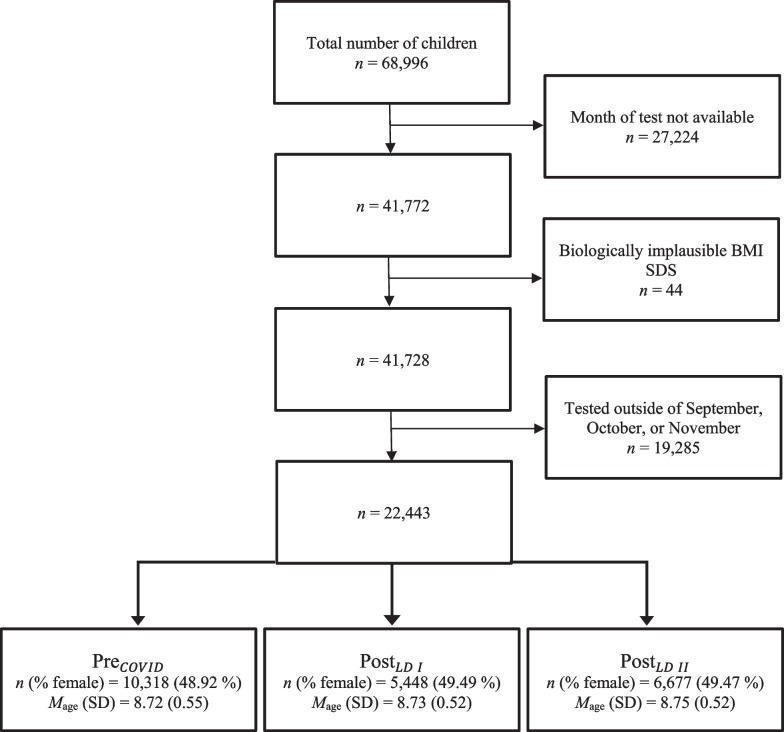
Data from 41,728 children (8.84 ± 0.56 years, 20,431 female) were collected in the context of a cohort study. Children were tested either before the pandemic (pre: Sept2017-March2020, n = 26,314), or following the first (post: Aug2020-Dec2020, n = 6657) or second lockdown in Germany (post: Aug2021-Jan2022, n = 8757). SEB was based on the official school type classification of the state of Berlin. Outcome was BMI standard deviation scores (SDS).
Significant effects of Time and SEB revealed elevated BMIs in post (M = 0.23, p = 0.011) and post (M = 0.22, p = 0.011) compared to pre (M = 0.17) cohorts and higher BMIs for children with lower SEB (b = - 0.13, p < 0.001). A significant Time × SEB interaction indicated that the effect of SEB on children's BMI increased in response to lockdowns, especially in post (b = - 0.05, p = 0.006). Results suggest that the COVID-19-related measures lead to increased BMI in children, and that children of lower SEB were at particular risk for higher BMIs following lockdowns.
These findings highlight the dependency of children's BMI on societal circumstances. Over the course of two lockdowns in Germany, children have experienced BMI increments, particularly in low socioeconomic areas. Authorities are called into action to counteract increasing rates of childhood weight by promoting physical activity of children and establishing related post-pandemic offers.
儿童肥胖与多种健康结果相关。为遏制2019冠状病毒病(COVID-19)大流行传播而采取的限制措施,如封锁和学校关闭,影响了儿童的日常结构、身体活动、饮食习惯和睡眠质量,可能会加剧儿童肥胖和儿童更高体重指数(BMI)的风险因素。社会经济条件较差可能导致在大流行措施之后BMI水平升高的风险相对更高。在本研究中,针对儿童的社会经济背景(SEB),调查了与COVID-19大流行相关的措施对三年级学生BMI的影响。
在一项队列研究中收集了41728名儿童(8.84±0.56岁,20431名女性)的数据。在大流行之前(前:2017年9月至2020年3月,n = 26314)、德国第一次封锁之后(后:2020年8月至12月,n = 6657)或第二次封锁之后(后:2021年8月至2022年1月,n = 8757)对儿童进行测试。SEB基于柏林州的官方学校类型分类。结果是BMI标准差分数(SDS)。
时间和SEB的显著影响显示,与前一组(M = 0.17)相比,后一组(M = 0.23,p = 0.011)和后一组(M = 0.22,p = 0.011)的BMI升高,且SEB较低的儿童BMI更高(b = -0.13,p < 0.001)。显著的时间×SEB交互作用表明,SEB对儿童BMI的影响随着封锁而增加,尤其是在后一组(b = -0.05,p = 0.006)。结果表明,与COVID-19相关的措施导致儿童BMI升高,且在封锁之后,SEB较低的儿童BMI升高的风险尤其高。
这些发现突出了儿童BMI对社会环境的依赖性。在德国的两次封锁期间,儿童的BMI有所增加,尤其是在社会经济地位较低的地区。呼吁当局采取行动,通过促进儿童的身体活动和提供相关的大流行后服务来应对儿童体重上升的趋势。