• 文献检索
  • 文档翻译
  • 深度研究
  • 学术资讯
  • Suppr Zotero 插件Zotero 插件
  • 邀请有礼
  • 套餐&价格
  • 历史记录
应用&插件
Suppr Zotero 插件Zotero 插件浏览器插件Mac 客户端Windows 客户端微信小程序
定价
高级版会员购买积分包购买API积分包
服务
文献检索文档翻译深度研究API 文档MCP 服务
关于我们
关于 Suppr公司介绍联系我们用户协议隐私条款
关注我们

Suppr 超能文献

核心技术专利:CN118964589B侵权必究
粤ICP备2023148730 号-1Suppr @ 2026

文献检索

告别复杂PubMed语法,用中文像聊天一样搜索,搜遍4000万医学文献。AI智能推荐,让科研检索更轻松。

立即免费搜索

文件翻译

保留排版,准确专业,支持PDF/Word/PPT等文件格式,支持 12+语言互译。

免费翻译文档

深度研究

AI帮你快速写综述,25分钟生成高质量综述,智能提取关键信息,辅助科研写作。

立即免费体验

意料之外的预期:婴儿利用他人的惊讶来修正自己的预期。

Expecting the Unexpected: Infants Use Others' Surprise to Revise Their Own Expectations.

作者信息

Wu Yang, Merrick Megan, Gweon Hyowon

机构信息

Department of Psychology, University of Toronto Scarborough, Toronto, ON, Canada.

Department of Psychological and Brain Sciences, Indiana University Bloomington, Bloomington, IN, USA.

出版信息

Open Mind (Camb). 2024 Mar 1;8:67-83. doi: 10.1162/opmi_a_00117. eCollection 2024.

DOI:10.1162/opmi_a_00117
PMID:38435704
原文链接:https://pmc.ncbi.nlm.nih.gov/articles/PMC10898783/
Abstract

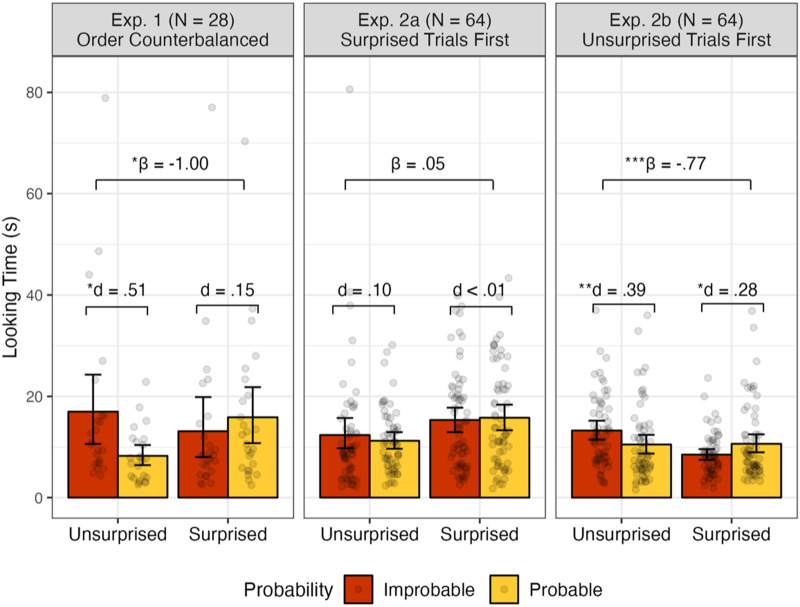
Human infants show systematic responses to events that violate their expectations. Can they also revise these expectations based on others' expressions of surprise? Here we ask whether infants ( = 156, mean = 15.2 months, range: 12.0-18.0 months) can use an experimenter's expression of surprise to revise their own expectations about statistically probable vs. improbable events. An experimenter sampled a ball from a box of red and white balls and briefly displayed either a surprised or an unsurprised expression at the outcome before revealing it to the infant. Following an unsurprised expression, the results were consistent with prior work; infants looked longer at a statistically improbable outcome than a probable outcome. Following a surprised expression, however, this standard pattern disappeared or was even reversed. These results suggest that even before infants can observe the unexpected events themselves, they can use others' surprise to . Starting early in life, human learners can leverage social information that signals others' prediction error to update their own predictions.

摘要

人类婴儿对违背其预期的事件会表现出系统性反应。他们能否也根据他人的惊讶表情来修正这些预期呢?在此,我们探究婴儿( = 156名,平均年龄 = 15.2个月,范围:12.0 - 18.0个月)是否能够利用实验者的惊讶表情来修正自己对统计上可能与不可能事件的预期。一名实验者从装有红球和白球的盒子中抽取一个球,并在向婴儿展示结果之前,短暂地展示出惊讶或无惊讶的表情。在无惊讶表情之后,结果与先前的研究一致;婴儿对统计上不可能的结果的注视时间比对可能结果的注视时间更长。然而,在惊讶表情之后,这种标准模式消失了,甚至出现了反转。这些结果表明,即使在婴儿自己能够观察到意外事件之前,他们就能利用他人的惊讶来……从生命早期开始,人类学习者就能利用表明他人预测误差的社会信息来更新自己的预测。
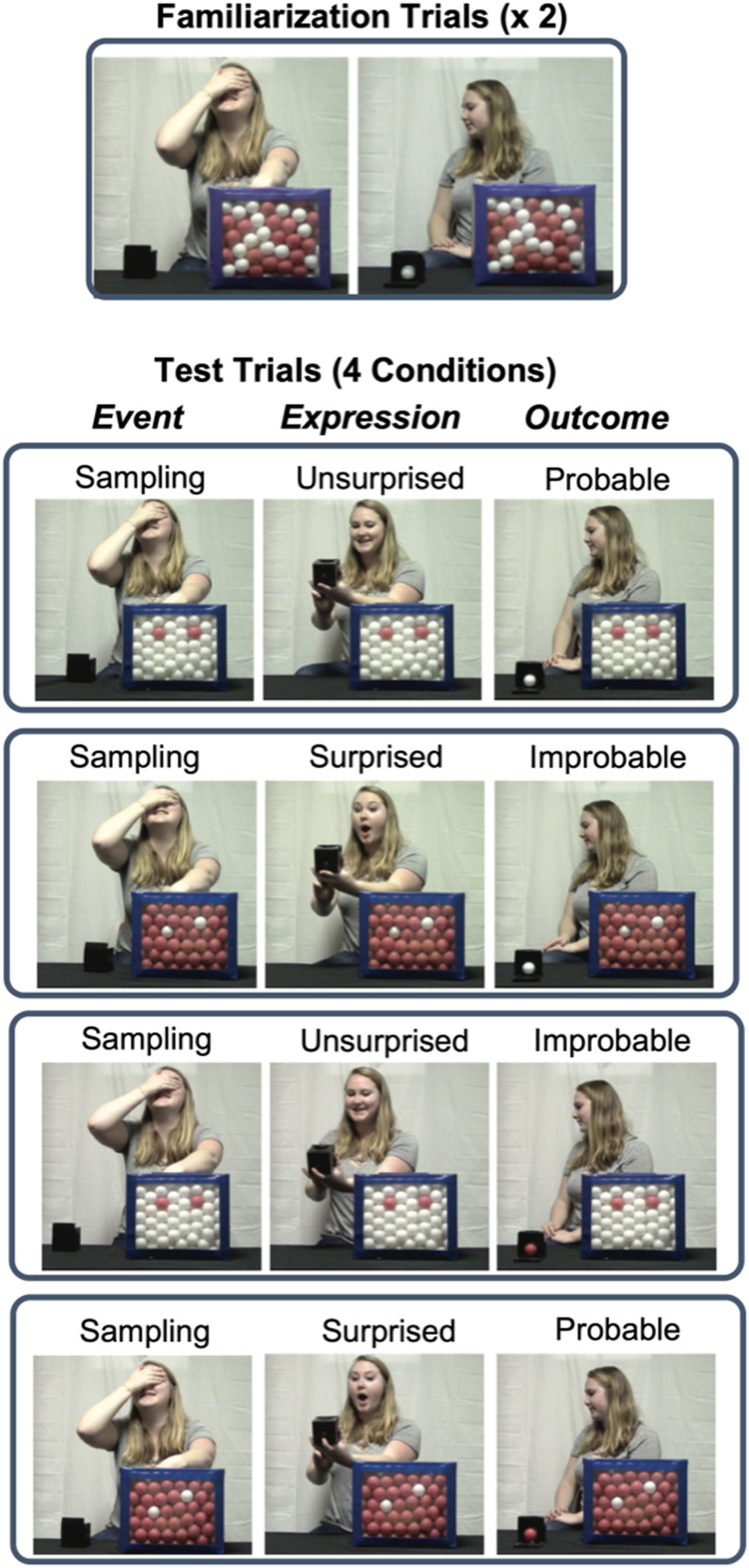
https://cdn.ncbi.nlm.nih.gov/pmc/blobs/fa40/10898783/7e48cbd98cb1/opmi-08-67-g002.jpg
https://cdn.ncbi.nlm.nih.gov/pmc/blobs/fa40/10898783/58c5d64808b6/opmi-08-67-g001.jpg
https://cdn.ncbi.nlm.nih.gov/pmc/blobs/fa40/10898783/7e48cbd98cb1/opmi-08-67-g002.jpg
https://cdn.ncbi.nlm.nih.gov/pmc/blobs/fa40/10898783/58c5d64808b6/opmi-08-67-g001.jpg
https://cdn.ncbi.nlm.nih.gov/pmc/blobs/fa40/10898783/7e48cbd98cb1/opmi-08-67-g002.jpg

相似文献

1
Expecting the Unexpected: Infants Use Others' Surprise to Revise Their Own Expectations.意料之外的预期:婴儿利用他人的惊讶来修正自己的预期。
Open Mind (Camb). 2024 Mar 1;8:67-83. doi: 10.1162/opmi_a_00117. eCollection 2024.
2
Infants expect friends, but not rivals, to be happy for each other when they succeed.婴儿期望朋友,而非对手,在他们成功时能为彼此感到高兴。
Dev Sci. 2024 Jan;27(1):e13423. doi: 10.1111/desc.13423. Epub 2023 Jun 13.
3
Peekaboo: a new look at infants' perception of emotion expressions.躲猫猫:对婴儿对情感表达感知的新视角
Dev Psychol. 2001 Nov;37(6):826-38.
4
Negativity bias in infants' expectations about agents' dispositions.婴儿对主体性格期望中的消极偏向。
Br J Dev Psychol. 2018 Nov;36(4):620-633. doi: 10.1111/bjdp.12246. Epub 2018 May 1.
5
Infants anticipate probabilistic but not deterministic outcomes.婴儿能够预测概率性结果,但无法预测确定性结果。
Cognition. 2016 Dec;157:227-236. doi: 10.1016/j.cognition.2016.09.003. Epub 2016 Sep 22.
6
Preschool-Aged Children Jointly Consider Others' Emotional Expressions and Prior Knowledge to Decide When to Explore.学龄前儿童会综合考虑他人的情感表达和先前知识来决定何时进行探索。
Child Dev. 2021 May;92(3):862-870. doi: 10.1111/cdev.13585. Epub 2021 May 25.
7
Can 15-month-old infants understand pretence? An investigation using the 'violation-of-expectation' paradigm.15个月大的婴儿能理解假装行为吗?一项使用“违反预期”范式的调查。
Acta Psychol (Amst). 2011 Oct;138(2):316-21. doi: 10.1016/j.actpsy.2011.07.006. Epub 2011 Aug 30.
8
Integrating expectations and outcomes: Preschoolers' developing ability to reason about others' emotions.整合期望与结果:幼儿发展出对他人情绪进行推理的能力。
Dev Psychol. 2019 Aug;55(8):1680-1693. doi: 10.1037/dev0000749. Epub 2019 May 16.
9
Encoding of Vicarious Reward Prediction in Anterior Cingulate Cortex and Relationship with Trait Empathy.前扣带回皮质中替代性奖励预测的编码及其与特质共情的关系。
J Neurosci. 2015 Oct 7;35(40):13720-7. doi: 10.1523/JNEUROSCI.1703-15.2015.
10
Violations of Core Knowledge Shape Early Learning.核心知识的违背会影响早期学习。
Top Cogn Sci. 2019 Jan;11(1):136-153. doi: 10.1111/tops.12389. Epub 2018 Oct 15.

引用本文的文献

1
When Success Is Surprising: Children's Ability to Use Surprise to Infer Competence.当成功令人惊讶时:儿童利用惊讶来推断能力的能力。
Open Mind (Camb). 2025 Jul 7;9:825-843. doi: 10.1162/opmi.a.2. eCollection 2025.
2
Who Peeked? Children Infer the Likely Cause of Improbable Success.谁在偷看?儿童推断出不太可能成功的可能原因。
Dev Sci. 2025 Jan;28(1):e13598. doi: 10.1111/desc.13598.

本文引用的文献

1
Emotion understanding as third-person appraisals: Integrating appraisal theories with developmental theories of emotion.作为第三人称评价的情绪理解:将评价理论与情绪发展理论相结合。
Psychol Rev. 2025 Jan;132(1):130-153. doi: 10.1037/rev0000507. Epub 2024 Sep 19.
2
Learning from other minds: An optimistic critique of reinforcement learning models of social learning.向他人学习:对社会学习强化学习模型的乐观批判。
Curr Opin Behav Sci. 2021 Apr;38:110-115. doi: 10.1016/j.cobeha.2021.01.006. Epub 2021 Mar 23.
3
Inferential social learning: cognitive foundations of human social learning and teaching.
推理社会学习:人类社会学习和教学的认知基础。
Trends Cogn Sci. 2021 Oct;25(10):896-910. doi: 10.1016/j.tics.2021.07.008. Epub 2021 Aug 18.
4
Preschool-Aged Children Jointly Consider Others' Emotional Expressions and Prior Knowledge to Decide When to Explore.学龄前儿童会综合考虑他人的情感表达和先前知识来决定何时进行探索。
Child Dev. 2021 May;92(3):862-870. doi: 10.1111/cdev.13585. Epub 2021 May 25.
5
Tackling Scientific Misconceptions: The Element of Surprise.攻克科学误区:出其不意。
Child Dev. 2021 Sep;92(5):2128-2141. doi: 10.1111/cdev.13582. Epub 2021 May 10.
6
Biased Attention to Threat: Answering Old Questions with Young Infants.对威胁的偏向性注意:用幼儿回答老问题。
Curr Dir Psychol Sci. 2019 Dec 1;28(6):534-539. doi: 10.1177/0963721419861415. Epub 2019 Sep 13.
7
Understanding Social Display Rules: Using One Person's Emotional Expressions to Infer the Desires of Another.理解社会展示规则:利用一个人的情感表达来推断另一个人的愿望。
Child Dev. 2020 Sep;91(5):1786-1799. doi: 10.1111/cdev.13346. Epub 2019 Dec 9.
8
Infant Statisticians: The Origins of Reasoning Under Uncertainty.婴儿统计学家:不确定性推理的起源。
Perspect Psychol Sci. 2019 Jul;14(4):499-509. doi: 10.1177/1745691619847201. Epub 2019 Jun 11.
9
Integrating expectations and outcomes: Preschoolers' developing ability to reason about others' emotions.整合期望与结果:幼儿发展出对他人情绪进行推理的能力。
Dev Psychol. 2019 Aug;55(8):1680-1693. doi: 10.1037/dev0000749. Epub 2019 May 16.
10
Another Look at Looking Time: Surprise as Rational Statistical Inference.再看注视时间:惊喜作为理性统计推断。
Top Cogn Sci. 2019 Jan;11(1):154-163. doi: 10.1111/tops.12393. Epub 2018 Nov 8.