Department of Biomedical and Biotechnological Sciences, University of Catania, 95123 Catania, Italy.
Department of Animal Physiology and Ethology, Faculty of Natural Sciences, Comenius University, Ilkovicova 6, 84215 Bratislava, Slovakia.
Int J Mol Sci. 2024 Nov 12;25(22):12155. doi: 10.3390/ijms252212155.
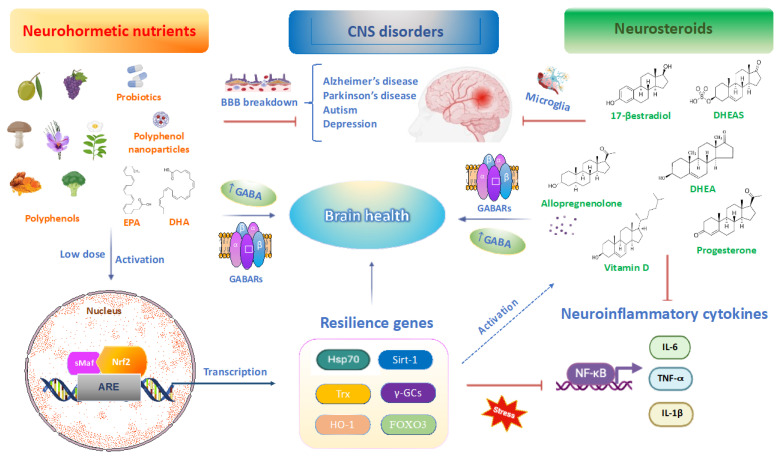
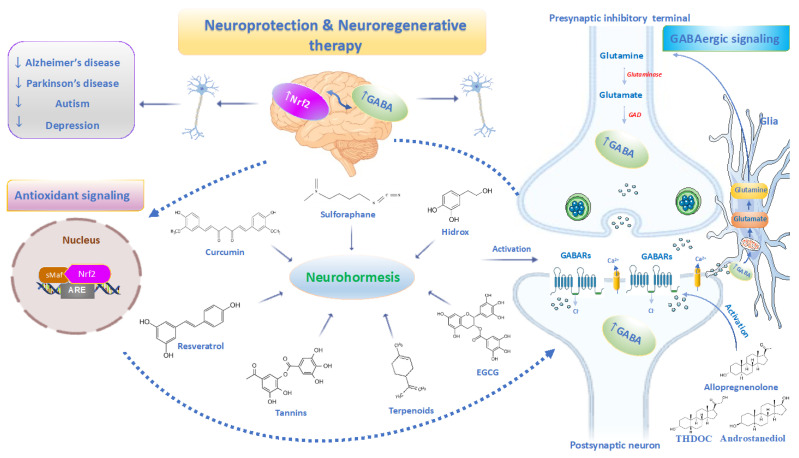
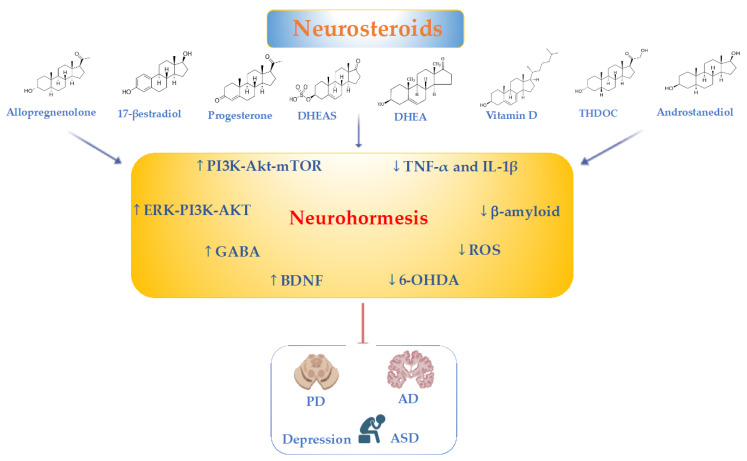
The interplay between functional food nutrients and neurosteroids has garnered significant attention for its potential to enhance stress resilience in health and/or disease. Several bioactive nutrients, including medicinal herbs, flavonoids, and bioavailable polyphenol-combined nanoparticles, as well as probiotics, vitamin D and omega-3 fatty acids, have been shown to improve blood-brain barrier (BBB) dysfunction, endogenous neurosteroid homeostasis and brain function. These nutrients can inhibit oxidative stress and neuroinflammation, which are linked to the pathogenesis of various neurological disorders. Interestingly, flavonoids exhibit dose-dependent effects, activating the nuclear factor erythroid 2-related factor 2 (Nrf2) pathway at the physiological/low dose (neurohormesis). This leads to the upregulation of antioxidant phase II genes and proteins such as heme oxygenase-1 (HO-1) and sirtuin-1 (Sirt1), which are activated by curcumin and resveratrol, respectively. These adaptive neuronal response mechanisms help protect against reactive oxygen species (ROS) and neurotoxicity. Impaired Nrf2 and neurosteroid hormone signaling in the brain can exacerbate selective vulnerability to neuroinflammatory conditions, contributing to the onset and progression of neurodegenerative and psychiatric disorders, including Alzheimer's disease, anxiety and depression and other neurological disorders, due to the vulnerability of neurons to stress. This review focuses on functional food nutrients targeting Nrf2 antioxidant pathway and redox resilience genes to regulate the neurosteroid homeostasis and BBB damage associated with altered GABAergic neurotransmission. By exploring the underlying molecular mechanisms using innovative technologies, we aim to develop promising neuroprotective strategies and personalized nutritional and neuroregenerative therapies to prevent or attenuate oxidative stress and neuroinflammation, ultimately promoting brain health.
功能性食品营养素与神经甾体之间的相互作用因其在增强健康和/或疾病状态下的应激适应能力方面的潜力而备受关注。几种生物活性营养素,包括草药、类黄酮、可生物利用的多酚复合纳米粒子以及益生菌、维生素 D 和 ω-3 脂肪酸,已被证明可改善血脑屏障(BBB)功能障碍、内源性神经甾体稳态和大脑功能。这些营养素可以抑制氧化应激和神经炎症,氧化应激和神经炎症与各种神经退行性疾病的发病机制有关。有趣的是,类黄酮表现出剂量依赖性效应,在生理/低剂量(神经激素)下激活核因子红细胞 2 相关因子 2(Nrf2)途径。这导致抗氧化第二期基因和蛋白质的上调,如血红素加氧酶-1(HO-1)和 Sirtuin-1(Sirt1),它们分别被姜黄素和白藜芦醇激活。这些适应性神经元反应机制有助于抵抗活性氧(ROS)和神经毒性。大脑中 Nrf2 和神经甾体激素信号的受损会加剧对神经炎症状态的选择性易感性,导致神经退行性和精神障碍(包括阿尔茨海默病、焦虑和抑郁等)的发生和进展,这是由于神经元对压力的脆弱性所致。本综述重点介绍了靶向 Nrf2 抗氧化途径和氧化还原应激抗性基因的功能性食品营养素,以调节与 GABA 能神经传递改变相关的神经甾体稳态和 BBB 损伤。通过使用创新技术探索潜在的分子机制,我们旨在开发有前途的神经保护策略和个性化营养与神经再生疗法,以预防或减轻氧化应激和神经炎症,最终促进大脑健康。