Bordeaux Population Health Research Center, Inserm U1219, University of Bordeaux, Bordeaux, France.
MSA French Reference Center, University Hospital Toulouse, Toulouse, France.
J Neurol Neurosurg Psychiatry. 2024 Aug 16;95(9):804-811. doi: 10.1136/jnnp-2023-332733.
Health-related quality of life (Hr-QoL) scales provide crucial information on neurodegenerative disease progression, help improve patient care and constitute a meaningful endpoint for therapeutic research. However, Hr-QoL progression is usually poorly documented, as for multiple system atrophy (MSA), a rare and rapidly progressing alpha-synucleinopathy. This work aimed to describe Hr-QoL progression during the natural course of MSA, explore disparities between patients and identify informative items using a four-step statistical strategy.
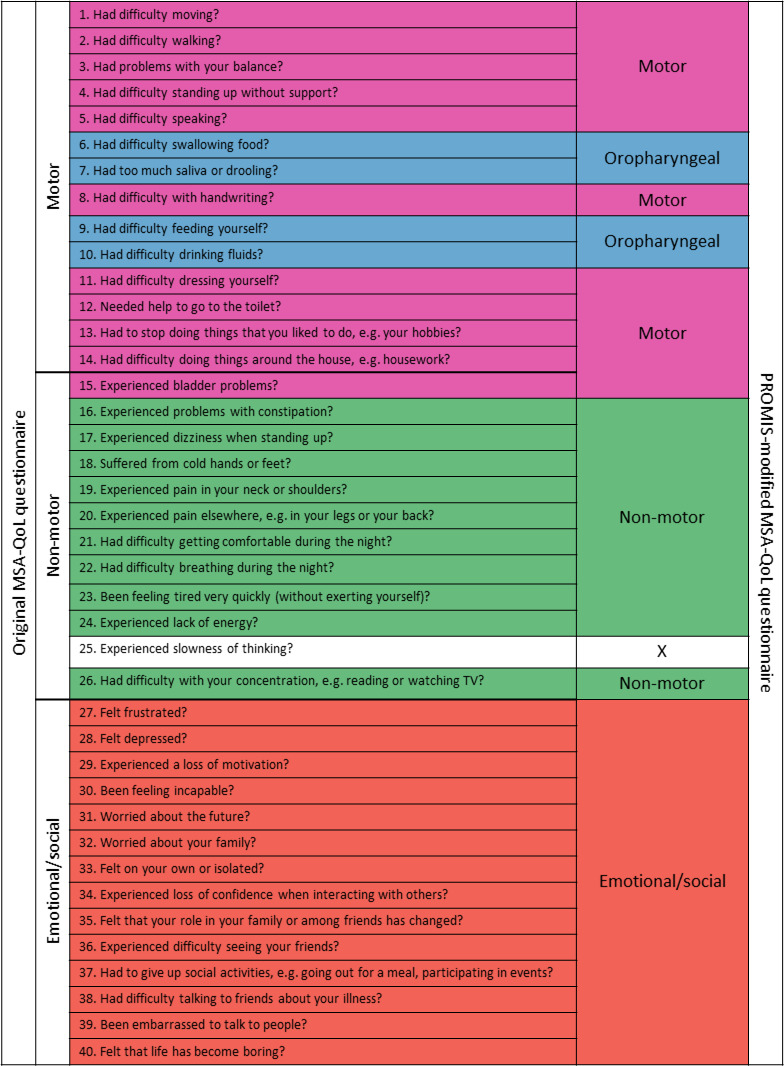
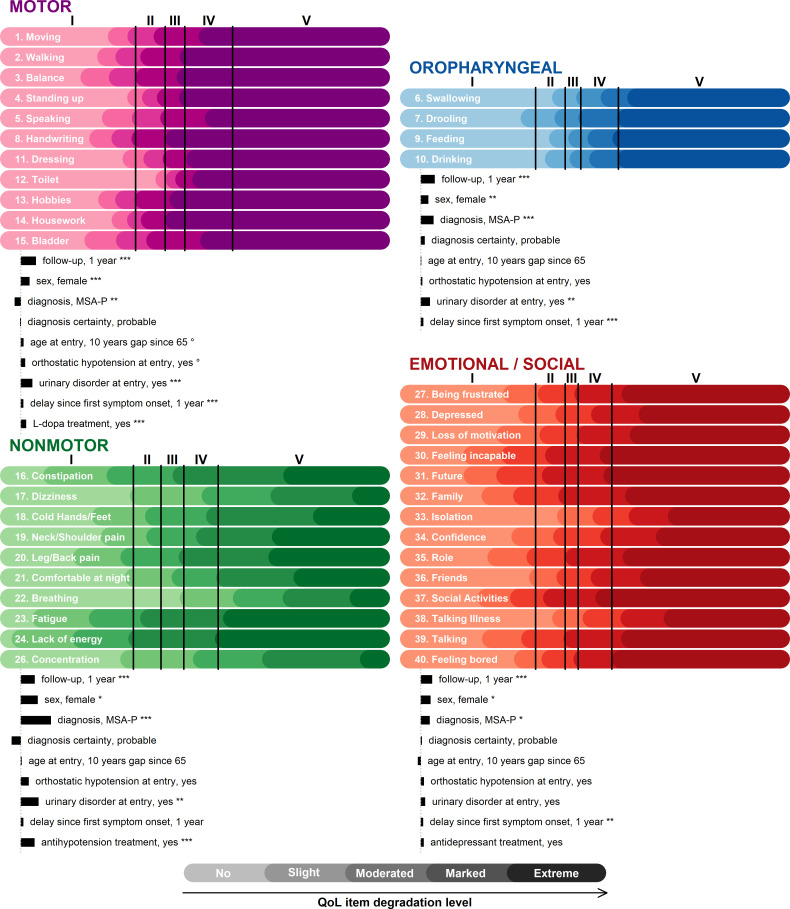
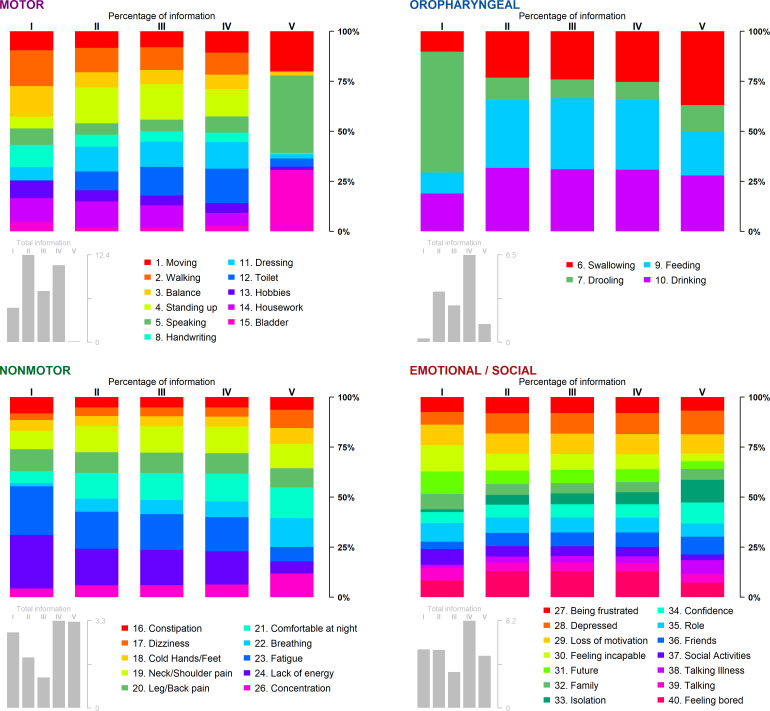
We leveraged the data of the French MSA cohort comprising annual assessments with the MSA-QoL questionnaire for more than 500 patients over up to 11 years. A four-step strategy (1) determined the subdimensions of Hr-QoL, (2) modelled the subdimension trajectories over time, (3) mapped item impairments with disease stages and (4) identified most informative items.
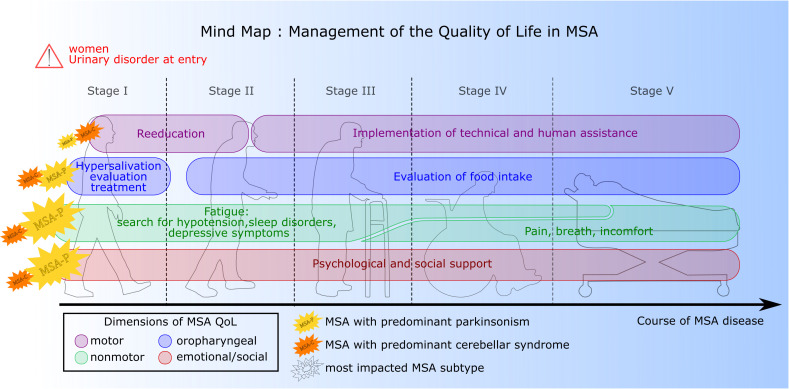
Four dimensions were identified. In addition to the original motor, non-motor and emotional domains, an oropharyngeal component was highlighted. While the motor and oropharyngeal domains deteriorated rapidly, the non-motor and emotional aspects were already impaired at cohort entry and deteriorated slowly over the disease course. Impairments were associated with sex, diagnosis subtype and delay since symptom onset. Except for the emotional domain, each dimension was driven by key identified items.
The multidimensional Hr-QoL deteriorates progressively over the course of MSA and brings essential knowledge for improving patient care. As exemplified with MSA, the thorough description of Hr-QoL over time using the four-step strategy can provide perspectives on neurodegenerative diseases' management to ultimately deliver better support focused on the patient's perspective.
健康相关生活质量(Hr-QoL)量表提供了关于神经退行性疾病进展的重要信息,有助于改善患者护理,并构成治疗研究的有意义终点。然而,由于多系统萎缩(MSA)是一种罕见且快速进展的α-突触核蛋白病,Hr-QoL 的进展通常记录不佳。本研究旨在描述 MSA 自然病程中的 Hr-QoL 进展,探索患者之间的差异,并使用四步统计策略确定有信息价值的项目。
我们利用了法国 MSA 队列的数据,该队列包含超过 500 名患者的年度评估,时间跨度超过 11 年,使用 MSA-QoL 问卷进行评估。采用四步策略(1)确定 Hr-QoL 的子维度,(2)建立子维度随时间的轨迹模型,(3)将项目障碍与疾病阶段映射,(4)确定最有信息价值的项目。
确定了四个维度。除了原始的运动、非运动和情感领域外,还突出了一个口咽部分。虽然运动和口咽领域迅速恶化,但非运动和情感方面在队列入组时已经受损,并在疾病过程中缓慢恶化。损伤与性别、诊断亚型和症状出现后延迟有关。除了情感领域外,每个维度都由关键识别项目驱动。
在 MSA 病程中,多维 Hr-QoL 逐渐恶化,并为改善患者护理提供了重要知识。正如 MSA 所例证的那样,使用四步策略对 Hr-QoL 进行随时间的详细描述可以为管理神经退行性疾病提供视角,最终提供更好的以患者为中心的支持。