• 文献检索
  • 文档翻译
  • 深度研究
  • 学术资讯
  • Suppr Zotero 插件Zotero 插件
  • 邀请有礼
  • 套餐&价格
  • 历史记录
应用&插件
Suppr Zotero 插件Zotero 插件浏览器插件Mac 客户端Windows 客户端微信小程序
定价
高级版会员购买积分包购买API积分包
服务
文献检索文档翻译深度研究API 文档MCP 服务
关于我们
关于 Suppr公司介绍联系我们用户协议隐私条款
关注我们

Suppr 超能文献

核心技术专利:CN118964589B侵权必究
粤ICP备2023148730 号-1Suppr @ 2026

文献检索

告别复杂PubMed语法,用中文像聊天一样搜索,搜遍4000万医学文献。AI智能推荐,让科研检索更轻松。

立即免费搜索

文件翻译

保留排版,准确专业,支持PDF/Word/PPT等文件格式,支持 12+语言互译。

免费翻译文档

深度研究

AI帮你快速写综述,25分钟生成高质量综述,智能提取关键信息,辅助科研写作。

立即免费体验

外侧踝关节扭伤后恢复运动时踝关节GO评分低会导致复发风险增加9倍:一项为期两年的前瞻性队列研究。

Low Ankle-GO Score While Returning to Sport After Lateral Ankle Sprain Leads to a 9-fold Increased Risk of Recurrence: A Two-year Prospective Cohort Study.

作者信息

Picot Brice, Fourchet François, Lopes Ronny, Rauline Gauthier, Freiha Kinan, D'hooghe Pieter, Valentin Eugénie, Hardy Alexandre

机构信息

Interuniversity Laboratory of Human Movement Sciences, Savoie Mont-Blanc University, Chambéry, 7424, F-73000, EA, France.

French Society of Sports Physical Therapist (SFMKS Lab), Pierrefitte-sur-Seine, France.

出版信息

Sports Med Open. 2024 Mar 8;10(1):23. doi: 10.1186/s40798-024-00693-w.

DOI:10.1186/s40798-024-00693-w
PMID:38453775
原文链接:https://pmc.ncbi.nlm.nih.gov/articles/PMC10920508/
Abstract

BACKGROUND

Lateral ankle sprain (LAS) is the most common sports injury, leading to a high rate of recurrence and the development of chronic ankle instability. One possible explanation is the lack of objective, evidence-based criteria to inform return to sport decisions following LAS. The aim of this study was therefore to assess the efficacy of a new functional score to distinguish patients at risk of recurrent LAS within two years after the initial injury.

METHODS

The Ankle-GO score was used in 64 active patients two months after LAS. This composite score includes 2 self-reported questionnaires and 4 functional tests, for a maximum score of 25 points. The rate of reinjury was prospectively recorded 2 years after inclusion. Potential predictive variables for reinjury were tested using the Chi-square and independent t-tests. The area under the receiver operating characteristics curve (AUC) with the optimal cut-off score was determined to assess the predictive value of the Ankle-GO score for the risk of reinjury. Multivariate logistic regression was then used to determine the influence of risk factors of reinjury.

RESULTS

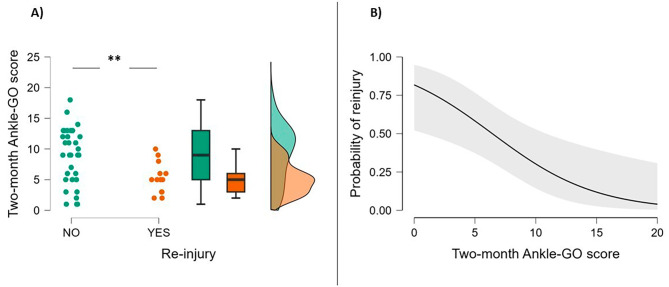
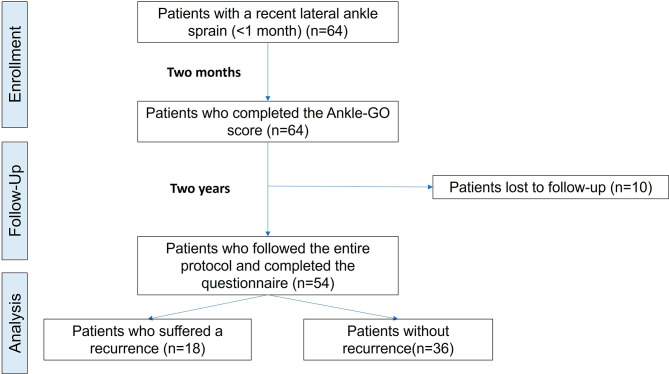
Fifty-four (85%) patients were included (23 men and 31 women, 34.7 ± 13 years old) including 18 (33.3%) with a reinjury. The two-month Ankle-GO score was lower in patients with a recurrent LAS (5.4 ± 2.8 points vs. 9.1 ± 4.5, p = 0.002) and predicted the risk of reinjury (AUC = 0.75). Patients with < 8 points were found to have a significantly higher risk of reinjury (OR = 8.6; 95%CI: 2-37.2, p = 0.001). Women also tend to have a higher risk of recurrence (OR = 3.8; 95%CI: 0.9-15.5, p = 0.065).

CONCLUSION

The Ankle-GO score is a new objective criterion for RTS after LAS. Patients with a low score at two months have a 9-fold greater risk of recurrence within two years.

摘要

背景

外侧踝关节扭伤(LAS)是最常见的运动损伤,导致高复发率和慢性踝关节不稳的发生。一种可能的解释是缺乏客观的、基于证据的标准来指导LAS后恢复运动的决策。因此,本研究的目的是评估一种新的功能评分在区分初次损伤后两年内有复发性LAS风险患者方面的有效性。

方法

64名活跃患者在LAS后两个月使用踝关节功能评分(Ankle-GO score)。这个综合评分包括2份自我报告问卷和4项功能测试,满分25分。纳入后2年对再损伤率进行前瞻性记录。使用卡方检验和独立t检验测试再损伤的潜在预测变量。确定具有最佳截断分数的受试者工作特征曲线(AUC)下面积,以评估Ankle-GO评分对再损伤风险的预测价值。然后使用多因素逻辑回归确定再损伤危险因素的影响。

结果

纳入54名(85%)患者(23名男性和31名女性,34.7±13岁),其中18名(33.3%)有再损伤。复发性LAS患者的两个月Ankle-GO评分较低(5.4±2.8分对9.1±4.5分,p = 0.002),并预测了再损伤风险(AUC = 0.75)。发现得分<8分的患者再损伤风险显著更高(OR = 8.6;95%CI:2 - 37.2,p = 0.001)。女性也往往有更高的复发风险(OR = 3.8;95%CI:0.9 - 15.5,p = 0.065)。

结论

Ankle-GO评分是LAS后恢复运动的一项新的客观标准。两个月时得分低的患者在两年内复发风险高9倍。
https://cdn.ncbi.nlm.nih.gov/pmc/blobs/eb32/10920508/456cb16e7897/40798_2024_693_Fig2_HTML.jpg
https://cdn.ncbi.nlm.nih.gov/pmc/blobs/eb32/10920508/56a2d1cd2b90/40798_2024_693_Fig1_HTML.jpg
https://cdn.ncbi.nlm.nih.gov/pmc/blobs/eb32/10920508/456cb16e7897/40798_2024_693_Fig2_HTML.jpg
https://cdn.ncbi.nlm.nih.gov/pmc/blobs/eb32/10920508/56a2d1cd2b90/40798_2024_693_Fig1_HTML.jpg
https://cdn.ncbi.nlm.nih.gov/pmc/blobs/eb32/10920508/456cb16e7897/40798_2024_693_Fig2_HTML.jpg

相似文献

1
Low Ankle-GO Score While Returning to Sport After Lateral Ankle Sprain Leads to a 9-fold Increased Risk of Recurrence: A Two-year Prospective Cohort Study.外侧踝关节扭伤后恢复运动时踝关节GO评分低会导致复发风险增加9倍:一项为期两年的前瞻性队列研究。
Sports Med Open. 2024 Mar 8;10(1):23. doi: 10.1186/s40798-024-00693-w.
2
Ankle-GO score is associated with the probability of becoming coper after lateral ankle sprain: a 1-year prospective cohort study.踝关节 GO 评分与外侧踝关节扭伤后能否恢复相关:一项为期 1 年的前瞻性队列研究。
Br J Sports Med. 2024 Oct 17;58(19):1115-1122. doi: 10.1136/bjsports-2024-108361.
3
Development and Validation of the Ankle-GO Score for Discriminating and Predicting Return-to-Sport Outcomes After Lateral Ankle Sprain.踝关节 GO 评分的制定与验证:用于鉴别与预测外侧踝关节扭伤后重返运动的结局。
Sports Health. 2024 Jan-Feb;16(1):47-57. doi: 10.1177/19417381231183647. Epub 2023 Jul 11.
4
Validity and reproducibility of the ARL-RSI score to assess psychological readiness before returning to sport after lateral ankle sprain.评估外侧踝关节扭伤后恢复运动前心理准备状态的ARL-RSI评分的有效性和可重复性。
J Exp Orthop. 2024 Jul 2;11(3):e12073. doi: 10.1002/jeo2.12073. eCollection 2024 Jul.
5
Criteria-Based Return to Sport Decision-Making Following Lateral Ankle Sprain Injury: a Systematic Review and Narrative Synthesis.基于标准的外侧踝关节扭伤后重返运动决策:系统评价和叙述性综合。
Sports Med. 2019 Apr;49(4):601-619. doi: 10.1007/s40279-019-01071-3.
6
Lack of Consensus on Return-to-Sport Criteria Following Lateral Ankle Sprain: A Systematic Review of Expert Opinions.距腓前韧带损伤后重返运动标准缺乏共识:专家意见的系统评价。
J Sport Rehabil. 2020 Feb 1;29(2):231-237. doi: 10.1123/jsr.2019-0038.
7
Which Functional Tests and Self-Reported Questionnaires Can Help Clinicians Make Valid Return to Sport Decisions in Patients With Chronic Ankle Instability? A Narrative Review and Expert Opinion.哪些功能测试和自我报告问卷可以帮助临床医生对慢性踝关节不稳患者做出有效的重返运动决策?一项叙述性综述与专家意见
Front Sports Act Living. 2022 May 26;4:902886. doi: 10.3389/fspor.2022.902886. eCollection 2022.
8
Evidence for Rehabilitation Interventions After Acute Lateral Ankle Sprains in Athletes: A Scoping Review.运动员急性外踝扭伤后康复干预的证据:范围综述。
J Sport Rehabil. 2022 May 1;31(4):457-464. doi: 10.1123/jsr.2021-0244. Epub 2021 Dec 30.
9
Prediction of Recurrent Lateral Ankle Sprain and Ankle Pain Using Applied Care Strategies and Patient-Reported Outcomes.应用护理策略和患者报告结局预测复发性外侧踝关节扭伤和踝关节疼痛。
J Athl Train. 2024 Nov 1;59(11):1070-1076. doi: 10.4085/1062-6050-0054.24.
10
Delayed functional therapy after acute lateral ankle sprain increases subjective ankle instability - the later, the worse: a retrospective analysis.急性外侧踝关节扭伤后延迟功能治疗会增加主观踝关节不稳——越晚治疗,情况越糟:一项回顾性分析。
BMC Sports Sci Med Rehabil. 2021 Aug 6;13(1):86. doi: 10.1186/s13102-021-00308-x.

引用本文的文献

1
Effect of proprioceptive neuromuscular facilitation on patients with chronic ankle instability: A systematic review and meta-analysis.本体感觉神经肌肉促进技术对慢性踝关节不稳患者的影响:一项系统评价与Meta分析
PLoS One. 2025 Jan 9;20(1):e0311355. doi: 10.1371/journal.pone.0311355. eCollection 2025.
2
Ankle Sprain Recurrence and Rehabilitation Among Athletes: A Case Study in the West Region of Cameroon.喀麦隆西部地区运动员踝关节扭伤复发与康复:一项案例研究
Cureus. 2024 Nov 5;16(11):e73065. doi: 10.7759/cureus.73065. eCollection 2024 Nov.
3
Ankle-GO score is associated with the probability of becoming coper after lateral ankle sprain: a 1-year prospective cohort study.

本文引用的文献

1
Deficits in neurocognitive performance in patients with chronic ankle instability during a neurocognitive balance task - A retrospective case-control study.慢性踝关节不稳患者在神经认知平衡任务中神经认知表现缺陷-一项回顾性病例对照研究。
Phys Ther Sport. 2024 Mar;66:1-8. doi: 10.1016/j.ptsp.2023.12.009. Epub 2024 Jan 3.
2
Development and Validation of the Ankle-GO Score for Discriminating and Predicting Return-to-Sport Outcomes After Lateral Ankle Sprain.踝关节 GO 评分的制定与验证:用于鉴别与预测外侧踝关节扭伤后重返运动的结局。
Sports Health. 2024 Jan-Feb;16(1):47-57. doi: 10.1177/19417381231183647. Epub 2023 Jul 11.
3
踝关节 GO 评分与外侧踝关节扭伤后能否恢复相关:一项为期 1 年的前瞻性队列研究。
Br J Sports Med. 2024 Oct 17;58(19):1115-1122. doi: 10.1136/bjsports-2024-108361.
Five-year clinical follow-up of arthroscopically treated chronic ankle instability.
关节镜治疗慢性踝关节不稳定的 5 年临床随访。
Orthop Traumatol Surg Res. 2023 Dec;109(8S):103649. doi: 10.1016/j.otsr.2023.103649. Epub 2023 Jun 25.
4
Impairment-based assessments for patients with lateral ankle sprain: A systematic review of measurement properties.基于损伤的外侧踝关节扭伤患者评估:测量特性的系统评价。
PLoS One. 2023 Feb 22;18(2):e0280388. doi: 10.1371/journal.pone.0280388. eCollection 2023.
5
Intrinsic Risk Factors for Ankle Sprain Differ Between Male and Female Athletes: A Systematic Review and Meta-Analysis.男女运动员踝关节扭伤的内在风险因素存在差异:一项系统评价与荟萃分析
Sports Med Open. 2022 Nov 18;8(1):139. doi: 10.1186/s40798-022-00530-y.
6
Which Functional Tests and Self-Reported Questionnaires Can Help Clinicians Make Valid Return to Sport Decisions in Patients With Chronic Ankle Instability? A Narrative Review and Expert Opinion.哪些功能测试和自我报告问卷可以帮助临床医生对慢性踝关节不稳患者做出有效的重返运动决策?一项叙述性综述与专家意见
Front Sports Act Living. 2022 May 26;4:902886. doi: 10.3389/fspor.2022.902886. eCollection 2022.
7
Perceived Instability, Pain, and Psychological Factors for Prediction of Function and Disability in Individuals With Chronic Ankle Instability.慢性踝关节不稳患者功能和残疾的预测:感知不稳定性、疼痛和心理因素。
J Athl Train. 2022 Nov 1;57(11-12):1048-1054. doi: 10.4085/1062-6050-0605.21.
8
Injury-Related Fear in Individuals With and Without Chronic Ankle Instability: A Systematic Review.有慢性踝关节不稳和无慢性踝关节不稳个体的损伤恐惧:系统评价。
J Sport Rehabil. 2021 Sep 20;30(8):1203-1212. doi: 10.1123/jsr.2021-0015.
9
Lateral Ankle Sprain and Subsequent Ankle Sprain Risk: A Systematic Review.外侧踝关节扭伤及其后续踝关节扭伤风险:系统评价。
J Athl Train. 2021 Jun 1;56(6):578-585. doi: 10.4085/1062-6050-168-20.
10
Diagnostic Accuracy of Clinical Tests Assessing Ligamentous Injury of the Talocrural and Subtalar Joints: A Systematic Review With Meta-Analysis.临床检测评估距下及跟距关节韧带损伤的诊断准确性:系统评价与荟萃分析。
Sports Health. 2022 May-Jun;14(3):336-347. doi: 10.1177/19417381211029953. Epub 2021 Jul 21.