Department of Clinical Nutrition, The Second Affiliated Hospital of Chongqing Medical University, Chongqing, 400016, China.
Department of Clinical Nutrition, The People's Hospital of Chongqing Liang Jiang New Area, Chongqing, 401135, China.
Nutr J. 2024 Mar 7;23(1):32. doi: 10.1186/s12937-024-00932-6.
Previous experimental studies have suggested that the consumption of soy isoflavones may have a potential impact on lowering blood pressure. Nevertheless, epidemiological studies have presented conflicting outcomes concerning the correlation between soy isoflavone consumption and blood pressure levels. Consequently, a comprehensive meta-analysis of all eligible randomized controlled trials (RCTs) was conducted to explore the influence of soy isoflavones on systolic blood pressure (SBP) and diastolic blood pressure (DBP) in adults.
A thorough search of PubMed, Embase, and the Cochrane Library for relevant literature up to April 30, 2023 was conducted. RCTs involving adults that compared soy isoflavone supplementation with a placebo (the same matrix devoid of soy isoflavone) were included. The combined effect size was presented as the weighted mean difference (WMD) along with 95% confidence interval (CI), employing a fixed-effects model.
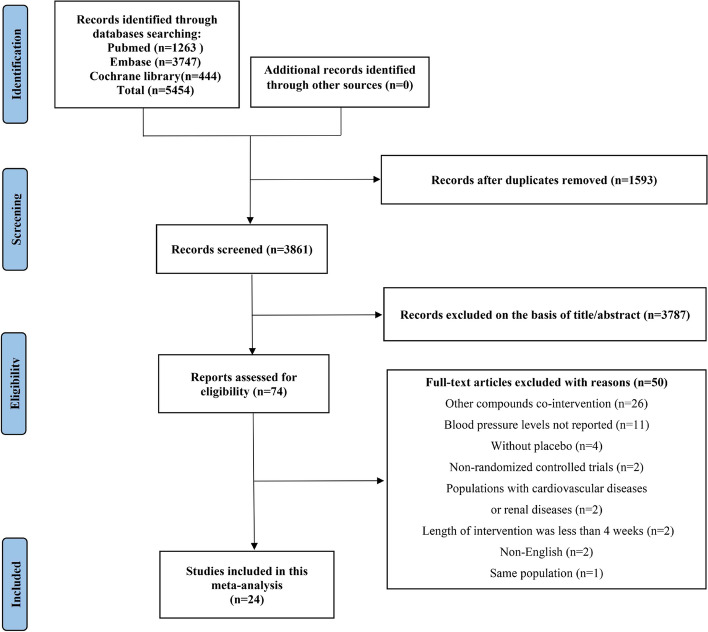
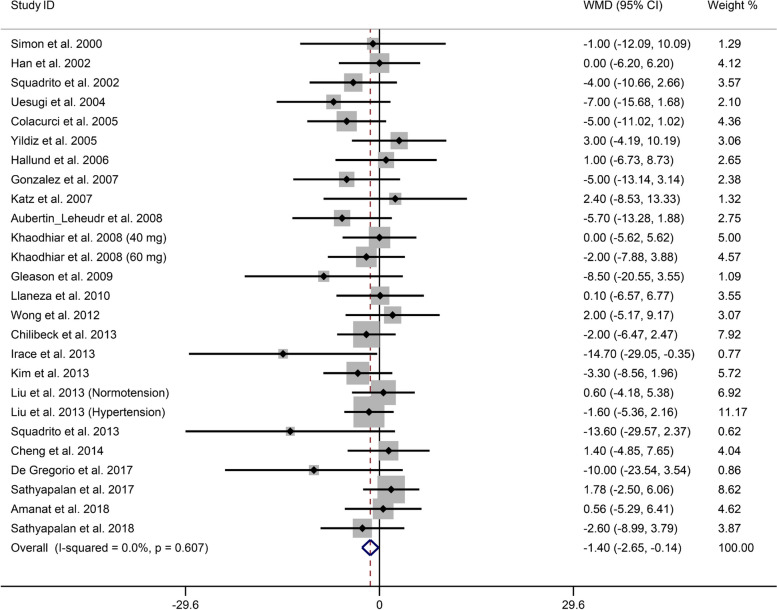
Our meta-analysis included a total of 24 studies involving 1945 participants. The results revealed a significant reduction in both SBP and DBP with soy isoflavone supplementation. Subgroup analyses suggested more pronounced reductions in SBP and DBP for interventions lasting ≥6 months, in individuals receiving mixed-type soy isoflavone, and among patients with metabolic syndrome or prehypertension. However, we did not detect significant nonlinear associations between supplementation dosage and intervention duration concerning both SBP and DBP. The overall quality of evidence was deemed moderate.
The current meta-analysis revealed that supplementation with soy isoflavones alone effectively reduces blood pressure. Additional high-quality studies are required to investigate the efficacy of blood pressure reduction through supplementation with an optimal quantity and proportion of soy isoflavone.
先前的实验研究表明,大豆异黄酮的摄入可能对降低血压有潜在影响。然而,关于大豆异黄酮摄入与血压水平之间的相关性,流行病学研究得出了相互矛盾的结果。因此,我们进行了一项全面的荟萃分析,纳入了所有合格的随机对照试验(RCT),以探讨大豆异黄酮对成年人收缩压(SBP)和舒张压(DBP)的影响。
我们全面检索了 PubMed、Embase 和 Cochrane 图书馆截至 2023 年 4 月 30 日的相关文献。纳入了比较大豆异黄酮补充剂与安慰剂(相同基质,不含大豆异黄酮)的成年人 RCT。合并效应量表示为加权均数差(WMD)及其 95%置信区间(CI),采用固定效应模型。
我们的荟萃分析共纳入了 24 项研究,涉及 1945 名参与者。结果显示,大豆异黄酮补充剂可显著降低 SBP 和 DBP。亚组分析表明,干预持续时间≥6 个月、接受混合类型大豆异黄酮、患有代谢综合征或高血压前期的个体,SBP 和 DBP 的降低更为明显。然而,我们未发现补充剂量和干预持续时间与 SBP 和 DBP 之间存在显著的非线性关联。总体证据质量被认为是中等的。
本荟萃分析显示,单独补充大豆异黄酮可有效降低血压。需要更多高质量的研究来探讨通过补充适量和适当比例的大豆异黄酮来降低血压的效果。