Chengdu Integrated TCM and Western Medicine Hospital, Chengdu, China.
College of Life and Science, Chengdu University of Traditional Chinese Medicine, Chengdu, Sichuan, China.
Front Endocrinol (Lausanne). 2023 Jul 18;14:1215521. doi: 10.3389/fendo.2023.1215521. eCollection 2023.
Accumulating evidence suggests that elevated serum uric acid (SUA) may be a risk factor for hypertriglyceridemia (HTG). However, the epidemiological evidence for the association between SUA and HTG is limited. This article aimed to use the data from National Health and Nutrition Examination Survey (NHANES) (2007-2018) database to bridge the research gap.
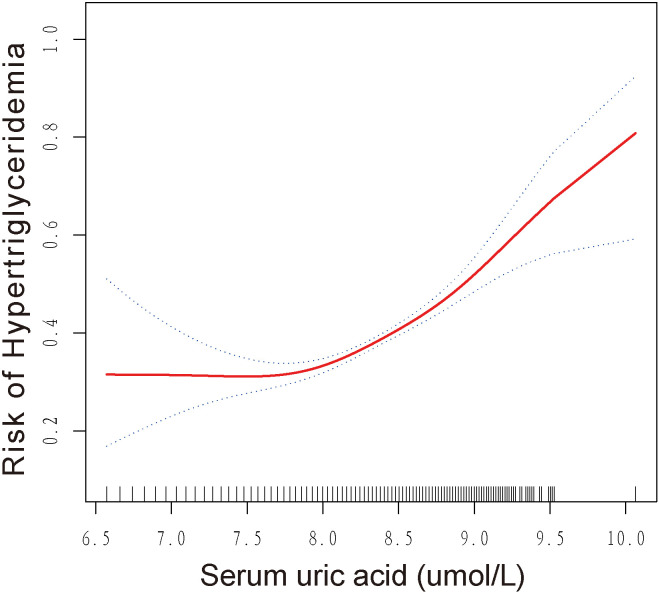
This cross-sectional study used data from 10027 adults involved in NHANES from 2007-2018. We designed the exposure variable as SUA and the outcome variable as HTG. The covariates included demographics, questionnaires, laboratory, and examination information. Weighted logistic regression and subgroup analysis were used to explore the independent association between SUA and HTG. Furthermore, interaction tests were also carried out to evaluate the strata differences. Generalized additive models (GAM), smooth curve fittings, and threshold effect analysis were applied to examine the non-linear relationship.
A total of 10027 participants were included, of which 3864 were HTG participants and 6163 were non-HTG participants. After fully adjusting for confounders, weighted multiple logistic regression models revealed a 77% increase in the risk of HTG when each unit of log2-SUA increased. There was also a positive association between elevated log2-SUA and developed risk of HTG in the quartile (Q) groups (Q1 OR: 1.00; Q2 OR: 1.17 [95%CI: 0.95,1.45]; Q3 OR: 1.43 [95%CI: 1.16,1.78]; Q4 OR: 1.68 [95%CI: 1.36,2.08]. The subgroup analysis results remained consistent across strata, with a strong positive correlation between SUA and HTG. Interaction tests showed no dependence on physical activity (PA), gender, BMI, smoking status, alcohol intake, hypertension, and diabetes for this positive association between log2-SUA and HTG (all for interaction >0.05). The participants' age may impact the strength of the association between SUA and HTG ( for interaction <0.05).
There is a positive association between SUA and HTG in US adults. Considering that SUA may be a risk factor for HTG, individuals diagnosed with HTG should prioritize the daily management of SUA as part of their comprehensive care.
越来越多的证据表明,血清尿酸(SUA)升高可能是高甘油三酯血症(HTG)的一个危险因素。然而,SUA 与 HTG 之间关联的流行病学证据有限。本文旨在利用国家健康与营养调查(NHANES)(2007-2018 年)数据库中的数据来填补这一研究空白。
本横断面研究使用了 2007-2018 年参与 NHANES 的 10027 名成年人的数据。我们将暴露变量设计为 SUA,将结局变量设计为 HTG。协变量包括人口统计学、问卷调查、实验室和检查信息。使用加权逻辑回归和亚组分析来探讨 SUA 与 HTG 之间的独立关联。此外,还进行了交互检验以评估分层差异。广义加性模型(GAM)、平滑曲线拟合和阈值效应分析用于检验非线性关系。
共纳入 10027 名参与者,其中 3864 名参与者患有 HTG,6163 名参与者未患有 HTG。在充分调整混杂因素后,加权多元逻辑回归模型显示,SUA 每增加一个对数 2 单位,HTG 的风险增加 77%。在四分位(Q)组中,升高的 log2-SUA 与 HTG 发病风险呈正相关(Q1 OR:1.00;Q2 OR:1.17[95%CI:0.95,1.45];Q3 OR:1.43[95%CI:1.16,1.78];Q4 OR:1.68[95%CI:1.36,2.08])。亚组分析结果在各亚组中保持一致,SUA 与 HTG 之间呈强正相关。交互检验显示,SUA 与 HTG 之间的这种正相关与体力活动(PA)、性别、BMI、吸烟状况、饮酒、高血压和糖尿病无关(所有交互检验 P>0.05)。参与者的年龄可能会影响 SUA 与 HTG 之间关联的强度(交互检验 P<0.05)。
美国成年人中 SUA 与 HTG 之间存在正相关。考虑到 SUA 可能是 HTG 的一个危险因素,诊断为 HTG 的个体应将 HTG 的日常管理作为其综合护理的一部分。