School of Chemistry, University of Southampton, Southampton SO17 1BJ, U.K.
Programa de Pós-Graduação em Biociências (PPGBio), Universidade Federal de Ciências da Saúde de Porto Alegre─UFCSPA, Porto Alegre 90050-170, Brazil.
J Phys Chem B. 2024 Mar 21;128(11):2717-2733. doi: 10.1021/acs.jpcb.3c07985. Epub 2024 Mar 8.
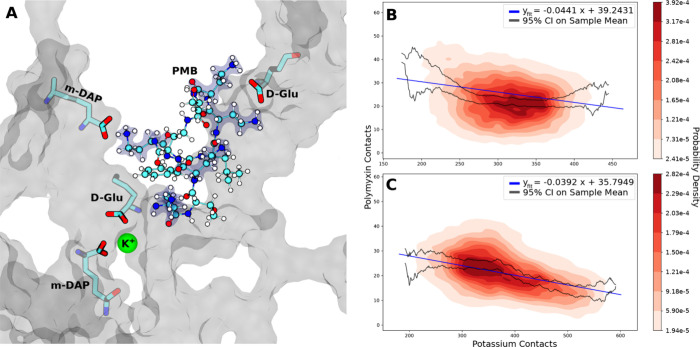
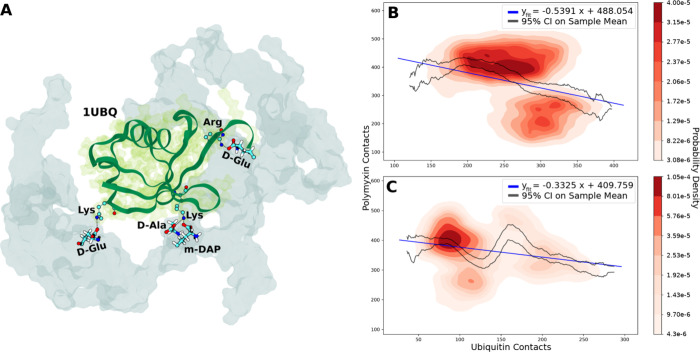
The cell envelope of Gram-negative bacteria is a crowded tripartite architecture that separates the cell interior from the external environment. Two membranes encapsulate the aqueous periplasm, which contains the cell wall. Little is known about the mechanisms via which antimicrobial peptides move through the periplasm from the outer membrane to their site of action, the inner membrane. We utilize all-atom molecular dynamics to study two antimicrobial peptides, polymyxins B1 and E, within models of the periplasm crowded to different extents. In a simple chemical environment, both PMB1 and PME bind irreversibly to the cell wall. The presence of specific macromolecules leads to competition with the polymyxins for cell wall interaction sites, resulting in polymyxin dissociation from the cell wall. Chemical complexity also impacts interactions between polymyxins and Braun's lipoprotein; thus, the interaction modes of lipoprotein antibiotics within the periplasm are dependent upon the nature of the other species present.
革兰氏阴性菌的细胞包膜是一个拥挤的三分体结构,将细胞内部与外部环境分隔开来。两层膜包裹着含水的周质,其中包含细胞壁。目前对于抗菌肽如何从外膜穿过周质到达作用部位——内膜的机制知之甚少。我们利用全原子分子动力学方法研究了两种抗菌肽,多粘菌素 B1 和 E,在不同程度拥挤的周质模型中。在简单的化学环境中,PMB1 和 PME 都不可逆地与细胞壁结合。特定大分子的存在会导致与多粘菌素竞争细胞壁相互作用位点,从而导致多粘菌素从细胞壁上解离。化学复杂性还会影响多粘菌素与 Braun 的脂蛋白之间的相互作用;因此,脂蛋白抗生素在周质中的相互作用模式取决于存在的其他物质的性质。