Department of Epidemiology, Colleges of Public Health and Health Professions and Medicine, University of Florida, Gainesville, FL, 32603, USA.
Channing Division of Network Medicine, Department of Medicine, Brigham and Women's Hospital and Harvard Medical School, Boston, MA, 02115, USA.
BMC Public Health. 2024 Mar 9;24(1):749. doi: 10.1186/s12889-024-17944-w.
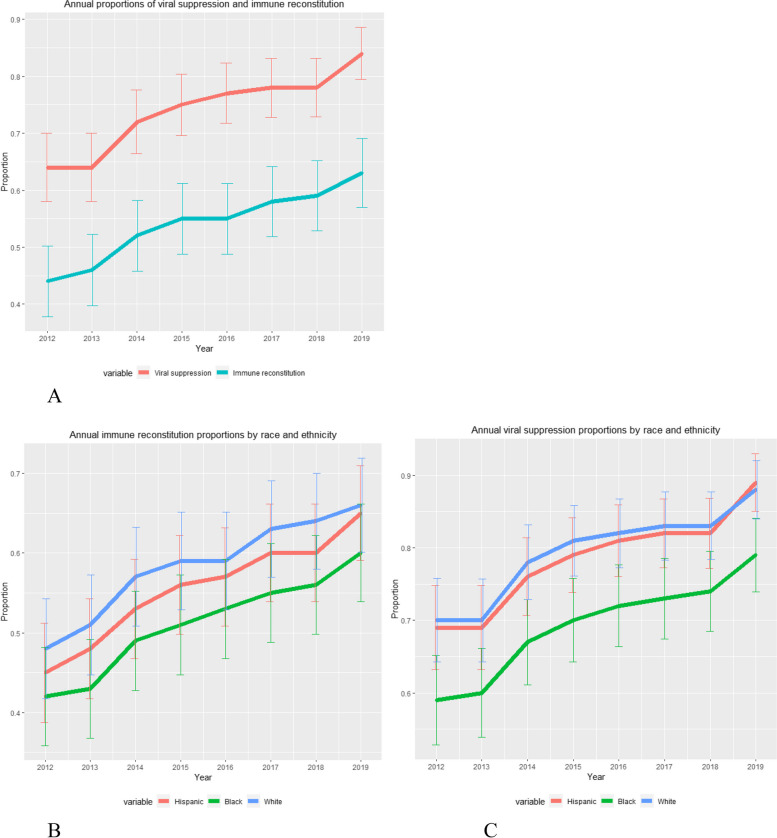
Racial/ethnic disparities in the HIV care continuum have been well documented in the US, with especially striking inequalities in viral suppression rates between White and Black persons with HIV (PWH). The South is considered an epicenter of the HIV epidemic in the US, with the largest population of PWH living in Florida. It is unclear whether any disparities in viral suppression or immune reconstitution-a clinical outcome highly correlated with overall prognosis-have changed over time or are homogenous geographically. In this analysis, we 1) investigate longitudinal trends in viral suppression and immune reconstitution among PWH in Florida, 2) examine the impact of socio-ecological factors on the association between race/ethnicity and clinical outcomes, 3) explore spatial and temporal variations in disparities in clinical outcomes.
Data were obtained from the Florida Department of Health for 42,369 PWH enrolled in the Ryan White program during 2008-2020. We linked the data to county-level socio-ecological variables available from County Health Rankings. GEE models were fit to assess the effect of race/ethnicity on immune reconstitution and viral suppression longitudinally. Poisson Bayesian hierarchical models were fit to analyze geographic variations in racial/ethnic disparities while adjusting for socio-ecological factors.
Proportions of PWH who experienced viral suppression and immune reconstitution rose by 60% and 45%, respectively, from 2008-2020. Odds of immune reconstitution and viral suppression were significantly higher among White [odds ratio =2.34, 95% credible interval=2.14-2.56; 1.95 (1.85-2.05)], and Hispanic [1.70 (1.54-1.87); 2.18(2.07-2.31)] PWH, compared with Black PWH. These findings remained unchanged after accounting for socio-ecological factors. Rural and urban counties in north-central Florida saw the largest racial/ethnic disparities.
There is persistent, spatially heterogeneous, racial/ethnic disparity in HIV clinical outcomes in Florida. This disparity could not be explained by socio-ecological factors, suggesting that further research on modifiable factors that can improve HIV outcomes among Black and Hispanic PWH in Florida is needed.
在美国,艾滋病毒护理连续体中的种族/民族差异已得到充分记录,艾滋病毒感染者(PWH)的病毒抑制率之间存在特别明显的不平等,尤其是白人和黑人之间。南部被认为是美国艾滋病毒流行的中心,佛罗里达州居住着最大的 PWH 人群。目前尚不清楚病毒抑制或免疫重建(与总体预后高度相关的临床结果)方面的任何差异是否随时间变化或在地理上是否具有同质性。在这项分析中,我们 1)调查佛罗里达州 PWH 的病毒抑制和免疫重建的纵向趋势,2)检查社会生态因素对种族/民族与临床结果之间关联的影响,3)探索临床结果差异的空间和时间变化。
数据来自佛罗里达州卫生部,涉及 2008 年至 2020 年期间参加 Ryan White 计划的 42369 名 PWH。我们将数据与来自县健康排名的县一级社会生态变量相关联。使用广义估计方程模型评估种族/民族对免疫重建和病毒抑制的纵向影响。使用泊松贝叶斯层次模型分析调整社会生态因素后种族/民族差异的地理变化。
从 2008 年至 2020 年,经历病毒抑制和免疫重建的 PWH 比例分别上升了 60%和 45%。与黑人 PWH 相比,白人[比值比=2.34,95%可信区间=2.14-2.56;1.95(1.85-2.05)]和西班牙裔[1.70(1.54-1.87);2.18(2.07-2.31)]PWH 发生免疫重建和病毒抑制的可能性显著更高。在考虑社会生态因素后,这些发现仍然不变。佛罗里达州中北部的农村和城市县存在最大的种族/民族差异。
佛罗里达州的艾滋病毒临床结果存在持续存在且空间异质的种族/民族差异。这种差异不能用社会生态因素来解释,这表明需要进一步研究可改变的因素,以改善佛罗里达州黑人及西班牙裔 PWH 的艾滋病毒结果。