Timerga Sara, Befkadu Aynalem, Seyoum Fetene
Department of Anesthesia, College of Medicine and Health Sciences, Wollo University, Dessie.
Department of Anesthesia, College of Medicine and Health Sciences, Debre Birhan University, Debre Birhan, Ethiopia.
Ann Med Surg (Lond). 2024 Jan 22;86(3):1322-1328. doi: 10.1097/MS9.0000000000001724. eCollection 2024 Mar.
Postoperative pain is poorly studied in developing countries. Severe pain after surgery remains a major problem, occurring in 50-70% of the patients. Differences exist across countries. Despite numerous published studies, the degree of pain following many types of surgery in everyday clinical practice is unknown. To improve postoperative pain-treatment and develop procedure-specific, optimized pain-treatment protocols, the prevalence and severity of postoperative pain must first be identified.
This study aimed to determine the prevalence and intensity of acute postoperative pain and the practice of postoperative pain management.
A total of 180 patients were enrolled in the study, with 160 calculated using a single population proportion formula and a 10% attrition rate added, with proportionate stratification according to the size of each ward to obtain the number of participants from each specialty ward. A multistage sampling with stratified proportionate at the initial stages and a simple random sampling technique at the final stage was used. The patients completed a numerical pain rating scale for pain immediately after surgery for the first 72 h after surgery. The prevalence of mild, moderate, or severe pain was calculated. The evaluation was performed at eight time points including immediately after surgery: T2, T4, T8, T12, T24, T48, and T72.
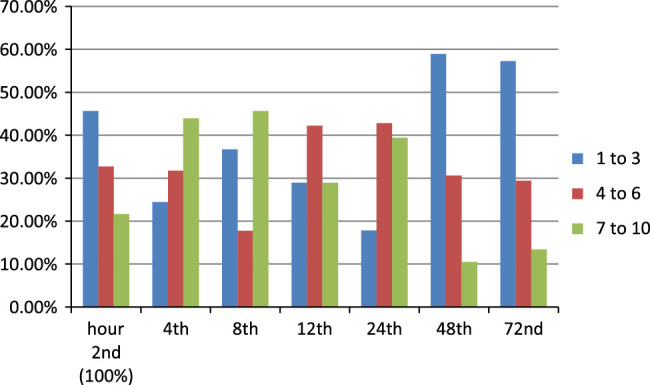
The prevalence of severe pain in patients who underwent elective surgery in the study period measured by numeric rating scale was 21.6, 43.9, 45.6, 28.9, 39.4, 10.5, and 13.4% at 2nd, 4th, 8th, 12th, 24th, 48th and 72 h, respectively.
The prevalence of moderate-to-severe pain within 72 h postoperatively was slightly lower than that other studies conducted in Ethiopia reported. This was still high, indicating better pain management in the postoperative period. Involvement of the anesthetist in pain management is crucial for better patient management.
发展中国家对术后疼痛的研究较少。术后剧痛仍是一个主要问题,50%至70%的患者会出现。不同国家存在差异。尽管有大量已发表的研究,但日常临床实践中多种手术类型后的疼痛程度仍不清楚。为改善术后疼痛治疗并制定特定手术的优化疼痛治疗方案,必须首先确定术后疼痛的患病率和严重程度。
本研究旨在确定急性术后疼痛的患病率和强度以及术后疼痛管理的实践情况。
共有180名患者纳入研究,其中160名使用单一总体比例公式计算,并加上10%的损耗率,根据每个病房的规模进行比例分层以获得各专科病房的参与者数量。采用初始阶段分层比例的多阶段抽样和最后阶段的简单随机抽样技术。患者在术后头72小时内于术后立即完成数字疼痛评分量表。计算轻度、中度或重度疼痛的患病率。在包括术后立即在内的八个时间点进行评估:T2、T4、T8、T12、T24、T48和T72。
在研究期间接受择期手术的患者中,通过数字评分量表测量的术后第2、4、8、12、24、48和72小时重度疼痛的患病率分别为21.6%、43.9%、45.6%、28.9%、39.4%、10.5%和13.4%。
术后72小时内中度至重度疼痛的患病率略低于埃塞俄比亚进行的其他研究报告。这一患病率仍然很高,表明术后疼痛管理仍需改善。麻醉师参与疼痛管理对于更好地管理患者至关重要。