Seurat Jérémy, Gerbino Krista R, Meyer Justin R, Borin Joshua M, Weitz Joshua S
Institut de Biologie, Ecole Normale Superieure, Paris, 75005, France.
School of Biological Sciences, Georgia Institute of Technology, Atlanta, 30332, GA, USA.
bioRxiv. 2024 Aug 5:2024.02.23.581735. doi: 10.1101/2024.02.23.581735.
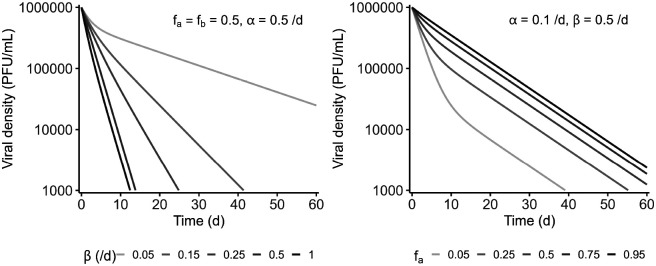
Virus population dynamics are driven by counter-balancing forces of production and loss. Whereas viral production arises from complex interactions with susceptible hosts, the loss of infectious virus particles is often approximated as a first-order kinetic process. As such, experimental protocols to measure infectious virus loss are not typically designed to identify non-exponential decay processes. Here, we propose methods to evaluate if an experimental design is adequate to identify multiphasic virus particle decay and to optimize the sampling times of decay experiments, accounting for uncertainties in viral kinetics. First, we evaluate synthetic scenarios of biphasic decays, with varying decay rates and initial proportions of subpopulations. We show that robust inference of multiphasic decay is more likely when the faster decaying subpopulation predominates insofar as early samples are taken to resolve the faster decay rate. Moreover, design optimization involving non-equal spacing between observations increases the precision of estimation while reducing the number of samples. We then apply these methods to infer multiple decay rates associated with the decay of bacteriophage ('phage') , an evolved isolate derived from phage . A pilot experiment confirmed that decay is multiphasic, but was unable to resolve the rate or proportion of the fast decaying subpopulation(s). We then applied a Fisher information matrix-based design optimization method to propose non-equally spaced sampling times. Using this strategy, we were able to robustly estimate multiple decay rates and the size of the respective subpopulations. Notably, we conclude that the vast majority (94%) of the phage population decays at a rate 16-fold higher than the slow decaying population. Altogether, these results provide both a rationale and a practical approach to quantitatively estimate heterogeneity in viral decay.
病毒群体动态受产生与损失的平衡力量驱动。病毒的产生源于与易感宿主的复杂相互作用,而感染性病毒颗粒的损失通常被近似为一级动力学过程。因此,用于测量感染性病毒损失的实验方案通常并非设计用于识别非指数衰减过程。在此,我们提出方法来评估实验设计是否足以识别多相病毒颗粒衰减,并优化衰减实验的采样时间,同时考虑病毒动力学中的不确定性。首先,我们评估双相衰减的合成场景,其中衰减率和亚群的初始比例各不相同。我们表明,当快速衰减的亚群占主导时,更有可能对多相衰减进行稳健推断,前提是采集早期样本以解析更快的衰减率。此外,涉及观测值之间非等间距的设计优化在减少样本数量的同时提高了估计精度。然后,我们应用这些方法来推断与噬菌体(“噬菌体”)衰减相关的多个衰减率,该噬菌体是从噬菌体进化而来的分离株。一项初步实验证实噬菌体衰减是多相的,但无法解析快速衰减亚群的速率或比例。然后,我们应用基于费舍尔信息矩阵的设计优化方法来提出非等间距的采样时间。使用这种策略,我们能够稳健地估计多个衰减率以及各个亚群的大小。值得注意的是,我们得出结论,绝大多数(94%)的噬菌体群体以比缓慢衰减群体高16倍的速率衰减。总之,这些结果为定量估计病毒衰减中的异质性提供了理论依据和实用方法。