Trani Jean-François, Zhu Yiqi, Park Soobin, Babulal Ganesh M
Brown School of Social Work, Washington University in St. Louis, St. Louis, Missouri, USA.
National Conservatory of Arts and Crafts, Paris, France.
Innov Aging. 2024 Feb 1;8(2):igae007. doi: 10.1093/geroni/igae007. eCollection 2024.
Multidimensional poverty is associated with dementia. We aimed at establishing this association in Pakistan.
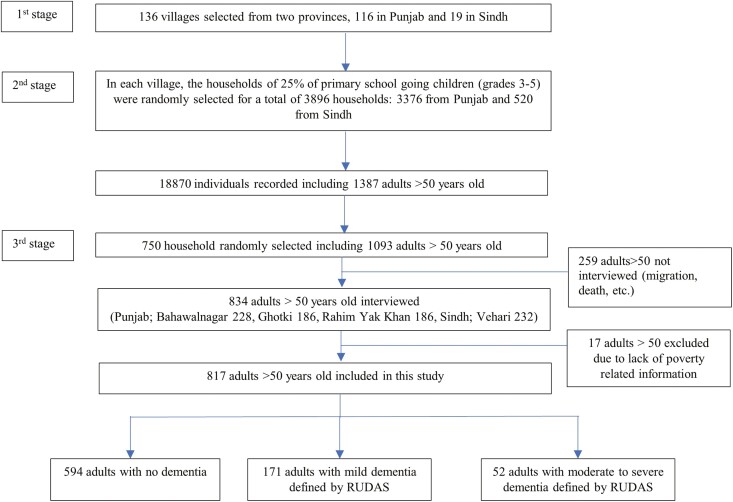
A cross-sectional study was conducted in Punjab and Sindh, Pakistan, between March 30, 2002, and August 22, 2022, among adults aged 50 and older. Multidimensional poverty measures were composed of 6 dimensions and 15 indicators. Poverty was compared between adults with and without dementia using the Rowland Universal Dementia Assessment Scale, adjusting for sex, age, marital status, and household size. Associations between dementia and poverty were investigated using a multivariate logistic regression model.
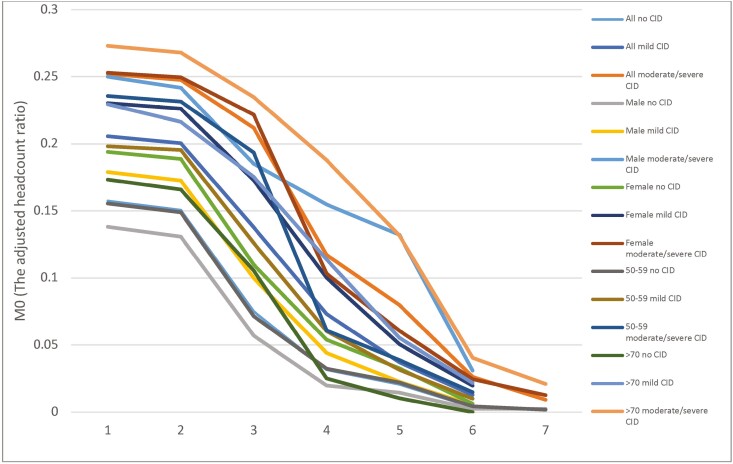
We found that 594 (72.7%), 171 (20.9%), and 52 (6.4%) had no, mild, and moderate-to-severe dementia, respectively. More women than men had dementia (11.4% vs 2.9%). Approximately 40.4% of adults with dementia were found to be deprived in 4 or more dimensions compared to 8.9% without dementia, and the difference in multidimensional poverty between them was 348.6%. Education, health, living conditions, and psychological well-being were the main contributors to poverty. Poverty in 4 or more dimensions was strongly associated with dementia (odds ratio [OR], 5.02; 95% confidence interval [CI], 2.07-12.16) after adjusting for sex, marital status, age, and household size, with greater odds for older women (OR, 2.02; 95% CI, 1.41-2.90).
Our findings suggest that early improvement in social determinants of health through targeted structural policies may prevent dementia later in life. Improving access to free, quality education, health care including mental health care and basic living standards, and employment should reduce the collective risk of dementia.
多维贫困与痴呆症相关。我们旨在在巴基斯坦证实这种关联。
2002年3月30日至2022年8月22日期间,在巴基斯坦旁遮普省和信德省对50岁及以上成年人开展了一项横断面研究。多维贫困衡量指标由6个维度和15项指标组成。使用罗兰通用痴呆评估量表,在调整性别、年龄、婚姻状况和家庭规模后,对患有和未患痴呆症的成年人的贫困状况进行比较。使用多变量逻辑回归模型研究痴呆症与贫困之间的关联。
我们发现,分别有594人(72.7%)、171人(20.9%)和52人(6.4%)未患痴呆症、患有轻度痴呆症以及患有中度至重度痴呆症。患痴呆症的女性多于男性(11.4%对2.9%)。与未患痴呆症的成年人相比,约40.4%的痴呆症患者在4个或更多维度上处于贫困状态,而未患痴呆症的成年人这一比例为8.9%,两者在多维贫困方面的差异为348.6%。教育、健康、生活条件和心理健康是贫困的主要促成因素。在调整性别、婚姻状况、年龄和家庭规模后,4个或更多维度的贫困与痴呆症密切相关(优势比[OR]为5.02;95%置信区间[CI]为2.07 - 12.16),老年女性的患病几率更高(OR为2.02;95% CI为1.41 - 2.90)。
我们的研究结果表明,通过有针对性的结构性政策尽早改善健康的社会决定因素,可能预防晚年痴呆症。改善免费优质教育、包括心理健康护理在内的医疗保健以及基本生活水平的获取机会,以及就业机会,应能降低痴呆症的总体风险。