Department of Immunology, Center of Immunomolecular Engineering, Innovation & Practice Base for Graduate Students Education, Zunyi Medical University, Zunyi, China.
Central Laboratory, Guizhou Aerospace Hospital, Zunyi, China.
Microbiol Spectr. 2024 Apr 2;12(4):e0376223. doi: 10.1128/spectrum.03762-23. Epub 2024 Mar 11.
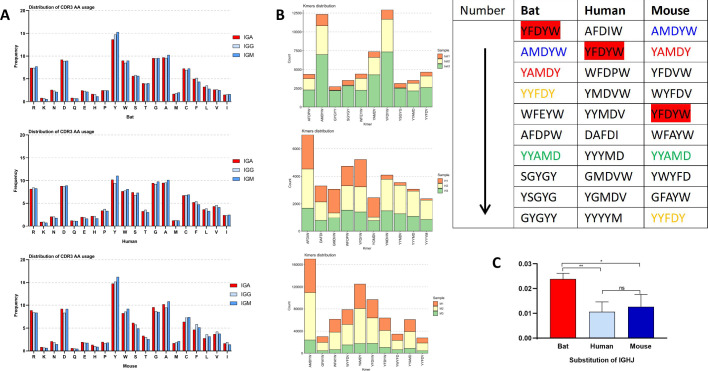
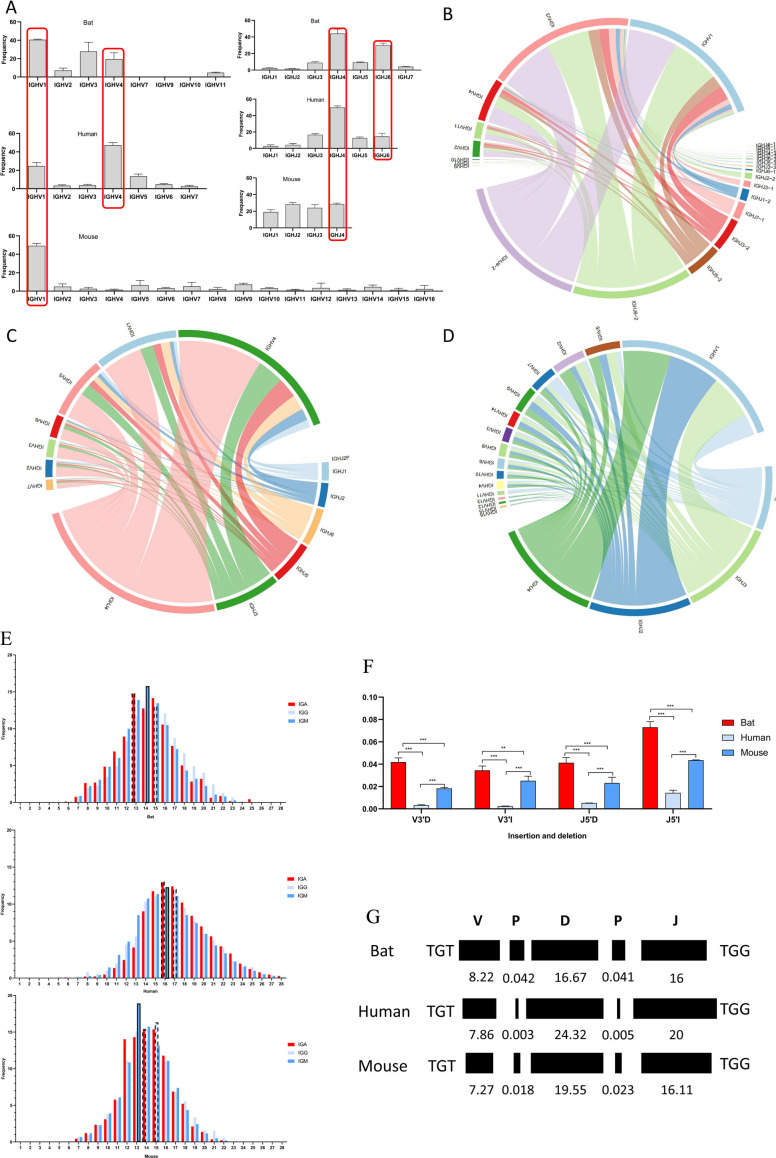
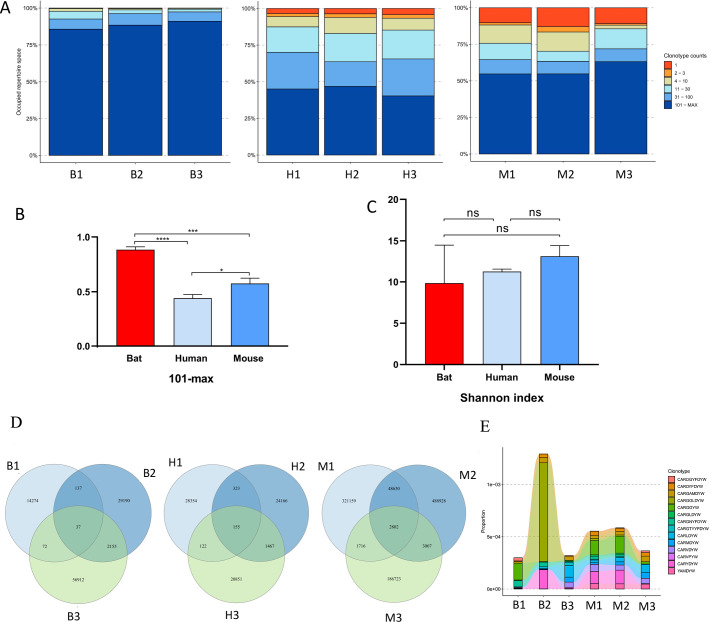
The emergence and re-emergence of abundant viruses from bats that impact human and animal health have resulted in a resurgence of interest in bat immunology. Characterizing the immune receptor repertoire is critical to understanding how bats coexist with viruses in the absence of disease and developing new therapeutics to target viruses in humans and susceptible livestock. In this study, IGH germline genes of Chiroptera including , and were annotated, and we profiled the characteristics of (RA) IGH CDR3 repertoire. The germline genes of Chiroptera are quite different from those of human, mouse, cow, and dog in evolution, but the three bat species have high homology. The CDR3 repertoire of RA is unique in many aspects including CDR3 subclass, V/J genes access and pairing, CDR3 clones, and somatic high-frequency mutation compared with that of human and mouse, which is an important point in understanding the asymptomatic nature of viral infection in bats. This study unveiled a detailed map of bat IGH germline genes on chromosome level and provided the first immune receptor repertoire of bat, which will stimulate new avenues of research that are directly relevant to human health and disease.IMPORTANCEThe intricate relationship between bats and viruses has been a subject of study since the mid-20th century, with more than 100 viruses identified, including those affecting humans. While preliminary investigations have outlined the innate immune responses of bats, the role of adaptive immunity remains unclear. This study presents a pioneering contribution to bat immunology by unveiling, for the first time, a detailed map of bat IGH germline genes at the chromosome level. This breakthrough not only provides a foundation for B cell receptor research in bats but also contributes to primer design and sequencing of the CDR3 repertoire. Additionally, we offer the first comprehensive immune receptor repertoire of bats, serving as a crucial library for future comparative analyses. In summary, this research significantly advances the understanding of bats' immune responses, providing essential resources for further investigations into viral tolerance and potential zoonotic threats.
蝙蝠中大量影响人类和动物健康的病毒的出现和再现,导致人们对蝙蝠免疫学重新产生兴趣。描述免疫受体库对于了解蝙蝠如何在没有疾病的情况下与病毒共存以及开发针对人类和易感牲畜中病毒的新疗法至关重要。在这项研究中,我注释了包括 、 和 在内的 Chiroptera 的 IGH 胚系基因,并对 RA 的 IGH CDR3 库的特征进行了分析。Chiroptera 的胚系基因在进化上与人类、小鼠、牛和狗有很大的不同,但这三个蝙蝠物种具有很高的同源性。与人类和小鼠相比,RA 的 CDR3 库在 CDR3 亚类、V/J 基因的访问和配对、CDR3 克隆和体细胞高频突变等方面具有独特性,这是理解蝙蝠中病毒感染无症状性质的一个重要方面。这项研究揭示了蝙蝠 IGH 胚系基因在染色体水平上的详细图谱,并提供了蝙蝠的第一个免疫受体库,这将激发与人类健康和疾病直接相关的新研究途径。
重要性:蝙蝠与病毒之间的复杂关系自 20 世纪中叶以来一直是研究的主题,已经确定了 100 多种病毒,包括影响人类的病毒。虽然初步研究概述了蝙蝠的先天免疫反应,但适应性免疫的作用仍不清楚。这项研究首次在染色体水平上揭示了蝙蝠 IGH 胚系基因的详细图谱,为蝙蝠免疫学做出了开创性的贡献。这一突破不仅为蝙蝠 B 细胞受体研究奠定了基础,还为 CDR3 库的引物设计和测序提供了帮助。此外,我们还提供了蝙蝠的第一个全面免疫受体库,作为未来比较分析的重要资源。总之,这项研究极大地促进了对蝙蝠免疫反应的理解,为进一步研究病毒耐受性和潜在的人畜共患病威胁提供了重要资源。