Komata Shinya, Lin Chung-Ping, Fujiwara Haruhiko
Department of Integrated Biosciences, Graduate School of Frontier Sciences, The University of Tokyo, Kashiwa, Japan.
Department of Life Science, National Taiwan Normal University, Taipei, Taiwan.
Front Insect Sci. 2022 Jul 12;2:929518. doi: 10.3389/finsc.2022.929518. eCollection 2022.
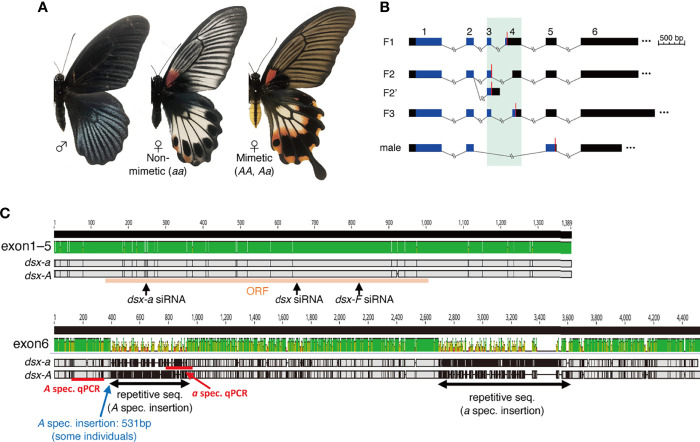
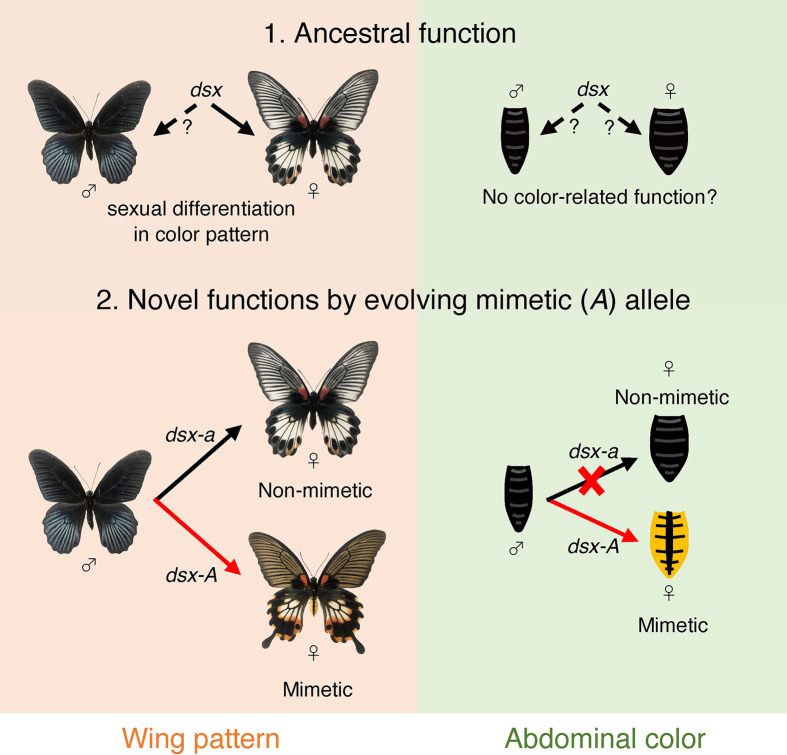
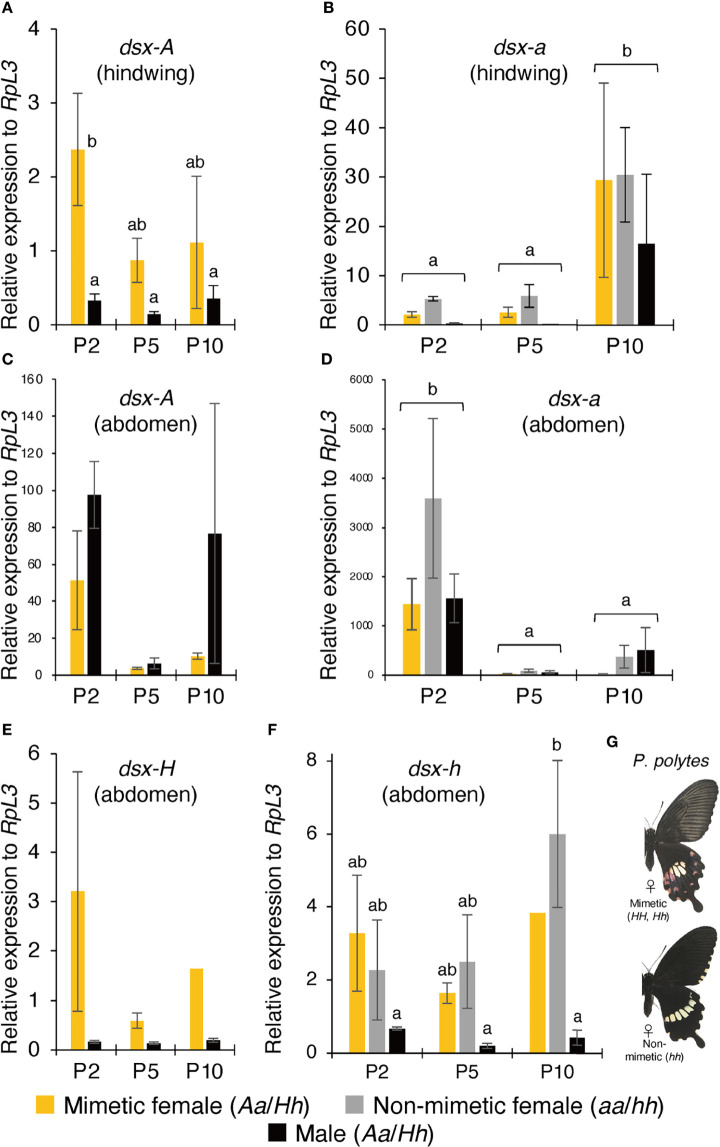
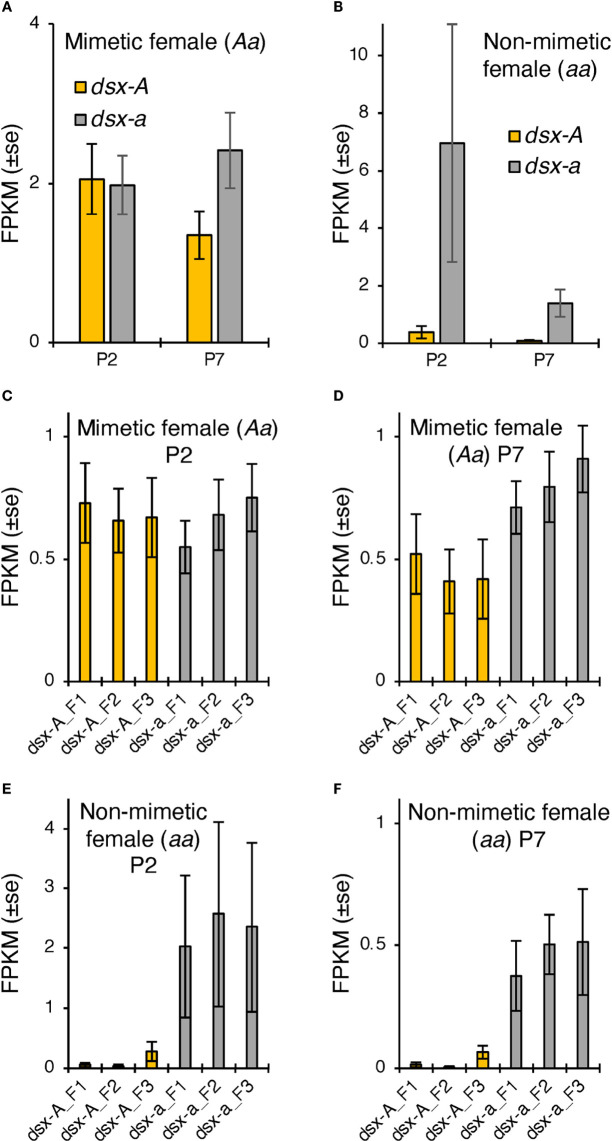
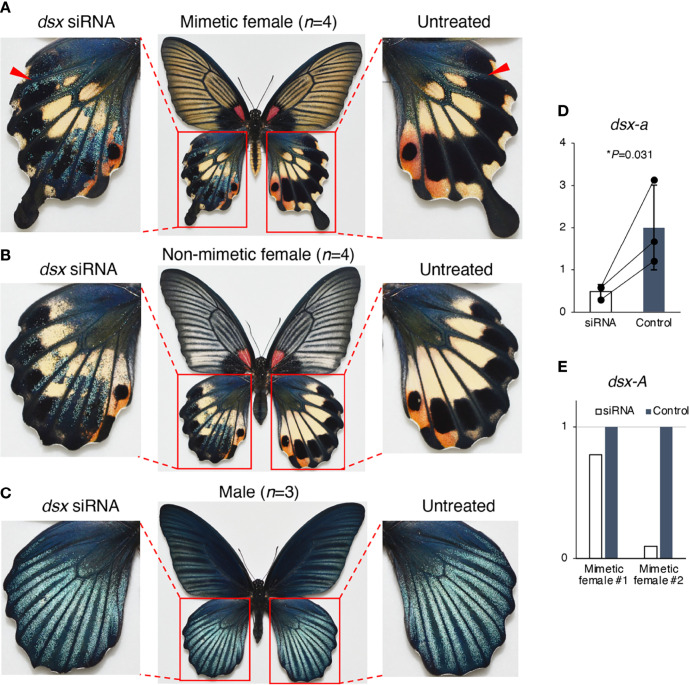
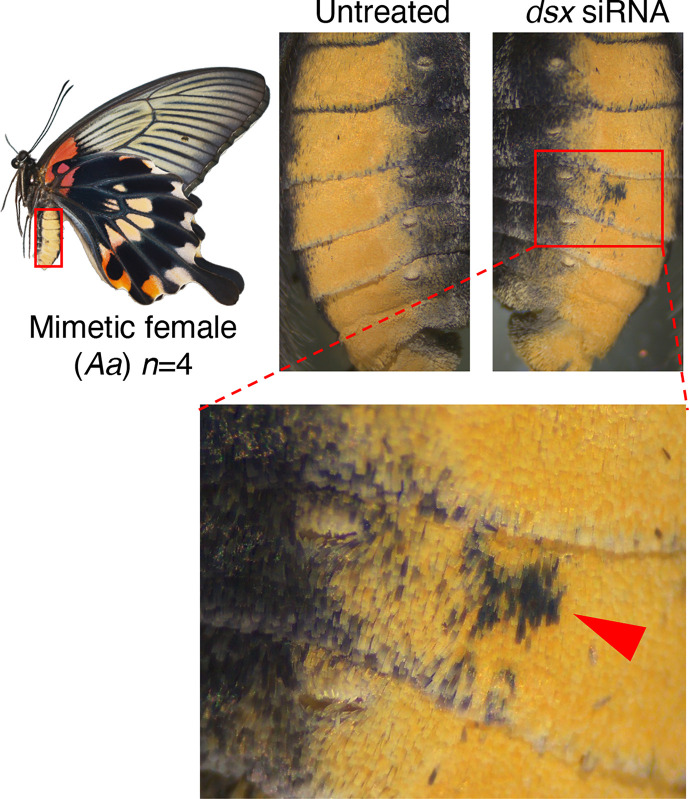
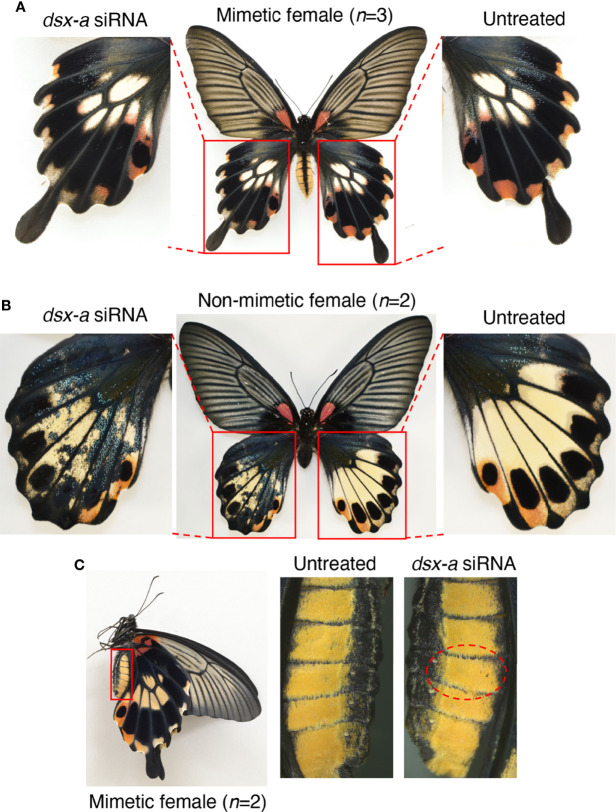
butterflies are known to possess female-limited Batesian mimicry polymorphisms. In , females have mimetic and non-mimetic forms, whereas males are monomorphic and non-mimetic. Mimetic females are characterized by color patterns and tails in the hindwing and yellow abdomens. Recently, an analysis of whole-genome sequences has shown that an approximately 160 kb region of chromosome 25 is responsible for mimicry and has high diversity between mimetic () and non-mimetic () alleles (highly diversified region: HDR). The HDR includes three genes, , (), and , but the functions of these genes are unknown. Here, we investigated the function of , a gene involved in sexual differentiation, which is expected to be functionally important for hindwing and abdominal mimetic traits in . . Expression analysis by reverse transcription quantitative PCR (RT-qPCR) and RNA sequencing showed that mimetic () was highly expressed in the hindwings in the early pupal stage. In the abdomen, both and were highly expressed during the early pupal stage. When was knocked down using small interfering RNAs (siRNAs) designed in the common region of and , a male-like pattern appeared on the hindwings of mimetic and non-mimetic females. Similarly, when was knocked down in the abdomen, the yellow scales characteristic of mimetic females changed to black. Furthermore, when was specifically knocked down, the color pattern of the hindwings changed, as in the case of knockdown in non-mimetic females but not mimetic females. These results suggest that is involved in color pattern formation on the hindwings of non-mimetic females, whereas is involved in hindwing and abdominal mimetic traits. was involved in abdominal and hindwing mimetic traits, but expression patterns in the hindwing and abdomen were different, suggesting that different regulatory mechanisms may exist. Our study is the first to show that the same gene () regulates both the hindwing and abdominal mimetic traits. This is the first functional analysis of abdominal mimicry in butterflies.
已知蝴蝶具有雌性特有的贝氏拟态多态性。在[某种蝴蝶]中,雌性有拟态和非拟态两种形态,而雄性则是单态且非拟态的。拟态雌性的特征是后翅上有颜色图案和尾突以及黄色腹部。最近,全基因组序列分析表明,25号染色体上一个约160 kb的区域负责拟态,并且在拟态([某种蝴蝶])和非拟态([另一种蝴蝶])等位基因之间具有高度多样性(高度多样化区域:HDR)。该HDR包含三个基因,[基因名称1]、[基因名称2]([基因名称2的别名])和[基因名称3],但这些基因的功能尚不清楚。在这里,我们研究了[基因名称1]的功能,该基因参与性别分化,预计对[某种蝴蝶]的后翅和腹部拟态特征具有重要功能。通过逆转录定量PCR(RT-qPCR)和RNA测序进行的表达分析表明,拟态[某种蝴蝶]在蛹早期后翅中高表达。在腹部,[基因名称1]和[基因名称2]在蛹早期均高表达。当使用在[基因名称1]和[基因名称2]的共同区域设计的小干扰RNA(siRNA)敲低[基因名称1]时,拟态和非拟态雌性的后翅上出现了类似雄性的图案。同样,当在腹部敲低[基因名称1]时,拟态雌性特有的黄色鳞片变成了黑色。此外,当特异性敲低[基因名称2]时,后翅的颜色图案发生了变化,就像在非拟态雌性中敲低[基因名称1]的情况一样,但在拟态雌性中没有。这些结果表明,[基因名称1]参与非拟态雌性后翅颜色图案的形成,而[基因名称2]参与后翅和腹部拟态特征。[基因名称3]参与腹部和后翅拟态特征,但在后翅和腹部的表达模式不同,这表明可能存在不同的调控机制。我们的研究首次表明,同一个基因([基因名称1])调节后翅和腹部拟态特征。这是蝴蝶腹部拟态的首次功能分析。