Department of Laboratory Medicine, Chonnam National University Hwasun Hospital, Hwasun 58128, Republic of Korea.
Health Promotion Research Institute, Korea Association of Health Promotion, Seoul 07572, Republic of Korea.
Nutrients. 2024 Feb 22;16(5):604. doi: 10.3390/nu16050604.
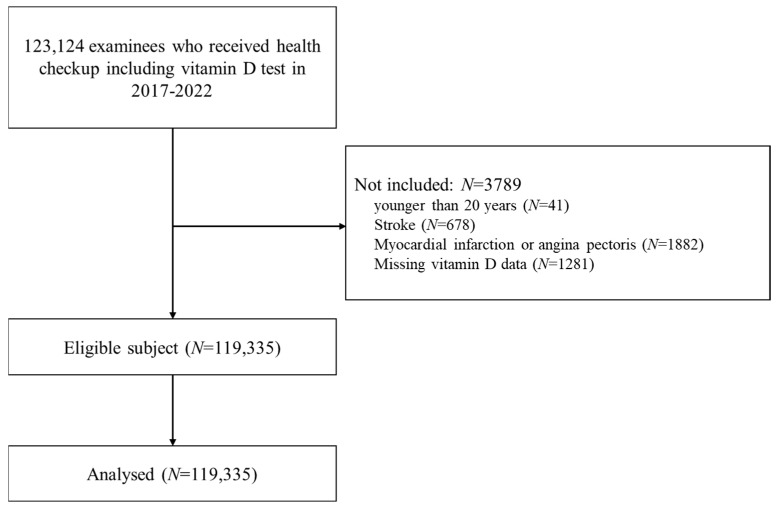
This study aimed to describe the latest 25-hydroxyvitamin D (25(OH)D) status of the South Korean population aged ≥ 20 years using 25(OH)D concentrations measured by liquid chromatography-tandem mass spectrometry and to determine the factors associated with total 25(OH)D concentrations. This cross-sectional, retrospective study consecutively selected 119,335 subjects with a median age of 57 (20-101) years who underwent health checkups among 13 Korean cities during 2017-2022. The total 25(OH)D concentration was 54.5 ± 24.0 nmol/L (mean ± SD). The 7.6%, 47.5%, and 82.9% of participants had 25(OH)D less than 25, 50, and 75 nmol/L, respectively. The prevalence of 25(OH)D deficiency (<25 nmol/L) was higher in females than in males (8.9% vs. 6.1%) and varied between age groups, decreasing in older subjects. Those aged 20-29 years had the highest prevalence of 25(OH)D deficiency (23.0% in females and 20.1% in males), which also varied between cities. In the adjusted model, female sex, older age, summer and autumn seasons, lower body mass index (<25 kg/m), and lower high-sensitivity C-reactive protein concentration (<1 mg/L) were associated with higher total 25(OH)D concentrations. This study could provide an exact understanding of the status of vitamin D and help devise strategies to prevent vitamin D deficiency among the Korean population.
本研究旨在使用液相色谱-串联质谱法测定的 25-羟维生素 D(25(OH)D)浓度描述韩国≥20 岁人群的最新 25(OH)D 状况,并确定与总 25(OH)D 浓度相关的因素。这是一项横断面、回顾性研究,连续选择了 2017-2022 年间韩国 13 个城市进行健康检查的 119335 名中位年龄为 57(20-101)岁的受试者。总 25(OH)D 浓度为 54.5±24.0nmol/L(平均值±标准差)。7.6%、47.5%和 82.9%的参与者的 25(OH)D 分别低于 25、50 和 75nmol/L。女性的 25(OH)D 缺乏症(<25nmol/L)患病率高于男性(8.9%比 6.1%),且在不同年龄组之间存在差异,随着年龄的增长而降低。20-29 岁年龄组女性和男性的 25(OH)D 缺乏症患病率最高(分别为 23.0%和 20.1%),不同城市之间也存在差异。在调整后的模型中,女性、年龄较大、夏季和秋季、较低的体重指数(<25kg/m)和较低的高敏 C 反应蛋白浓度(<1mg/L)与较高的总 25(OH)D 浓度相关。本研究可以更准确地了解维生素 D 的状况,并有助于制定预防韩国人群维生素 D 缺乏的策略。