Department of Gynecology, The Second Affiliated Hospital, Zhejiang University School of Medicine, Zhejiang University, Hangzhou, 310009, People's Republic of China.
Zhejiang Provincial Clinical Research Center for Obstetrics and Gynecology, Hangzhou, China.
Cell Commun Signal. 2024 Mar 12;22(1):179. doi: 10.1186/s12964-024-01562-5.
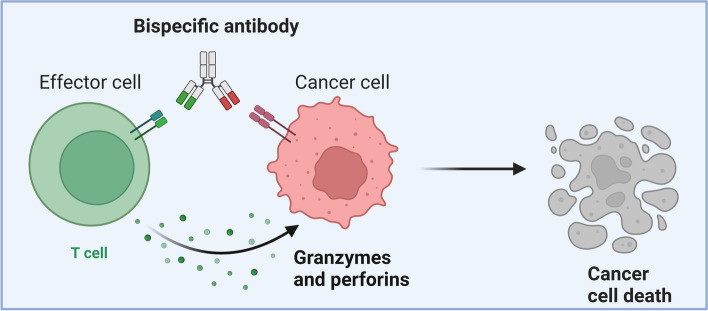
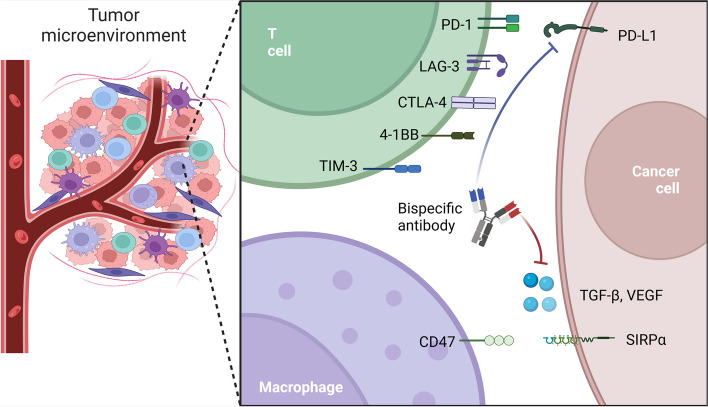
The programmed cell death 1 (PD-1) signaling pathway, a key player in immune checkpoint regulation, has become a focal point in cancer immunotherapy. In the context of cancer, upregulated PD-L1 on tumor cells can result in T cell exhaustion and immune evasion, fostering tumor progression. The advent of PD-1/PD-L1 inhibitor has demonstrated clinical success by unleashing T cells from exhaustion. Nevertheless, challenges such as resistance and adverse effects have spurred the exploration of innovative strategies, with bispecific antibodies (BsAbs) emerging as a promising frontier. BsAbs offer a multifaceted approach to cancer immunotherapy by simultaneously targeting PD-L1 and other immune regulatory molecules. We focus on recent advancements in PD-1/PD-L1 therapy with a particular emphasis on the development and potential of BsAbs, especially in the context of solid tumors. Various BsAb products targeting PD-1 signaling are discussed, highlighting their unique mechanisms of action and therapeutic potential. Noteworthy examples include anti-TGFβ × PD-L1, anti-CD47 × PD-L1, anti-VEGF × PD-L1, anti-4-1BB × PD-L1, anti-LAG-3 × PD-L1, and anti-PD-1 × CTLA-4 BsAbs. Besides, we summarize ongoing clinical studies evaluating the efficacy and safety of these innovative BsAb agents. By unraveling the intricacies of the tumor microenvironment and harnessing the synergistic effects of anti-PD-1/PD-L1 BsAbs, there exists the potential to elevate the precision and efficacy of cancer immunotherapy, ultimately enabling the development of personalized treatment strategies tailored to individual patient profiles.
程序性细胞死亡 1(PD-1)信号通路是免疫检查点调节的关键因素,已成为癌症免疫治疗的焦点。在癌症中,肿瘤细胞上上调的 PD-L1 可导致 T 细胞衰竭和免疫逃逸,促进肿瘤进展。PD-1/PD-L1 抑制剂的出现通过使 T 细胞从衰竭中释放出来,已经证明了临床成功。然而,耐药性和不良反应等挑战促使人们探索创新策略,双特异性抗体(BsAbs)作为一个有前途的前沿领域出现了。BsAbs 通过同时靶向 PD-L1 和其他免疫调节分子,为癌症免疫治疗提供了一种多方面的方法。我们专注于 PD-1/PD-L1 治疗的最新进展,特别强调了 BsAbs 的开发和潜力,尤其是在实体瘤方面。讨论了针对 PD-1 信号的各种 BsAb 产品,强调了它们独特的作用机制和治疗潜力。值得注意的例子包括抗 TGFβ×PD-L1、抗 CD47×PD-L1、抗 VEGF×PD-L1、抗 4-1BB×PD-L1、抗 LAG-3×PD-L1 和抗 PD-1×CTLA-4 BsAbs。此外,我们总结了正在进行的临床研究,评估这些创新 BsAb 药物的疗效和安全性。通过揭示肿瘤微环境的复杂性并利用抗 PD-1/PD-L1 BsAbs 的协同效应,有可能提高癌症免疫治疗的精度和疗效,最终实现针对个体患者特征的个性化治疗策略的开发。