Department of Operating room, The First Affiliated Hospital, Zhejiang University School of Medicine, Hangzhou, 310003, China.
Department of Orthopedic Surgery, The First Affiliated Hospital, Zhejiang University School of Medicine, Hangzhou, 310003, China.
Stem Cell Res Ther. 2024 Mar 13;15(1):75. doi: 10.1186/s13287-024-03680-w.
Annulus fibrosis (AF) defects have been identified as the primary cause of disc herniation relapse and subsequent disc degeneration following discectomy. Stem cell-based tissue engineering offers a promising approach for structural repair. Menstrual blood-derived mesenchymal stem cells (MenSCs), a type of adult stem cell, have gained attention as an appealing source for clinical applications due to their potential for structure regeneration, with ease of acquisition and regardless of ethical issues.
The differential potential of MenSCs cocultured with AF cells was examined by the expression of collagen I, SCX, and CD146 using immunofluorescence. Western blot and ELISA were used to examine the expression of TGF-β and IGF-I in coculture system. An AF defect animal model was established in tail disc of Sprague-Dawley rats (males, 8 weeks old). An injectable gel containing MenSCs (about 1*10/ml) was fabricated and transplanted into the AF defects immediately after the animal model establishment, to evaluate its repairment properties. Disc degeneration was assessed via magnetic resonance (MR) imaging and histological staining. Immunohistochemical analysis was performed to assess the expression of aggrecan, MMP13, TGF-β and IGF-I in discs with different treatments. Apoptosis in the discs was evaluated using TUNEL, caspase3, and caspase 8 immunofluorescence staining.
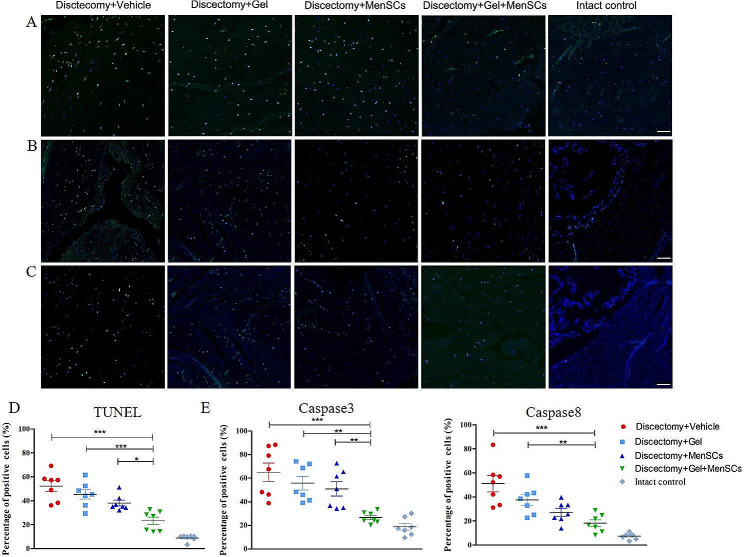
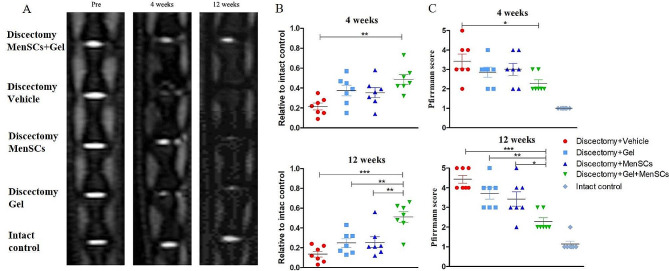
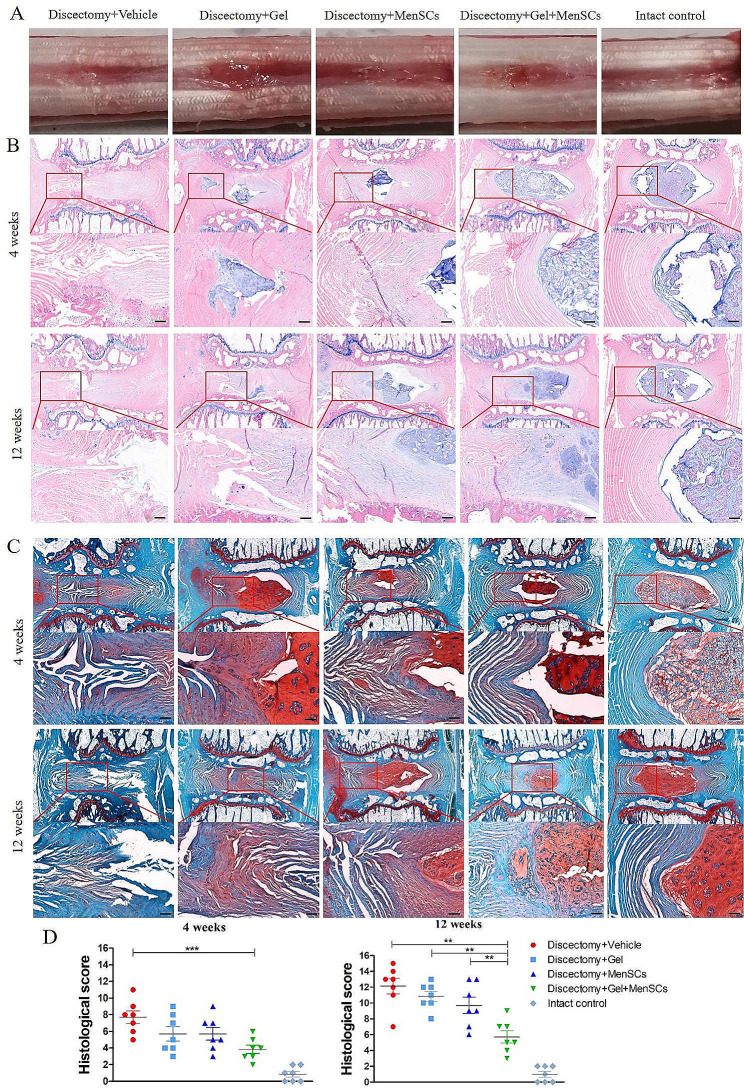
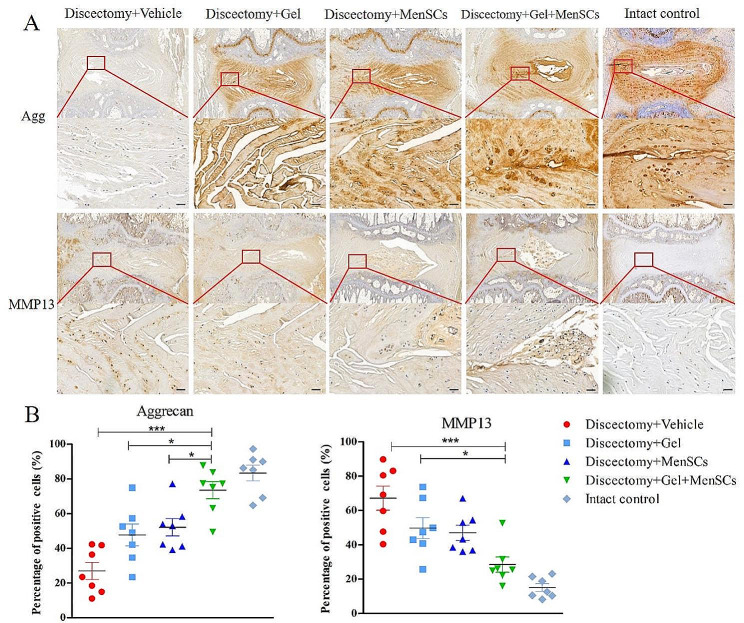
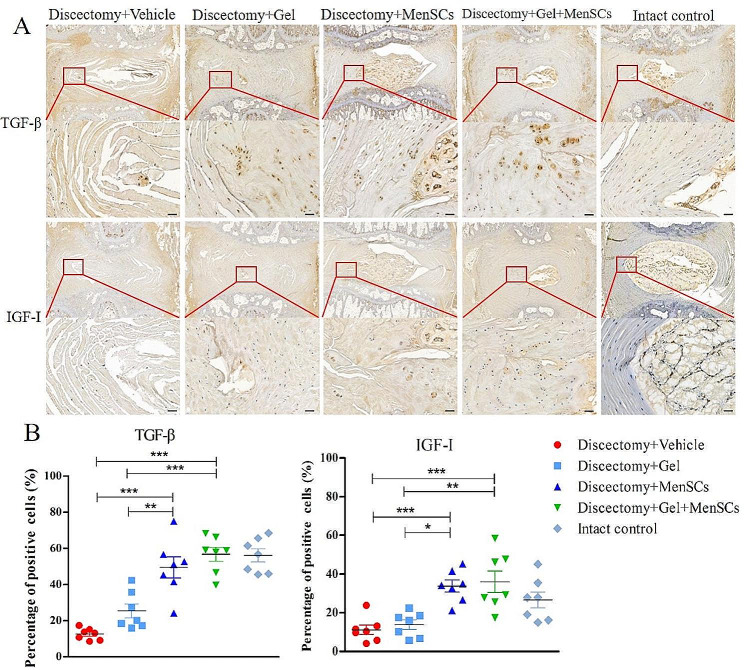
Coculturing MenSCs with AF cells demonstrated ability to express collagen I and biomarkers of AF cells. Moreover, the coculture system presented upregulation of the growth factors TGF-β and IGF-I. After 12 weeks, discs treated with MenSCs gel exhibited significantly lower Pffirrmann scores (2.29 ± 0.18), compared to discs treated with MenSCs (3.43 ± 0.37, p < 0.05) or gel (3.71 ± 0.29, p < 0.01) alone. There is significant higher MR index in disc treated with MenSCs gel than that treated with MenSCs (0.51 ± 0.05 vs. 0.24 ± 0.04, p < 0.01) or gel (0.51 ± 0.05 vs. 0.26 ± 0.06, p < 0.01) alone. Additionally, MenSCs gel demonstrated preservation of the structure of degenerated discs, as indicated by histological scoring (5.43 ± 0.43 vs. 9.71 ± 1.04 in MenSCs group and 10.86 ± 0.63 in gel group, both p < 0.01), increased aggrecan expression, and decreased MMP13 expression in vivo. Furthermore, the percentage of TUNEL and caspase 3-positive cells in the disc treated with MenSCs Gel was significantly lower than those treated with gel alone and MenSCs alone. The expression of TGF-β and IGF-I was higher in discs treated with MenSCs gel or MenSCs alone than in those treated with gel alone.
MenSCs embedded in collagen I gel has the potential to preserve the disc structure and prevent disc degeneration after discectomy, which was probably attributed to the paracrine of growth factors of MenSCs.
纤维环(AF)缺陷已被确定为椎间盘切除术后椎间盘复发和随后椎间盘退变的主要原因。基于干细胞的组织工程为结构修复提供了一种很有前途的方法。间充质干细胞(MenSCs)来源于月经血,是一种成体干细胞,由于其具有结构再生的潜力,易于获取,且不存在伦理问题,因此作为一种有吸引力的临床应用来源而受到关注。
通过免疫荧光检测 MenSCs 与 AF 细胞共培养后胶原蛋白 I、SCX 和 CD146 的表达情况。Western blot 和 ELISA 检测共培养系统中 TGF-β和 IGF-I 的表达。在 Sprague-Dawley 大鼠(雄性,8 周龄)尾椎间盘建立 AF 缺陷动物模型。建立动物模型后,立即将含有 MenSCs(约 1*10/ml)的可注射凝胶注入 AF 缺陷部位,以评估其修复性能。通过磁共振(MR)成像和组织学染色评估椎间盘退变。采用免疫组织化学分析评估不同处理的椎间盘内聚集蛋白聚糖、MMP13、TGF-β和 IGF-I 的表达。采用 TUNEL、caspase3 和 caspase 8 免疫荧光染色评估椎间盘细胞凋亡。
MenSCs 与 AF 细胞共培养后,能够表达胶原蛋白 I 和 AF 细胞标志物。此外,共培养系统中生长因子 TGF-β和 IGF-I 的表达上调。12 周后,与单独用 MenSCs(3.43±0.37,p<0.05)或凝胶(3.71±0.29,p<0.01)处理的椎间盘相比,用 MenSCs 凝胶处理的椎间盘的 Pffirrmann 评分(2.29±0.18)显著降低。与单独用 MenSCs(0.51±0.05 vs. 0.24±0.04,p<0.01)或凝胶(0.51±0.05 vs. 0.26±0.06,p<0.01)处理的椎间盘相比,用 MenSCs 凝胶处理的椎间盘的 MR 指数显著升高。此外,MenSCs 凝胶处理的椎间盘的结构保存较好,组织学评分(MenSCs 组 5.43±0.43,凝胶组 10.86±0.63,均 p<0.01),体内聚集蛋白聚糖表达增加,MMP13 表达减少。此外,用 MenSCs 凝胶处理的椎间盘的 TUNEL 和 caspase 3 阳性细胞百分比明显低于单独用凝胶和 MenSCs 处理的椎间盘。与单独用凝胶处理的椎间盘相比,用 MenSCs 凝胶或单独用 MenSCs 处理的椎间盘 TGF-β和 IGF-I 的表达水平更高。
胶原 I 凝胶中嵌入的 MenSCs 具有在椎间盘切除术后保持椎间盘结构和预防椎间盘退变的潜力,这可能归因于 MenSCs 的旁分泌生长因子。