Gil-Fuster Elies, Eisert Jens, Bravo-Prieto Carlos
Dahlem Center for Complex Quantum Systems, Freie Universität Berlin, Berlin, Germany.
Fraunhofer Heinrich Hertz Institute, Berlin, Germany.
Nat Commun. 2024 Mar 13;15(1):2277. doi: 10.1038/s41467-024-45882-z.
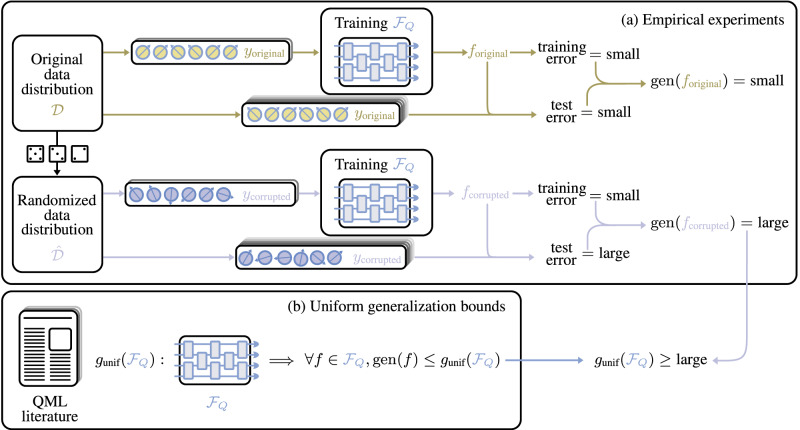
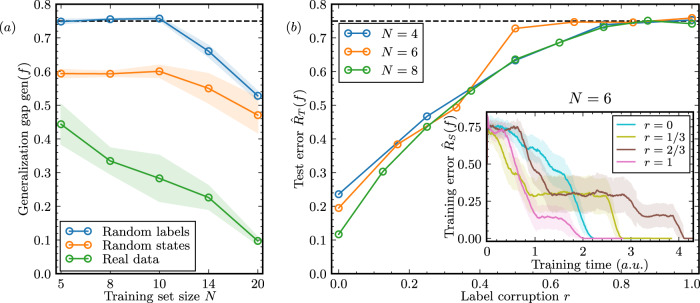
Quantum machine learning models have shown successful generalization performance even when trained with few data. In this work, through systematic randomization experiments, we show that traditional approaches to understanding generalization fail to explain the behavior of such quantum models. Our experiments reveal that state-of-the-art quantum neural networks accurately fit random states and random labeling of training data. This ability to memorize random data defies current notions of small generalization error, problematizing approaches that build on complexity measures such as the VC dimension, the Rademacher complexity, and all their uniform relatives. We complement our empirical results with a theoretical construction showing that quantum neural networks can fit arbitrary labels to quantum states, hinting at their memorization ability. Our results do not preclude the possibility of good generalization with few training data but rather rule out any possible guarantees based only on the properties of the model family. These findings expose a fundamental challenge in the conventional understanding of generalization in quantum machine learning and highlight the need for a paradigm shift in the study of quantum models for machine learning tasks.
量子机器学习模型即使在使用少量数据进行训练时也表现出了成功的泛化性能。在这项工作中,通过系统的随机化实验,我们表明传统的理解泛化的方法无法解释此类量子模型的行为。我们的实验表明,先进的量子神经网络能够准确地拟合训练数据的随机状态和随机标签。这种记忆随机数据的能力与当前关于小泛化误差的概念相悖,使基于诸如VC维、拉德马赫复杂度及其所有均匀相关量等复杂度度量的方法陷入困境。我们用一个理论构造来补充我们的实证结果,该构造表明量子神经网络可以将任意标签拟合到量子态,这暗示了它们的记忆能力。我们的结果并不排除使用少量训练数据进行良好泛化的可能性,而是排除了仅基于模型族属性的任何可能保证。这些发现揭示了传统量子机器学习泛化理解中的一个基本挑战,并突出了在机器学习任务的量子模型研究中进行范式转变的必要性。