Yan Shichang, Ji Qipei, Ding Jilin, Liu Zhixiang, Wei Wei, Li Huaqiang, Li Luojie, Ma Chuan, Liao Defu, He Ziyan, Ai Shuangchun
School of Health and Rehabilitation, Chengdu University of Traditional Chinese Medicine, Chengdu, China.
Department of Rehabilitation, Mianyang Hospital of Traditional Chinese Medicine, Mianyang, China.
Front Neurosci. 2024 Feb 29;18:1304906. doi: 10.3389/fnins.2024.1304906. eCollection 2024.
Cerebral ischaemic stroke is a common disease that poses a serious threat to human health. Butyrate is an important metabolite of intestinal microorganisms. Recent studies have shown that butyrate has a significant protective effect in animal models of cerebral ischaemic injury.
The aim of this study was to evaluate the protective effect of butyrate on cerebral ischaemic stroke by meta-analysis, aiming to provide a scientific basis for the clinical application of butyrate in patients with cerebral ischaemia.
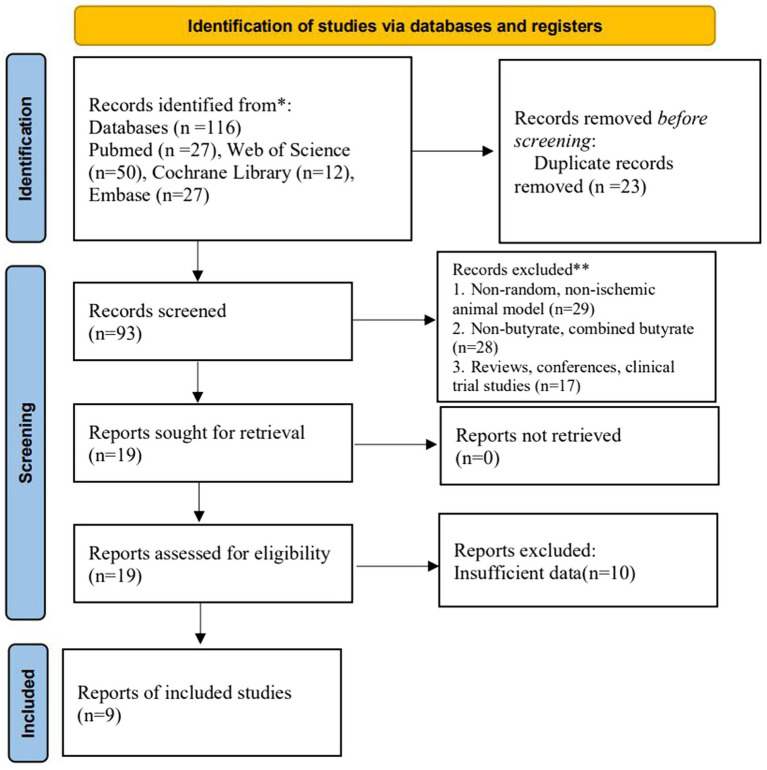
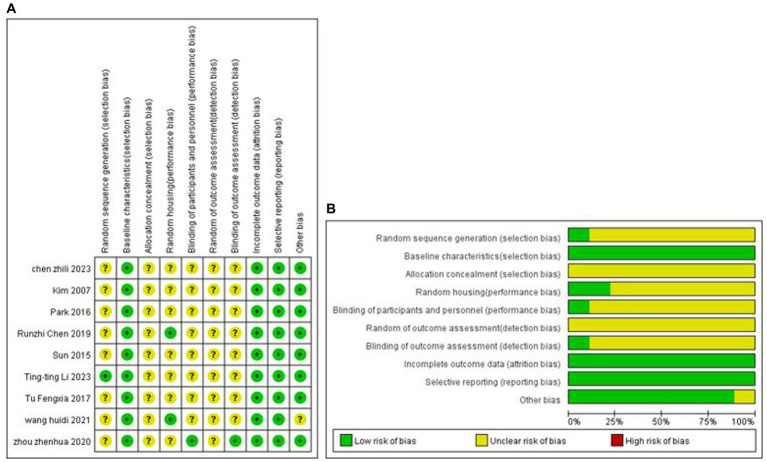
A systematic search was conducted for all relevant studies published before 23 January 2024, in PubMed, Web of Science, Cochrane Library, and Embase. Methodological quality was assessed using Syrcle's risk of bias tool for animal studies. Data were analysed using Rev Man 5.3 software.
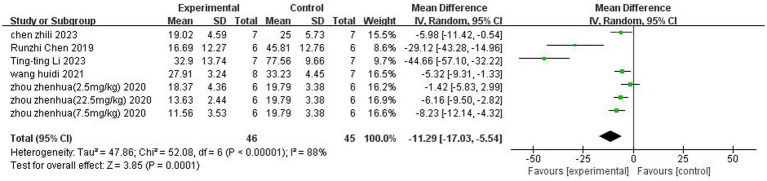
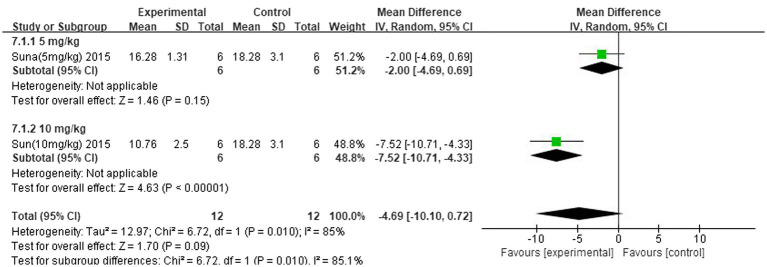
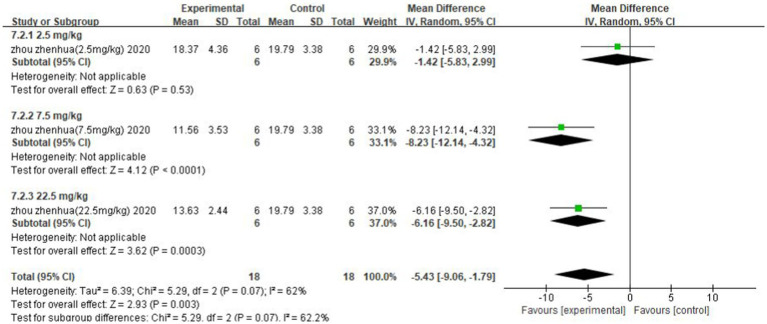
A total of nine studies were included, and compared with controls, butyrate significantly increased BDNF levels in the brain (SMD = 2.33, 95%CI = [1.20, 3.47], < 0.005) and P-Akt expression (SMD = 3.53, 95% CI = [0.97, 6.10], < 0.05). Butyrate also decreased IL-β levels in the brain (SMD = -2.02, 95% CI = [-3.22, -0.81], < 0.005), TNF-α levels (SMD = -0.86, 95% CI = [-1.60, -0.12], < 0.05), and peripheral vascular IL-1β levels (SMD = -2.10, 95%CI = [-3.59, -0.61], < 0.05). In addition, butyrate reduced cerebral infarct volume (MD = -11.29, 95%CI = [-17.03, -5.54], < 0.05), mNSS score (MD = -2.86, 95%CI = [-4.12, -1.60], < 0.005), foot fault score (MD = -7.59, 95%CI = [-9.83, -5, 35], < 0.005), and Morris water maze time (SMD = -2.49, 95%CI = [-4.42, -0.55], < 0.05).
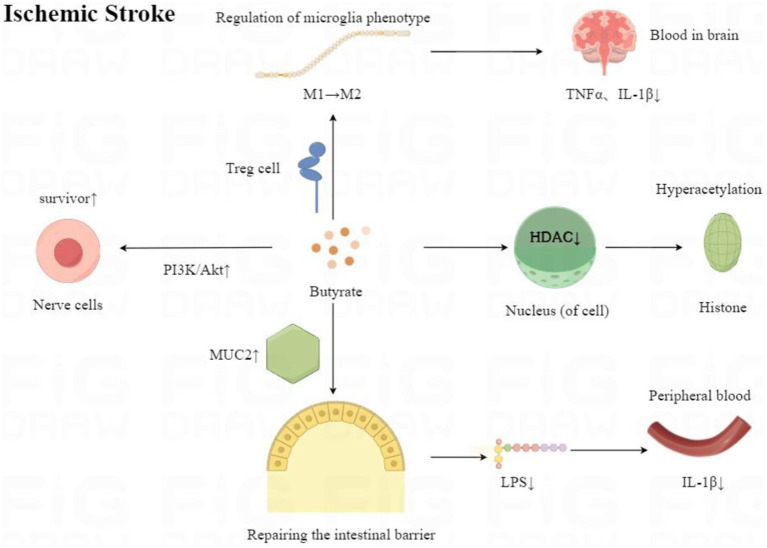
The results of this study indicate that butyrate has a protective effect on cerebral ischaemic stroke in animal models, and the mechanism is related to reducing inflammation and inhibiting apoptosis. It provides an evidence-based basis for the future clinical development of butyrate in the treatment of ischaemic stroke.
https://www.crd.york.ac.uk/PROSPERO/, CRD42023482844.
脑缺血性中风是一种对人类健康构成严重威胁的常见疾病。丁酸盐是肠道微生物的重要代谢产物。最近的研究表明,丁酸盐在脑缺血损伤动物模型中具有显著的保护作用。
本研究旨在通过荟萃分析评估丁酸盐对脑缺血性中风的保护作用,旨在为丁酸盐在脑缺血患者中的临床应用提供科学依据。
在PubMed、Web of Science、Cochrane图书馆和Embase中对2024年1月23日前发表的所有相关研究进行系统检索。使用Syrcle动物研究偏倚风险工具评估方法学质量。使用Rev Man 5.3软件进行数据分析。
共纳入9项研究,与对照组相比,丁酸盐显著提高了大脑中的脑源性神经营养因子(BDNF)水平(标准化均数差[SMD]=2.33,95%置信区间[CI]=[1.20, 3.47],P<0.005)和磷酸化蛋白激酶B(P-Akt)表达(SMD=3.53,95%CI=[0.97, 6.10],P<0.05)。丁酸盐还降低了大脑中的白细胞介素-β(IL-β)水平(SMD=-2.02,95%CI=[-3.22, -0.81],P<0.005)、肿瘤坏死因子-α(TNF-α)水平(SMD=-0.86,95%CI=[-1.60, -0.12],P<0.05)以及外周血管中的IL-1β水平(SMD=-2.10,95%CI=[-3.59, -0.61],P<0.05)。此外,丁酸盐减少了脑梗死体积(平均差[MD]=-11.29,95%CI=[-17.03, -5.54],P<0.05)、改良神经功能缺损评分(mNSS)(MD=-2.86,95%CI=[-4.12, -1.60],P<0.005)、足错误评分(MD=-7.59,95%CI=[-9.83, -5.35],P<0.005)以及莫里斯水迷宫时间(SMD=-2.49,95%CI=[-4.42, -0.55],P<0.05)。
本研究结果表明,丁酸盐对动物模型中的脑缺血性中风具有保护作用,其机制与减轻炎症和抑制细胞凋亡有关。它为丁酸盐未来在缺血性中风治疗中的临床开发提供了循证依据。