Wu Zhi-Guo, Huang Ying-Jie, Wang Tun-Yi, Deng Chu-Yu, Xu Zhi-Rui, Tang Chun-Zhi
Clinical Medical College of Acupuncture, Moxibustion and Rehabilitation, Guangzhou University of Chinese Medicine, Guangzhou, China.
Front Aging Neurosci. 2023 Mar 1;15:1110087. doi: 10.3389/fnagi.2023.1110087. eCollection 2023.
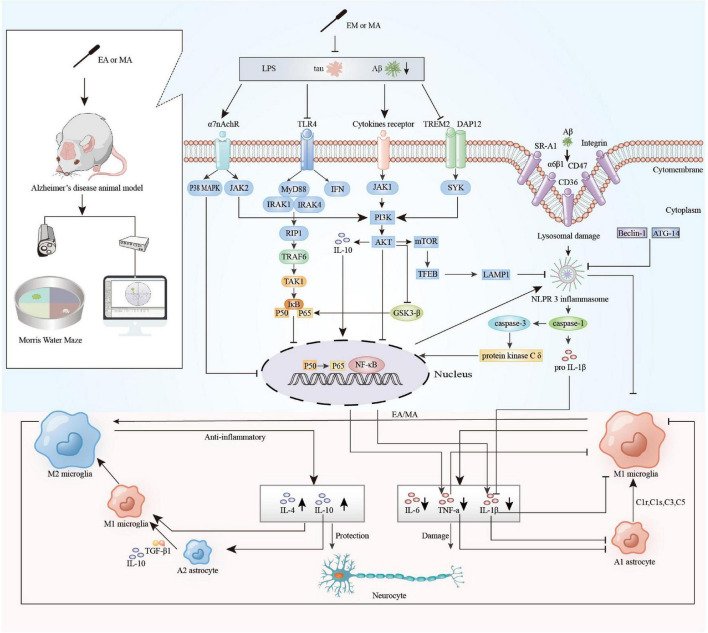
Despite neuroinflammation being an important component of the pathology of Alzheimer's disease (AD), effective therapies to alleviate neuroinflammation are still lacking. Many animal experiments in AD have found that acupuncture may ameliorate cognition by decreasing neuroinflammation and modulating cytokines, but its effects have not been systematically examined. We aimed to assess its efficacy on neuroinflammation in AD and to investigate the potential mechanisms.
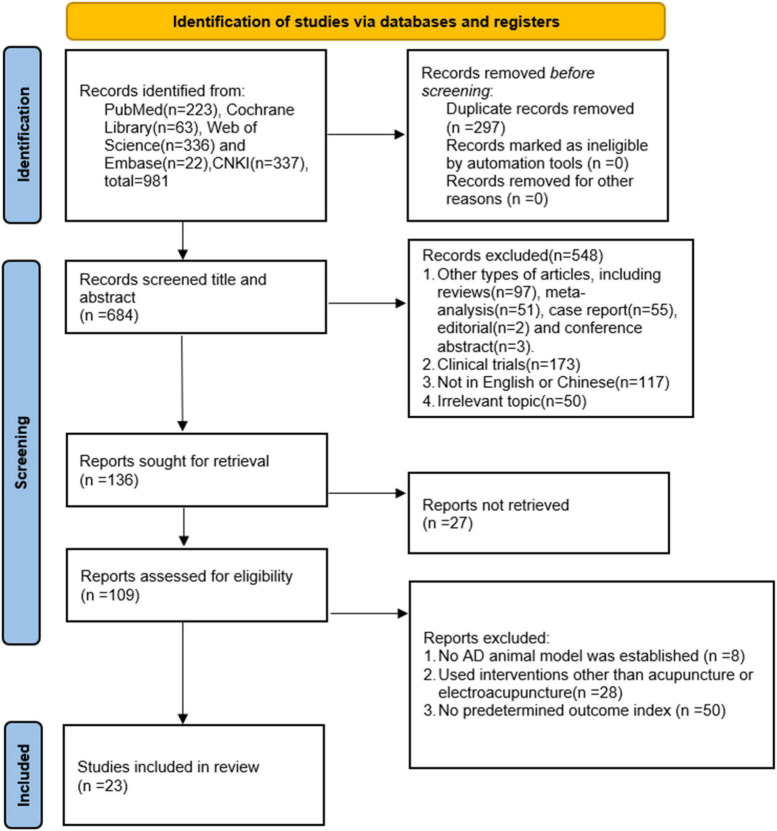
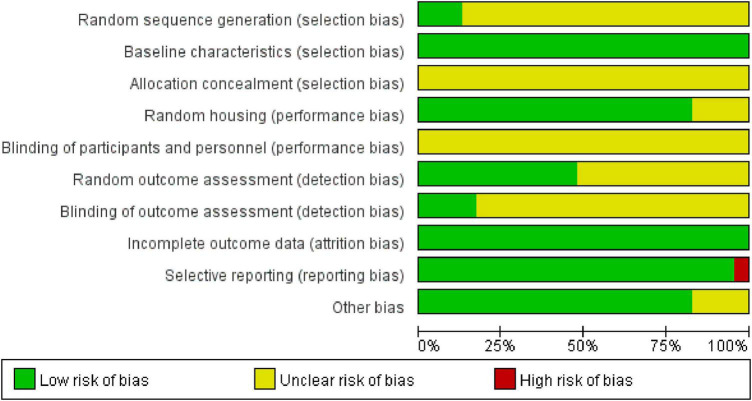
The following databases were searched from inception until 24 August 2022: Web of Science, EMBASE, PubMed, the Cochrane Library, and China National Knowledge Infrastructure. Animal studies that reported the efficacy of acupuncture on neuroinflammation in AD were included. The SYRCLE Robt was utilized to evaluate methodological quality. Stata 17 was utilized to conduct a meta-analysis of cytokine levels and the results of the Morris water maze.
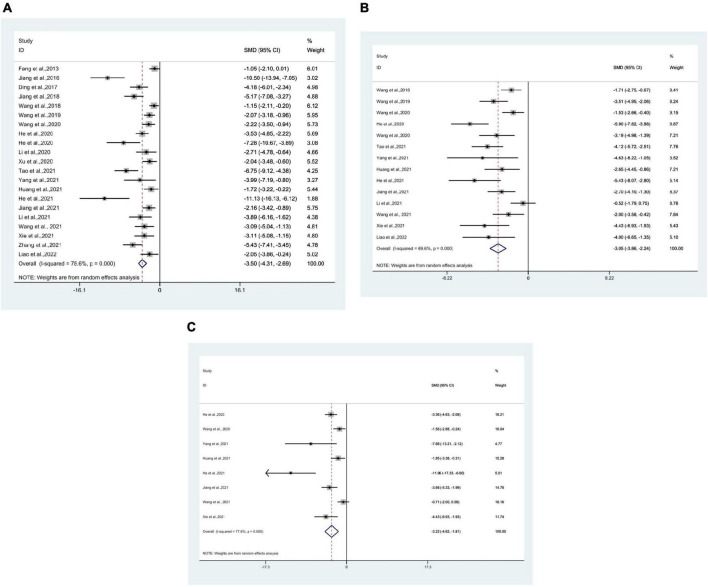
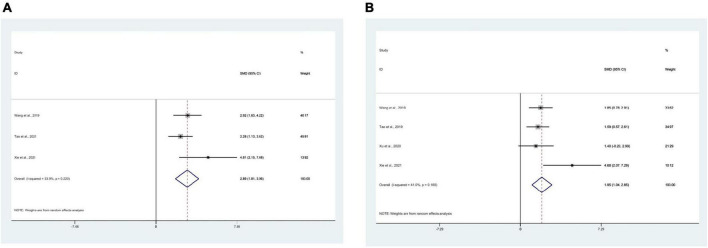
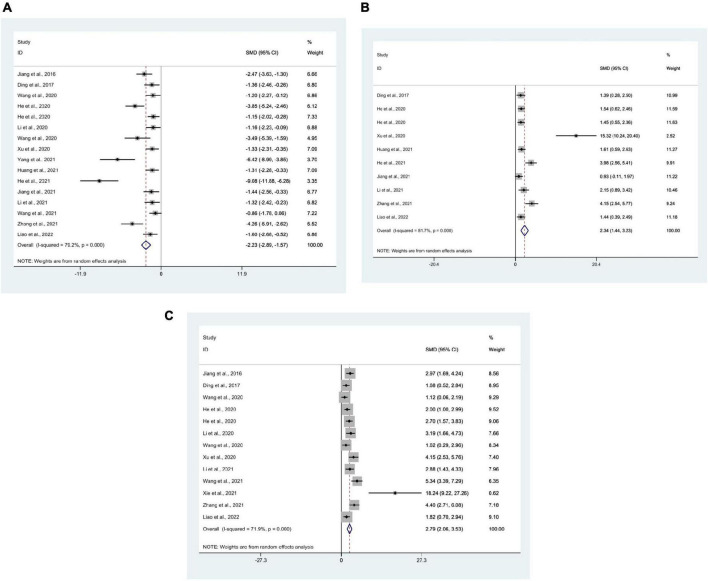
23 studies were included, with a total of 417 rats/mice. The overall quality of all included reports was medium. The results indicated that acupuncture significantly reduced the expressions of pro-inflammatory cytokines which included IL-1β [SMD = -3.50, 95% CI (-4.31, -2.69); = 78.6%] ( < 0.05), TNF-α [SMD = -3.05, 95% CI (-3.86, -2.24); = 69.6%] ( < 0.05), IL-6 [SMD = -3.22, 95% CI (-4.62, -1.81); = 77.6%] and enhanced the expressions of anti-inflammatory cytokines including IL-4 [SMD = 2.77, 95% CI (1.95, 3.59); = 33.9%] ( < 0.05), IL-10 [SMD = 1.84, 95% CI (1.20, 2.49); = 41.0%] ( < 0.05) in an animal model of AD. Regarding the Morris water maze, compared to the control group, the acupuncture group showed a shorter escape latency [SMD = -2.23, 95% CI (-2.89, -1.57); = 79.2%] ( < 0.05), longer duration in platform quadrant [SMD = 2.34, 95% CI (1.44, 3.23); = 81.7%] ( < 0.05), and increased platform crossing number [SMD = 2.79, 95% CI (2.06, 3.53); = 71.9%] ( < 0.05).
Acupuncture may reduce neuroinflammation in AD by modulating cytokine expression. This modulation significantly improved cognitive function in animal models of AD.
https://www.crd.york.ac.uk/PROSPERO/, identifier CRD42022354878.
尽管神经炎症是阿尔茨海默病(AD)病理的重要组成部分,但仍缺乏有效的缓解神经炎症的疗法。许多AD动物实验发现,针刺可能通过减轻神经炎症和调节细胞因子来改善认知,但尚未对其效果进行系统研究。我们旨在评估其对AD神经炎症的疗效,并探讨潜在机制。
检索了从建库至2022年8月24日的以下数据库:Web of Science、EMBASE、PubMed、Cochrane图书馆和中国知网。纳入报告针刺对AD神经炎症疗效的动物研究。采用SYRCLE Robt评估方法学质量。使用Stata 17对细胞因子水平和莫里斯水迷宫结果进行荟萃分析。
纳入23项研究,共417只大鼠/小鼠。所有纳入报告的总体质量为中等。结果表明,在AD动物模型中,针刺显著降低了促炎细胞因子的表达,包括IL-1β[标准化均数差(SMD)=-3.50,95%置信区间(CI)(-4.31,-2.69);I²=78.6%](P<0.05)、TNF-α[SMD=-3.05,95%CI(-3.86,-2.24);I²=69.6%](P<0.05)、IL-6[SMD=-3.22,95%CI(-4.62,-1.81);I²=77.6%],并增强了抗炎细胞因子的表达,包括IL-4[SMD=2.77,95%CI(1.95,3.59);I²=33.9%](P<0.05)、IL-10[SMD=1.84,95%CI(1.20,2.49);I²=41.0%](P<0.05)。关于莫里斯水迷宫,与对照组相比,针刺组的逃避潜伏期更短[SMD=-2.23,95%CI(-2.89,-1.57);I²=79.2%](P<0.05),在平台象限的停留时间更长[SMD=2.34,95%CI(1.44,3.23);I²=81.7%](P<0.05),穿越平台的次数增加[SMD=2.79,95%CI(2.06,3.53);I²=71.9%](P<0.05)。
针刺可能通过调节细胞因子表达减轻AD中的神经炎症。这种调节显著改善了AD动物模型的认知功能。