The Forsyth Institute, Cambridge, Massachusetts, USA.
Harvard School of Dental Medicine, Boston, Massachusetts, USA.
Microbiol Spectr. 2024 Apr 2;12(4):e0401723. doi: 10.1128/spectrum.04017-23. Epub 2024 Mar 15.
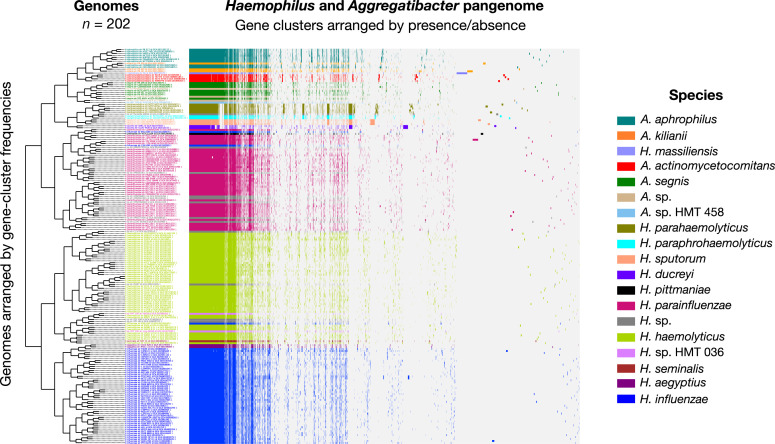
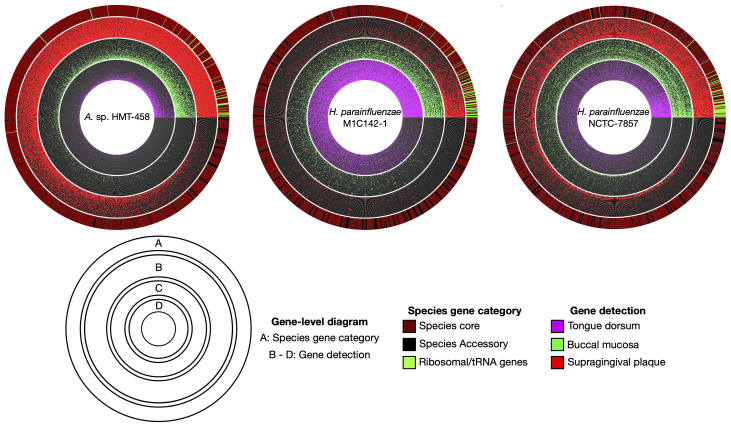
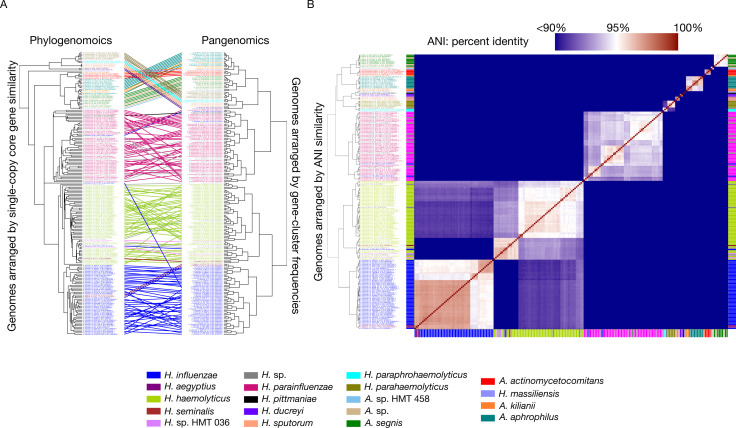
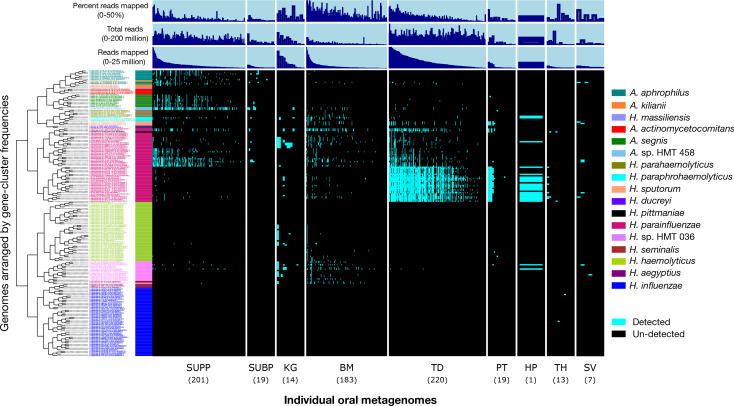
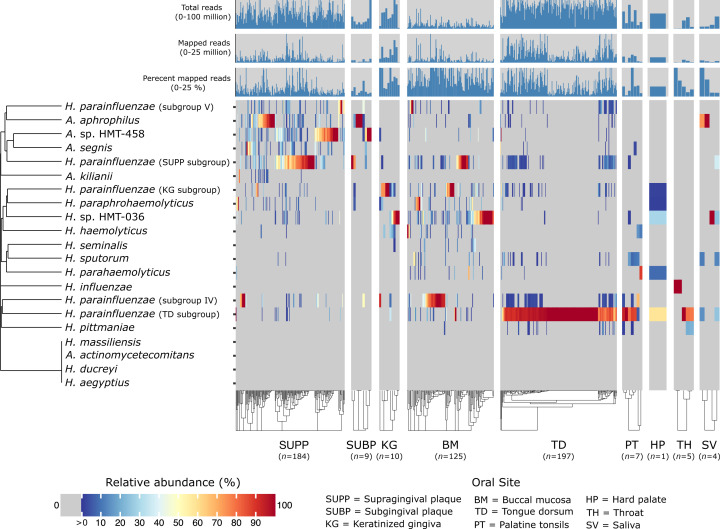
and are two of the most common bacterial genera in the human oral cavity, encompassing both commensals and pathogens of substantial ecological and medical significance. In this study, we conducted a metapangenomic analysis of oral and species to uncover genomic diversity, phylogenetic relationships, and habitat specialization within the human oral cavity. Using three metrics-pangenomic gene content, phylogenomics, and average nucleotide identity (ANI)-we first identified distinct species and sub-species groups among these genera. Mapping of metagenomic reads then revealed clear patterns of habitat specialization, such as species predominantly in dental plaque, a distinctive sub-species group on the tongue dorsum, and . sp. HMT-036 predominantly in keratinized gingiva and buccal mucosa. In addition, we found that supragingival plaque samples contained predominantly only one out of the three taxa, , , and . sp. HMT-458, suggesting independent niches or a competitive relationship. Functional analyses revealed the presence of key metabolic genes, such as oxaloacetate decarboxylase, correlated with habitat specialization, suggesting metabolic versatility as a driving force. Additionally, heme synthesis distinguishes . sp. HMT-036 from closely related , suggesting that the availability of micronutrients, particularly iron, was important in the evolutionary ecology of these species. Overall, our study exemplifies the power of metapangenomics to identify factors that may affect ecological interactions within microbial communities, including genomic diversity, habitat specialization, and metabolic versatility.
Understanding the microbial ecology of the mouth is essential for comprehending human physiology. This study employs metapangenomics to reveal that various and species exhibit distinct ecological preferences within the oral cavity of healthy individuals, thereby supporting the site-specialist hypothesis. Additionally, it was observed that the gene pool of different species correlates with their ecological niches. These findings shed light on the significance of key metabolic functions in shaping microbial distribution patterns and interspecies interactions in the oral ecosystem.
和 是人类口腔中最常见的两种细菌属,包括共生菌和具有重要生态和医学意义的病原体。在这项研究中,我们对口腔 和 物种进行了宏基因组分析,以揭示其基因组多样性、系统发育关系和在人类口腔中的栖息地特化。我们使用三种指标——全基因组基因含量、系统发育基因组学和平均核苷酸同一性 (ANI)——首先在这些属中鉴定出不同的种和亚种群。然后通过对宏基因组reads 的映射,揭示了明显的栖息地特化模式,例如 物种主要存在于牙菌斑中,一个独特的 亚种群存在于舌背, 和. sp. HMT-036 主要存在于角化的牙龈和颊黏膜。此外,我们发现龈上菌斑样本主要只包含三个分类群中的一个, 、 、和. sp. HMT-458,表明存在独立的小生境或竞争关系。功能分析显示存在关键代谢基因,如草酰乙酸脱羧酶,与栖息地特化相关,表明代谢多功能性是驱动因素。此外,血红素合成将. sp. HMT-036 与密切相关的 区分开来,表明在这些物种的进化生态学中,微量元素(特别是铁)的可用性很重要。总的来说,我们的研究表明宏基因组学可以识别可能影响微生物群落内生态相互作用的因素,包括基因组多样性、栖息地特化和代谢多功能性。
理解口腔微生物生态学对于理解人类生理学至关重要。本研究运用宏基因组学揭示了不同的 和 物种在健康个体口腔中表现出不同的生态偏好,从而支持了小生境特化假说。此外,还观察到不同 物种的基因库与其生态位相关。这些发现揭示了关键代谢功能在塑造口腔生态系统中微生物分布模式和种间相互作用的重要性。