Zhu Shihong, Liu Xiaoyin, Lu Xiyue, Liao Qiang, Luo Huiyang, Tian Yuan, Cheng Xu, Jiang Yaxin, Liu Guangdi, Chen Jing
Department of Neurosurgery, West China Hospital, West China Medical School, Sichuan University, Chengdu, Sichuan Province, China.
National Engineering Research Center for Biomaterials, College of Biomedical Engineering, Sichuan University, Chengdu, Sichuan Province, China.
Neural Regen Res. 2024 Oct 1;19(10):2157-2174. doi: 10.4103/1673-5374.391179. Epub 2023 Dec 21.
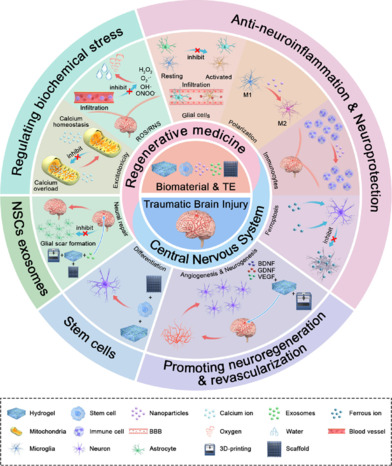
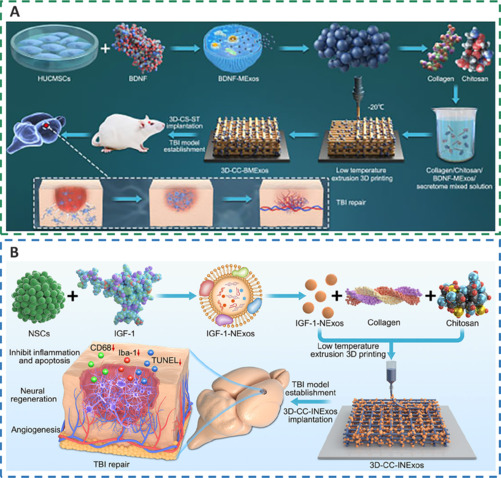
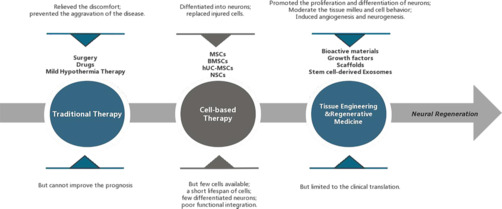
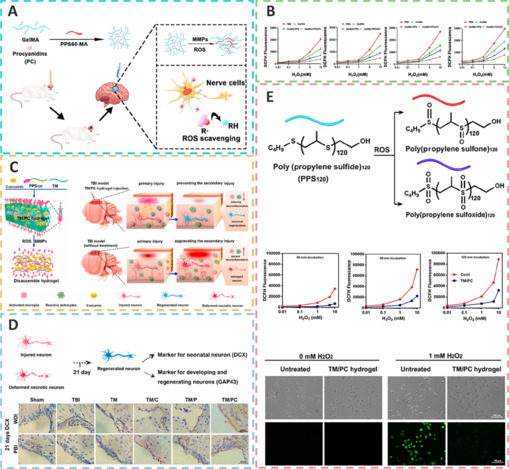
Traumatic brain injury is a serious medical condition that can be attributed to falls, motor vehicle accidents, sports injuries and acts of violence, causing a series of neural injuries and neuropsychiatric symptoms. However, limited accessibility to the injury sites, complicated histological and anatomical structure, intricate cellular and extracellular milieu, lack of regenerative capacity in the native cells, vast variety of damage routes, and the insufficient time available for treatment have restricted the widespread application of several therapeutic methods in cases of central nervous system injury. Tissue engineering and regenerative medicine have emerged as innovative approaches in the field of nerve regeneration. By combining biomaterials, stem cells, and growth factors, these approaches have provided a platform for developing effective treatments for neural injuries, which can offer the potential to restore neural function, improve patient outcomes, and reduce the need for drugs and invasive surgical procedures. Biomaterials have shown advantages in promoting neural development, inhibiting glial scar formation, and providing a suitable biomimetic neural microenvironment, which makes their application promising in the field of neural regeneration. For instance, bioactive scaffolds loaded with stem cells can provide a biocompatible and biodegradable milieu. Furthermore, stem cells-derived exosomes combine the advantages of stem cells, avoid the risk of immune rejection, cooperate with biomaterials to enhance their biological functions, and exert stable functions, thereby inducing angiogenesis and neural regeneration in patients with traumatic brain injury and promoting the recovery of brain function. Unfortunately, biomaterials have shown positive effects in the laboratory, but when similar materials are used in clinical studies of human central nervous system regeneration, their efficacy is unsatisfactory. Here, we review the characteristics and properties of various bioactive materials, followed by the introduction of applications based on biochemistry and cell molecules, and discuss the emerging role of biomaterials in promoting neural regeneration. Further, we summarize the adaptive biomaterials infused with exosomes produced from stem cells and stem cells themselves for the treatment of traumatic brain injury. Finally, we present the main limitations of biomaterials for the treatment of traumatic brain injury and offer insights into their future potential.
创伤性脑损伤是一种严重的医学状况,可归因于跌倒、机动车事故、运动损伤和暴力行为,会导致一系列神经损伤和神经精神症状。然而,损伤部位难以接近、组织学和解剖结构复杂、细胞内外环境错综复杂、天然细胞缺乏再生能力、损伤途径多种多样以及治疗时间有限,限制了几种治疗方法在中枢神经系统损伤病例中的广泛应用。组织工程和再生医学已成为神经再生领域的创新方法。通过结合生物材料、干细胞和生长因子,这些方法为开发神经损伤的有效治疗方法提供了一个平台,有望恢复神经功能、改善患者预后并减少药物和侵入性手术的需求。生物材料在促进神经发育、抑制胶质瘢痕形成以及提供合适的仿生神经微环境方面显示出优势,这使得它们在神经再生领域的应用前景广阔。例如,负载干细胞的生物活性支架可以提供生物相容性和可生物降解的环境。此外,干细胞衍生的外泌体兼具干细胞的优势,避免了免疫排斥的风险,与生物材料协同作用以增强其生物学功能,并发挥稳定的功能,从而在创伤性脑损伤患者中诱导血管生成和神经再生,促进脑功能恢复。不幸的是,生物材料在实验室中已显示出积极效果,但在人类中枢神经系统再生的临床研究中使用类似材料时,其疗效并不理想。在此,我们综述了各种生物活性材料的特性和性质,随后介绍基于生物化学和细胞分子的应用,并讨论生物材料在促进神经再生中的新兴作用。此外,我们总结了注入干细胞产生的外泌体以及干细胞本身的适应性生物材料用于治疗创伤性脑损伤的情况。最后,我们阐述了生物材料在治疗创伤性脑损伤方面的主要局限性,并对其未来潜力提出见解。