Department of Human Evolutionary Biology, Harvard University, 11 Divinity Ave, Cambridge, MA 02138, USA; Department of Anthropology, Tufts University, 110 Braker Hall, 8 Upper Campus Rd, Medford, MA 02155, USA.
Department of Anthropology, Tufts University, 110 Braker Hall, 8 Upper Campus Rd, Medford, MA 02155, USA.
Curr Biol. 2024 Mar 25;34(6):1364-1369.e2. doi: 10.1016/j.cub.2024.02.025. Epub 2024 Mar 14.
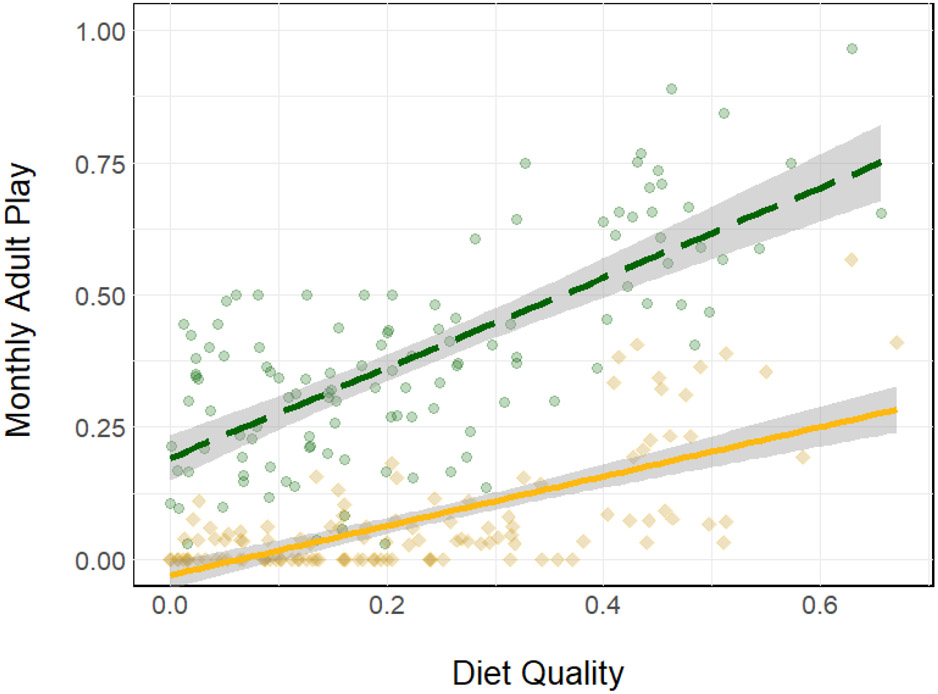
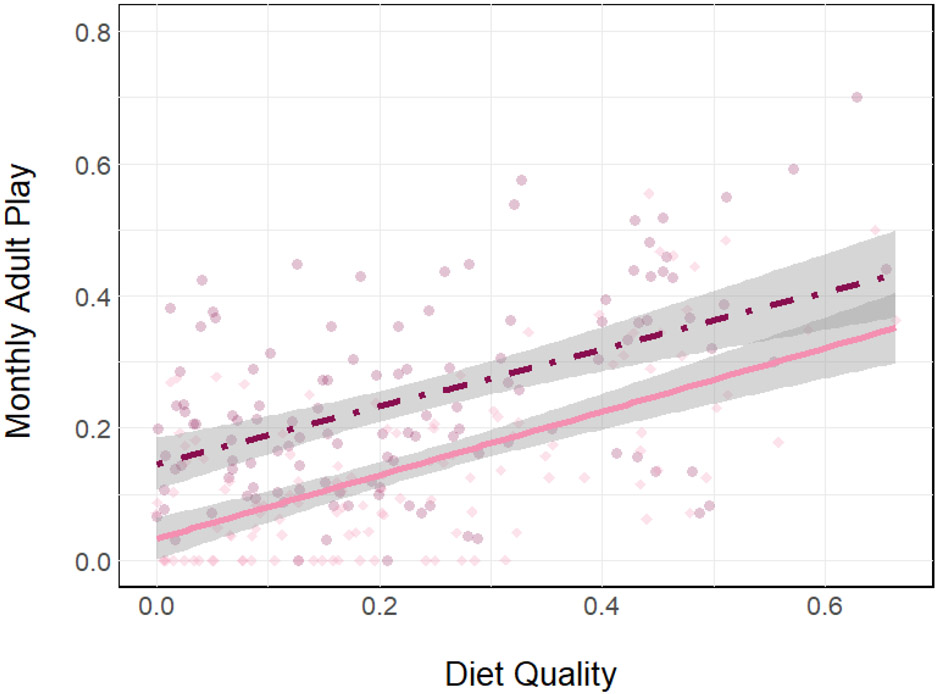
Though common among humans, social play by adults is an uncommon occurrence in most animals, even between parents and offspring. The most common explanation for why adult play is so rare is that its function and benefits are largely limited to development, so that social play has little value later in life. Here, we draw from 10 years of behavioral data collected by the Kibale Chimpanzee Project to consider an alternative hypothesis: that despite its benefits, adult play in non-humans is ecologically constrained by energy shortage or time limitations. We further hypothesized that, since they may be the only available partners for their young offspring, mother chimpanzees pay greater costs of play than other adults. Our analysis of nearly 4,000 adult play bouts revealed that adult chimpanzees played both among themselves and with immature partners. Social play was infrequent when diet quality was low but increased with the proportion of high-quality fruits in the diet. This suggests that adults engage in play facultatively when they have more energy and/or time to do so. However, when diet quality was low and most adult play fell to near zero, play persisted between mothers and offspring. Increased use of play by adult chimpanzees during periods of resource abundance suggests that play retains value as a social currency beyond development but that its costs constrain its use. At the same time, when ecological conditions constrain opportunities for young to play, play by mothers fills a critical role to promote healthy offspring development.
尽管在人类中很常见,但在大多数动物中,包括父母与后代之间,成年动物的社交游戏并不常见。对于为什么成年动物的游戏如此罕见,最常见的解释是,其功能和益处主要局限于发育,因此在生命后期,社交游戏的价值很小。在这里,我们从基巴拉黑猩猩项目收集的 10 年行为数据中汲取了一个替代假设:尽管有好处,但非人类的成年游戏受到能量短缺或时间限制的生态约束。我们进一步假设,由于它们可能是其幼崽唯一可用的伴侣,因此母黑猩猩比其他成年黑猩猩付出了更大的游戏代价。我们对近 4000 次成年游戏行为的分析表明,成年黑猩猩不仅彼此之间进行游戏,而且还与未成熟的伙伴进行游戏。当饮食质量较低时,社交游戏很少发生,但随着饮食中高质量水果的比例增加,社交游戏会增加。这表明,当成年人有更多的能量和/或时间时,他们会选择进行游戏。然而,当饮食质量较低且大多数成年游戏接近零时,母亲和幼崽之间仍会继续进行游戏。成年黑猩猩在资源丰富时期更多地使用游戏表明,游戏作为一种社交货币,其价值不仅限于发育阶段,但游戏的代价限制了其使用。同时,当生态条件限制了幼崽玩耍的机会时,母亲的游戏扮演了一个重要的角色,有助于促进幼崽的健康发育。