Department of Otolaryngology, Federico II University of Naples, Naples, Italy.
Department of Otolaryngology, Ospedali Riuniti Marche Nord, Fano, Italy.
Eur Arch Otorhinolaryngol. 2024 Jul;281(7):3671-3678. doi: 10.1007/s00405-024-08548-6. Epub 2024 Mar 16.
Although COVID-19 anosmia is often transient, patients with persistent olfactory dysfunction (pOD) can experience refractory parosmia and diminished smell. This study evaluated four putative therapies for parosmia in patients with chronic COVID-19 olfactory impairment.
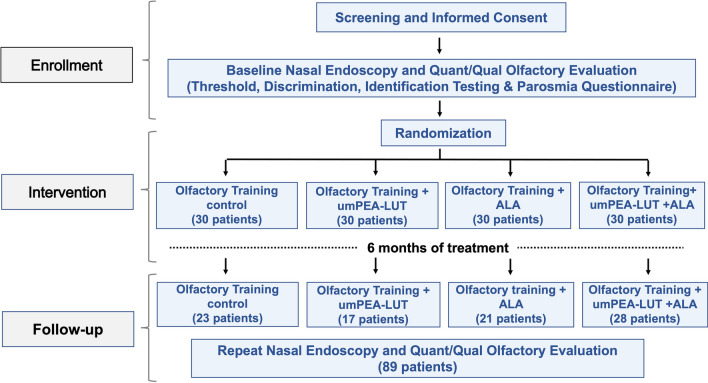
After screening nasal endoscopy, 85 patients (49 female, 58%) with pOD and treatment-refractory parosmia were randomized to: (1) ultramicronized palmitoylethanolamide and luteolin + olfactory training (OT) (umPEALUT group, n = 17), (2) alpha-lipoic acid + OT (ALA group, n = 21), (3) umPEALUT + ALA + OT (combination group, n = 28), or 4) olfactory training (OT) alone (control group, n = 23). Olfactory function was assessed at baseline (T) and 6 months (T) using a parosmia questionnaire and Sniffin' Sticks test of odor threshold, detection, and identification (TDI). Analyses included one-way ANOVA for numeric data and Chi-Square analyses for nominal data on parosmia.
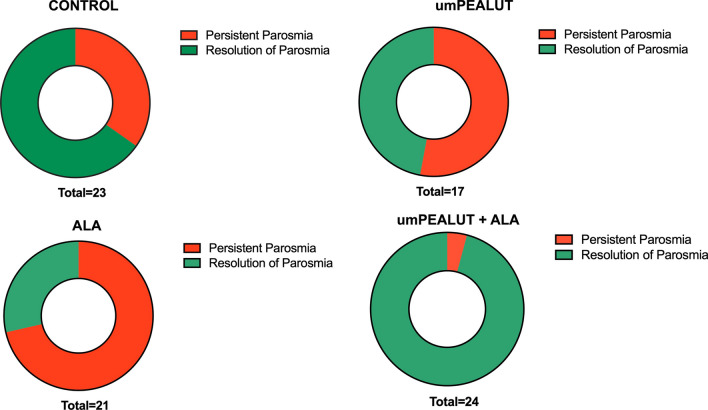
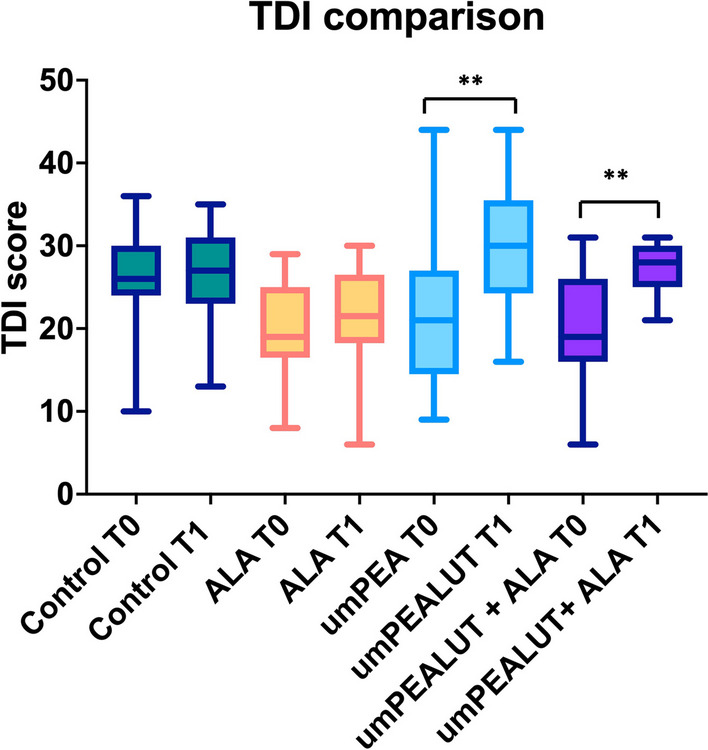
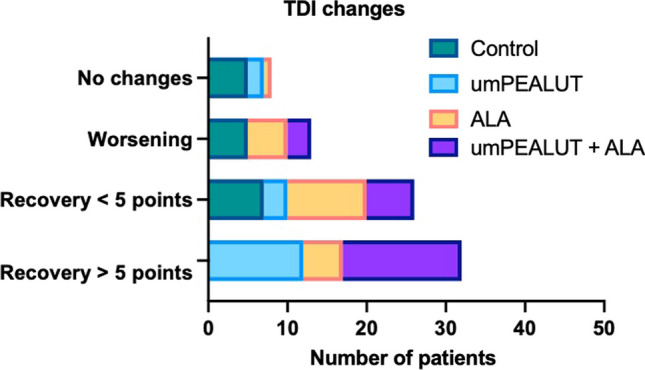
The umPEALUT group had the largest improvement in TDI scores (21.8 ± 9.4 to 29.7 ± 7.5) followed by the combination group (19.6 ± 6.29 to 27.5 ± 2.7), both p < 0.01. The control and ALA groups had no significant change. Patients in the combination and umPEALUT groups had significantly improved TDI scores compared to ALA and control groups (p < 0.001). Rates of parosmia resolution after 6 months were reported at 96% for combination, 65% for control, 53% for umPEALUT and 29% for ALA (p < 0.001). All treatment regimens were well-tolerated.
umPEALUT and OT, with or without ALA, was associated with improvement in TDI scores and parosmia, whereas OT alone or OT with ALA were associated with little benefit.
尽管 COVID-19 嗅觉丧失通常是短暂的,但持续性嗅觉障碍(pOD)患者可能会经历难治性幻嗅和嗅觉减退。本研究评估了四种用于治疗慢性 COVID-19 嗅觉障碍患者幻嗅的潜在疗法。
鼻内镜筛查后,85 名(49 名女性,58%)pOD 伴治疗抵抗性幻嗅的患者被随机分为:(1)超微化棕榈酸乙酯和叶黄素+嗅觉训练(OT)(umPEALUT 组,n=17),(2)α-硫辛酸+OT(ALA 组,n=21),(3)umPEALUT+ALA+OT(联合组,n=28),或 4)嗅觉训练(OT)单独(对照组,n=23)。使用幻嗅问卷和嗅敏度、检测和识别(TDI)的嗅觉测试棒,在基线(T)和 6 个月(T)时评估嗅觉功能。分析包括数值数据的单向方差分析和名义数据的卡方分析。
umPEALUT 组 TDI 评分改善最大(21.8±9.4 至 29.7±7.5),其次是联合组(19.6±6.29 至 27.5±2.7),均 p<0.01。对照组和 ALA 组没有显著变化。联合组和 umPEALUT 组的 TDI 评分显著优于 ALA 组和对照组(p<0.001)。6 个月后报告的幻嗅缓解率分别为联合组 96%、对照组 65%、umPEALUT 组 53%和 ALA 组 29%(p<0.001)。所有治疗方案均耐受良好。
umPEALUT 和 OT,联合或不联合 ALA,与 TDI 评分和幻嗅改善相关,而 OT 单独或 OT 联合 ALA 则获益甚微。