Department of Biomedical Informatics, University of Utah, Salt Lake City, Utah, USA
Center for Health Outcomes and Population Equity, University of Utah Health Huntsman Cancer Institute, Salt Lake City, Utah, USA.
BMJ Open. 2024 Mar 20;14(3):e081455. doi: 10.1136/bmjopen-2023-081455.
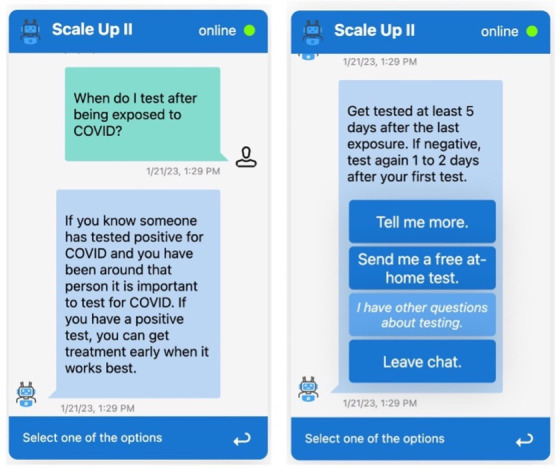
SCALE-UP II aims to investigate the effectiveness of population health management interventions using text messaging (TM), chatbots and patient navigation (PN) in increasing the uptake of at-home COVID-19 testing among patients in historically marginalised communities, specifically, those receiving care at community health centres (CHCs).
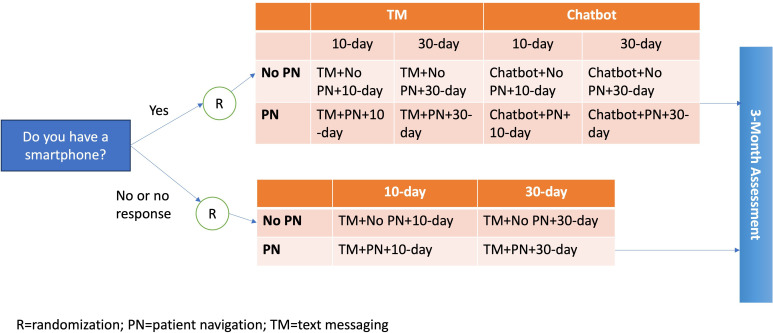
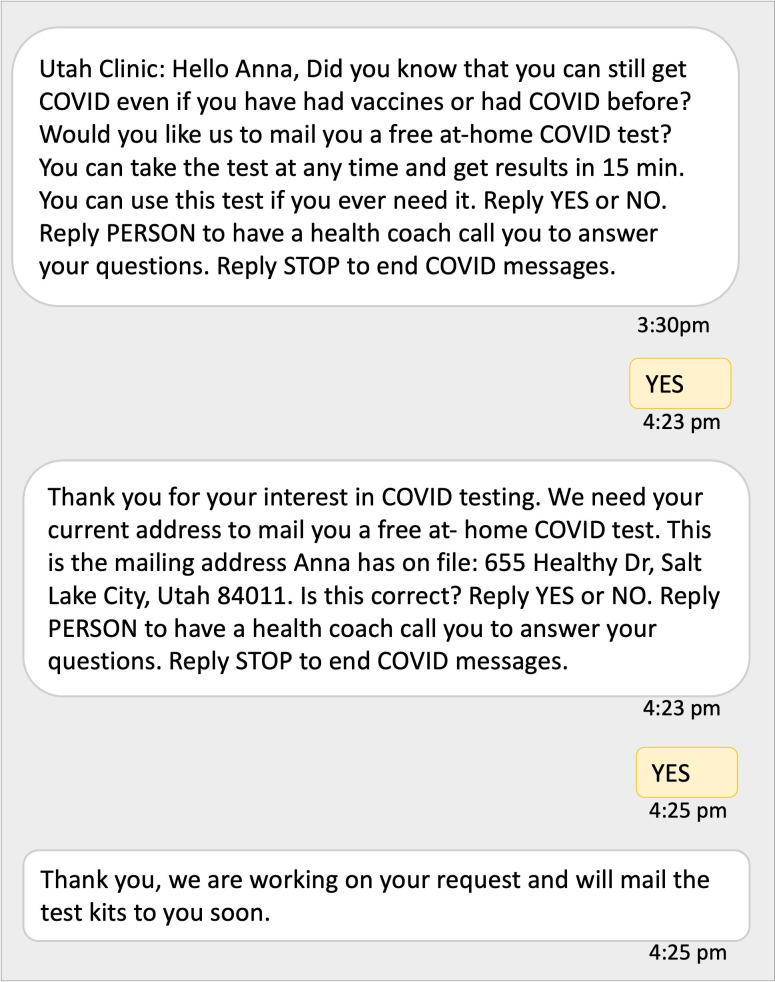
The trial is a multisite, randomised pragmatic clinical trial. Eligible patients are >18 years old with a primary care visit in the last 3 years at one of the participating CHCs. Demographic data will be obtained from CHC electronic health records. Patients will be randomised to one of two factorial designs based on smartphone ownership. Patients who self-report replying to a text message that they have a smartphone will be randomised in a 2×2×2 factorial fashion to receive (1) chatbot or TM; (2) PN (yes or no); and (3) repeated offers to interact with the interventions every 10 or 30 days. Participants who do not self-report as having a smartphone will be randomised in a 2×2 factorial fashion to receive (1) TM with or without PN; and (2) repeated offers every 10 or 30 days. The interventions will be sent in English or Spanish, with an option to request at-home COVID-19 test kits. The primary outcome is the proportion of participants using at-home COVID-19 tests during a 90-day follow-up. The study will evaluate the main effects and interactions among interventions, implementation outcomes and predictors and moderators of study outcomes. Statistical analyses will include logistic regression, stratified subgroup analyses and adjustment for stratification factors.
The protocol was approved by the University of Utah Institutional Review Board. On completion, study data will be made available in compliance with National Institutes of Health data sharing policies. Results will be disseminated through study partners and peer-reviewed publications.
ClinicalTrials.gov: NCT05533918 and NCT05533359.
SCALE-UP II 旨在通过短信(TM)、聊天机器人和患者导航(PN)来调查人口健康管理干预措施的有效性,以提高历史上处于边缘地位的社区(特别是在参与的社区卫生中心(CHC)接受护理的患者)中在家进行 COVID-19 检测的接受率。
该试验是一项多站点、随机实用临床试验。合格的患者年龄在 18 岁以上,且在过去 3 年内在参与的 CHC 中有过一次初级保健就诊。人口统计学数据将从 CHC 的电子健康记录中获得。患者将根据智能手机的拥有情况,随机分为两种析因设计之一。自我报告回复短信表示拥有智能手机的患者将以 2×2×2 析因方式随机分配,以接收(1)聊天机器人或 TM;(2)PN(是或否);以及(3)每 10 或 30 天重复提供与干预措施互动的机会。自我报告没有智能手机的参与者将以 2×2 析因方式随机分配,以接收(1)带或不带 PN 的 TM;以及(2)每 10 或 30 天重复提供机会。干预措施将以英语或西班牙语发送,并提供申请在家进行 COVID-19 检测试剂盒的选项。主要结果是在 90 天随访期间使用在家进行 COVID-19 检测的参与者比例。该研究将评估干预措施、实施结果以及研究结果的预测因素和调节因素之间的主要影响和相互作用。统计分析将包括逻辑回归、分层亚组分析和分层因素调整。
该方案已获得犹他大学机构审查委员会的批准。完成后,研究数据将按照美国国立卫生研究院的数据共享政策提供。研究结果将通过研究合作伙伴和同行评审出版物进行传播。
ClinicalTrials.gov:NCT05533918 和 NCT05533359。