Yang Qian, Meng Dandan, Zhang Qinyuan, Wang Jin
School of Chinese Medicine, Shandong University of Traditional Chinese Medicine, Jinan, China.
Front Oncol. 2024 Mar 6;14:1334915. doi: 10.3389/fonc.2024.1334915. eCollection 2024.
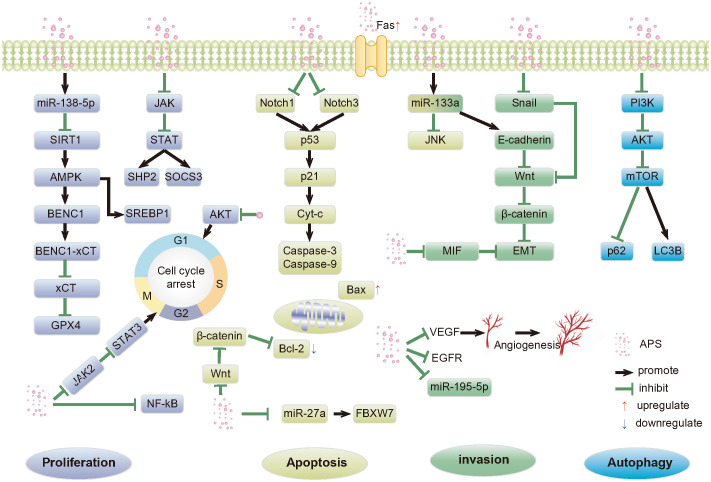
The dry root of the soybean plant (Fisch) Bge. var. (Bge) Hsiao or (Fisch) Bge, Astragali Radix (AR) has a long medicinal history. polysaccharide (APS), the natural macromolecule that exhibits immune regulatory, anti-inflammatory, anti-tumor, and other pharmacological activities, is an important active ingredient extracted from AR. Recently, APS has been increasingly used in cancer therapy owing to its anti-tumor ability as it prevents the progression of prostate, liver, cervical, ovarian, and non-small-cell lung cancer by suppressing tumor cell growth and invasion and enhancing apoptosis. In addition, APS enhances the sensitivity of tumors to antineoplastic agents and improves the body's immunity. This macromolecule has prospects for broad application in tumor therapy through various pathways. In this article, we present the latest progress in the research on the anti-tumor effects of APS and its underlying mechanisms, aiming to provide novel theoretical support and reference for its use in cancer therapy.
豆科植物蒙古黄芪(Fisch)Bge.变种(Bge)Hsiao或膜荚黄芪(Fisch)Bge的干燥根,即黄芪(AR),有着悠久的药用历史。黄芪多糖(APS)是一种具有免疫调节、抗炎、抗肿瘤等药理活性的天然大分子,是从黄芪中提取的重要活性成分。近年来,由于其抗肿瘤能力,APS在癌症治疗中的应用越来越多,它通过抑制肿瘤细胞生长和侵袭以及增强细胞凋亡来阻止前列腺癌、肝癌、宫颈癌、卵巢癌和非小细胞肺癌的进展。此外,APS还能增强肿瘤对抗肿瘤药物的敏感性并提高机体免疫力。这种大分子通过多种途径在肿瘤治疗中具有广泛的应用前景。在本文中,我们介绍了APS抗肿瘤作用及其潜在机制的最新研究进展,旨在为其在癌症治疗中的应用提供新的理论支持和参考。