• 文献检索
  • 文档翻译
  • 深度研究
  • 学术资讯
  • Suppr Zotero 插件Zotero 插件
  • 邀请有礼
  • 套餐&价格
  • 历史记录
应用&插件
Suppr Zotero 插件Zotero 插件浏览器插件Mac 客户端Windows 客户端微信小程序
定价
高级版会员购买积分包购买API积分包
服务
文献检索文档翻译深度研究API 文档MCP 服务
关于我们
关于 Suppr公司介绍联系我们用户协议隐私条款
关注我们

Suppr 超能文献

核心技术专利:CN118964589B侵权必究
粤ICP备2023148730 号-1Suppr @ 2026

文献检索

告别复杂PubMed语法,用中文像聊天一样搜索,搜遍4000万医学文献。AI智能推荐,让科研检索更轻松。

立即免费搜索

文件翻译

保留排版,准确专业,支持PDF/Word/PPT等文件格式,支持 12+语言互译。

免费翻译文档

深度研究

AI帮你快速写综述,25分钟生成高质量综述,智能提取关键信息,辅助科研写作。

立即免费体验

DDK-Linker:一种基于网络的策略,通过将高通量组学数据集与疾病知识联系起来,识别疾病信号。

DDK-Linker: a network-based strategy identifies disease signals by linking high-throughput omics datasets to disease knowledge.

机构信息

State Key Laboratory of Medical Proteomics, Beijing Proteome Research Center, National Center for Protein Sciences (Beijing), Beijing Institute of Lifeomics, Beijing 102206, China.

School of Traditional Chinese Medicine, Beijing University of Chinese Medicine, Beijing 100029, China.

出版信息

Brief Bioinform. 2024 Jan 22;25(2). doi: 10.1093/bib/bbae111.

DOI:10.1093/bib/bbae111
PMID:38517698
原文链接:https://pmc.ncbi.nlm.nih.gov/articles/PMC10959161/
Abstract

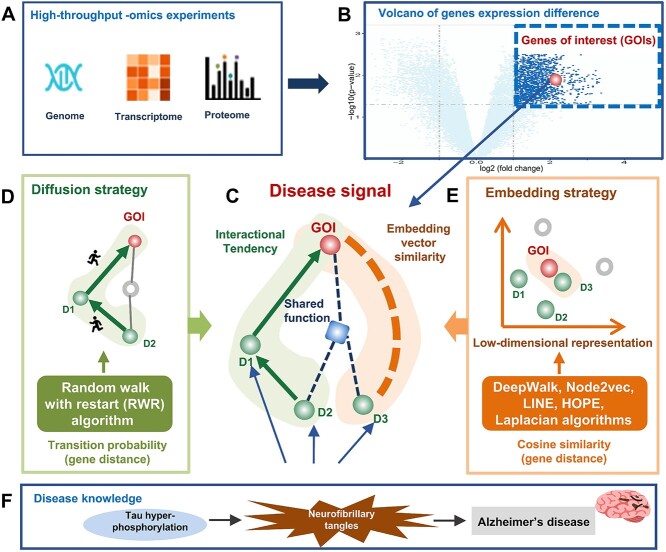
The high-throughput genomic and proteomic scanning approaches allow investigators to measure the quantification of genome-wide genes (or gene products) for certain disease conditions, which plays an essential role in promoting the discovery of disease mechanisms. The high-throughput approaches often generate a large gene list of interest (GOIs), such as differentially expressed genes/proteins. However, researchers have to perform manual triage and validation to explore the most promising, biologically plausible linkages between the known disease genes and GOIs (disease signals) for further study. Here, to address this challenge, we proposed a network-based strategy DDK-Linker to facilitate the exploration of disease signals hidden in omics data by linking GOIs to disease knowns genes. Specifically, it reconstructed gene distances in the protein-protein interaction (PPI) network through six network methods (random walk with restart, Deepwalk, Node2Vec, LINE, HOPE, Laplacian) to discover disease signals in omics data that have shorter distances to disease genes. Furthermore, benefiting from the establishment of knowledge base we established, the abundant bioinformatics annotations were provided for each candidate disease signal. To assist in omics data interpretation and facilitate the usage, we have developed this strategy into an application that users can access through a website or download the R package. We believe DDK-Linker will accelerate the exploring of disease genes and drug targets in a variety of omics data, such as genomics, transcriptomics and proteomics data, and provide clues for complex disease mechanism and pharmacological research. DDK-Linker is freely accessible at http://ddklinker.ncpsb.org.cn/.

摘要

高通量基因组和蛋白质组扫描方法使研究人员能够测量特定疾病条件下全基因组基因(或基因产物)的定量,这在促进疾病机制的发现中起着至关重要的作用。高通量方法通常会生成大量感兴趣的基因列表(GOIs),例如差异表达的基因/蛋白质。然而,研究人员必须进行手动分诊和验证,以探索已知疾病基因和 GOIs(疾病信号)之间最有前途、最合理的生物学联系,以便进一步研究。在这里,为了解决这个挑战,我们提出了一种基于网络的策略 DDK-Linker,通过将 GOIs 链接到已知疾病基因,来促进从组学数据中探索隐藏的疾病信号。具体来说,它通过六种网络方法(随机游走重启、Deepwalk、Node2Vec、LINE、HOPE、Laplacian)重建蛋白质-蛋白质相互作用(PPI)网络中的基因距离,以发现与疾病基因距离较短的组学数据中的疾病信号。此外,得益于我们建立的知识库,为每个候选疾病信号提供了丰富的生物信息学注释。为了协助组学数据的解释和方便使用,我们将该策略开发成一个应用程序,用户可以通过网站或下载 R 包进行访问。我们相信 DDK-Linker 将加速在各种组学数据(如基因组学、转录组学和蛋白质组学数据)中探索疾病基因和药物靶点,并为复杂疾病机制和药理学研究提供线索。DDK-Linker 可在 http://ddklinker.ncpsb.org.cn/ 免费访问。
https://cdn.ncbi.nlm.nih.gov/pmc/blobs/ea97/10959161/c67fc5706722/bbae111f5.jpg
https://cdn.ncbi.nlm.nih.gov/pmc/blobs/ea97/10959161/2b0746950a36/bbae111f1.jpg
https://cdn.ncbi.nlm.nih.gov/pmc/blobs/ea97/10959161/571a07d0a73f/bbae111f2.jpg
https://cdn.ncbi.nlm.nih.gov/pmc/blobs/ea97/10959161/c443ce0428a1/bbae111f3.jpg
https://cdn.ncbi.nlm.nih.gov/pmc/blobs/ea97/10959161/1c923ec61d17/bbae111f4.jpg
https://cdn.ncbi.nlm.nih.gov/pmc/blobs/ea97/10959161/c67fc5706722/bbae111f5.jpg
https://cdn.ncbi.nlm.nih.gov/pmc/blobs/ea97/10959161/2b0746950a36/bbae111f1.jpg
https://cdn.ncbi.nlm.nih.gov/pmc/blobs/ea97/10959161/571a07d0a73f/bbae111f2.jpg
https://cdn.ncbi.nlm.nih.gov/pmc/blobs/ea97/10959161/c443ce0428a1/bbae111f3.jpg
https://cdn.ncbi.nlm.nih.gov/pmc/blobs/ea97/10959161/1c923ec61d17/bbae111f4.jpg
https://cdn.ncbi.nlm.nih.gov/pmc/blobs/ea97/10959161/c67fc5706722/bbae111f5.jpg

相似文献

1
DDK-Linker: a network-based strategy identifies disease signals by linking high-throughput omics datasets to disease knowledge.DDK-Linker:一种基于网络的策略,通过将高通量组学数据集与疾病知识联系起来,识别疾病信号。
Brief Bioinform. 2024 Jan 22;25(2). doi: 10.1093/bib/bbae111.
2
FunRich: An open access standalone functional enrichment and interaction network analysis tool.FunRich:一个开放获取的独立功能富集和相互作用网络分析工具。
Proteomics. 2015 Aug;15(15):2597-601. doi: 10.1002/pmic.201400515. Epub 2015 Jun 17.
3
pwOmics: an R package for pathway-based integration of time-series omics data using public database knowledge.pwOmics:一个基于 R 的软件包,用于使用公共数据库知识进行基于途径的时间序列组学数据的整合。
Bioinformatics. 2015 Sep 15;31(18):3072-4. doi: 10.1093/bioinformatics/btv323. Epub 2015 May 21.
4
Integrative analysis of human omics data using biomolecular networks.利用生物分子网络对人类组学数据进行综合分析。
Mol Biosyst. 2016 Oct 20;12(10):2953-64. doi: 10.1039/c6mb00476h. Epub 2016 Aug 11.
5
From Omics to Multi-Omics: A Review of Advantages and Tradeoffs.从组学到多组学:优势与权衡综述
Genes (Basel). 2024 Nov 29;15(12):1551. doi: 10.3390/genes15121551.
6
Pinstripe: a suite of programs for integrating transcriptomic and proteomic datasets identifies novel proteins and improves differentiation of protein-coding and non-coding genes.Pinstripe:一套用于整合转录组和蛋白质组数据集的程序,可识别新的蛋白质,并提高蛋白质编码和非编码基因的区分能力。
Bioinformatics. 2012 Dec 1;28(23):3042-50. doi: 10.1093/bioinformatics/bts582. Epub 2012 Oct 7.
7
iOmicsPASS: network-based integration of multiomics data for predictive subnetwork discovery.iOmicsPASS:基于网络的多组学数据整合,用于预测子网络发现。
NPJ Syst Biol Appl. 2019 Jul 9;5:22. doi: 10.1038/s41540-019-0099-y. eCollection 2019.
8
Confero: an integrated contrast data and gene set platform for computational analysis and biological interpretation of omics data.Confero:一个集成的对比数据和基因集平台,用于计算分析和生物学解释组学数据。
BMC Genomics. 2013 Jul 29;14:514. doi: 10.1186/1471-2164-14-514.
9
An overview of technologies for MS-based proteomics-centric multi-omics.基于 MS 的蛋白质组学中心型多组学技术概述。
Expert Rev Proteomics. 2022 Mar;19(3):165-181. doi: 10.1080/14789450.2022.2070476. Epub 2022 May 2.
10
VAN: an R package for identifying biologically perturbed networks via differential variability analysis.VAN:一个通过差异变异性分析识别生物扰动网络的R包。
BMC Res Notes. 2013 Oct 25;6:430. doi: 10.1186/1756-0500-6-430.

引用本文的文献

1
Personalized analysis of human cancer multi-omics for precision oncology.用于精准肿瘤学的人类癌症多组学个性化分析。
Comput Struct Biotechnol J. 2024 May 10;23:2049-2056. doi: 10.1016/j.csbj.2024.05.011. eCollection 2024 Dec.

本文引用的文献

1
The Imageable Genome.可成像基因组
Nat Commun. 2023 Nov 13;14(1):7329. doi: 10.1038/s41467-023-43123-3.
2
Benchmarking integration of single-cell differential expression.单细胞差异表达整合的基准测试
Nat Commun. 2023 Mar 21;14(1):1570. doi: 10.1038/s41467-023-37126-3.
3
KEGG for taxonomy-based analysis of pathways and genomes.KEGG 用于基于分类的途径和基因组分析。
Nucleic Acids Res. 2023 Jan 6;51(D1):D587-D592. doi: 10.1093/nar/gkac963.
4
The regulatory effects of PTPN6 on inflammatory process: Reports from mice to men.蛋白酪氨酸磷酸酶非受体型6对炎症过程的调节作用:从小鼠到人类的研究报道
Arch Biochem Biophys. 2022 May 30;721:109189. doi: 10.1016/j.abb.2022.109189. Epub 2022 Mar 17.
5
The neuronal-specific isoform of BIN1 regulates β-secretase cleavage of APP and Aβ generation in a RIN3-dependent manner.神经元特异性 BIN1 异构体通过 RIN3 依赖性方式调节 APP 的β-分泌酶切割和 Aβ 的生成。
Sci Rep. 2022 Mar 3;12(1):3486. doi: 10.1038/s41598-022-07372-4.
6
Machine learning prediction and tau-based screening identifies potential Alzheimer's disease genes relevant to immunity.机器学习预测和基于 Tau 的筛选鉴定出与免疫相关的潜在阿尔茨海默病基因。
Commun Biol. 2022 Feb 11;5(1):125. doi: 10.1038/s42003-022-03068-7.
7
OmicsOne: associate omics data with phenotypes in one-click.OmicsOne:一键将组学数据与表型关联起来。
Clin Proteomics. 2021 Dec 11;18(1):29. doi: 10.1186/s12014-021-09334-w.
8
Machine learning meets omics: applications and perspectives.机器学习与组学的融合:应用与展望。
Brief Bioinform. 2022 Jan 17;23(1). doi: 10.1093/bib/bbab460.
9
A review on omics-based biomarkers discovery for Alzheimer's disease from the bioinformatics perspectives: Statistical approach vs machine learning approach.基于组学的生物标志物在阿尔茨海默病中的研究进展:从生物信息学角度看统计方法与机器学习方法的比较。
Comput Biol Med. 2021 Dec;139:104947. doi: 10.1016/j.compbiomed.2021.104947. Epub 2021 Oct 14.
10
Comparative Analysis of Unsupervised Protein Similarity Prediction Based on Graph Embedding.基于图嵌入的无监督蛋白质相似性预测的比较分析
Front Genet. 2021 Sep 22;12:744334. doi: 10.3389/fgene.2021.744334. eCollection 2021.