Department of Molecular Toxicology, Helmholtz-Centre for Environmental Research-UFZ GmbH, 04318 Leipzig, Germany.
Institute for Bioanalysis, University of Applied Sciences Coburg, 96450 Coburg, Germany.
ISME J. 2024 Jan 8;18(1). doi: 10.1093/ismejo/wrae050.
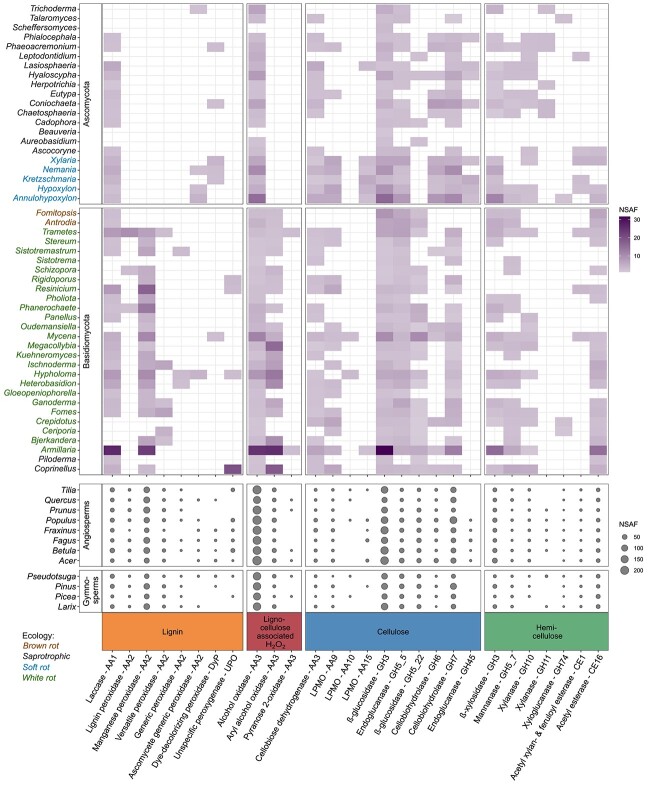
Deadwood provides habitat for fungi and serves diverse ecological functions in forests. We already have profound knowledge of fungal assembly processes, physiological and enzymatic activities, and resulting physico-chemical changes during deadwood decay. However, in situ detection and identification methods, fungal origins, and a mechanistic understanding of the main lignocellulolytic enzymes are lacking. This study used metaproteomics to detect the main extracellular lignocellulolytic enzymes in 12 tree species in a temperate forest that have decomposed for 8 ½ years. Mainly white-rot (and few brown-rot) Basidiomycota were identified as the main wood decomposers, with Armillaria as the dominant genus; additionally, several soft-rot xylariaceous Ascomycota were identified. The key enzymes involved in lignocellulolysis included manganese peroxidase, peroxide-producing alcohol oxidases, laccase, diverse glycoside hydrolases (cellulase, glucosidase, xylanase), esterases, and lytic polysaccharide monooxygenases. The fungal community and enzyme composition differed among the 12 tree species. Ascomycota species were more prevalent in angiosperm logs than in gymnosperm logs. Regarding lignocellulolysis as a function, the extracellular enzyme toolbox acted simultaneously and was interrelated (e.g. peroxidases and peroxide-producing enzymes were strongly correlated), highly functionally redundant, and present in all logs. In summary, our in situ study provides comprehensive and detailed insight into the enzymatic machinery of wood-inhabiting fungi in temperate tree species. These findings will allow us to relate changes in environmental factors to lignocellulolysis as an ecosystem function in the future.
枯木为真菌提供了栖息地,并在森林中发挥着多样化的生态功能。我们已经对真菌的组装过程、生理和酶活性以及枯木腐烂过程中的理化变化有了深刻的认识。然而,目前还缺乏原位检测和鉴定方法、真菌起源以及主要木质纤维素酶的机制理解。本研究使用代谢组学检测了 12 种温带森林树种在分解 8 年半后主要的胞外木质纤维素酶。主要的白腐菌(和少数褐腐菌)担子菌被鉴定为主要的木材分解者,以蜜环菌为优势属;此外,还鉴定出几种软腐木层孔菌子囊菌。木质纤维素降解中涉及的关键酶包括锰过氧化物酶、产过氧化物醇氧化酶、漆酶、多种糖苷水解酶(纤维素酶、葡萄糖苷酶、木聚糖酶)、酯酶和溶菌多糖单加氧酶。木质纤维素分解过程中的真菌群落和酶组成在 12 个树种中存在差异。子囊菌在被子植物原木中比在裸子植物原木中更为普遍。就木质纤维素降解而言,胞外酶工具箱同时起作用并相互关联(例如,过氧化物酶和产过氧化物酶之间存在强烈的相关性),高度功能冗余,并存在于所有原木中。总之,我们的原位研究为温带树种中木质素栖息真菌的酶机制提供了全面而详细的见解。这些发现将使我们能够在未来将环境因素的变化与木质纤维素降解作为生态系统功能联系起来。