Key Laboratory for Prevention and Control of Emerging Infectious Diseases and Public Health Security, the XPCC, School of Medicine, Shihezi University, Shihezi, Xinjiang, Uygur Autonomous Region, China.
Department of Parasitology and Zoology, University of Veterinary Medicine, Budapest, Hungary.
Parasit Vectors. 2024 Mar 22;17(1):152. doi: 10.1186/s13071-024-06216-6.
In the family Trypanosomatidae, the genus Trypanosoma contains protozoan parasites that infect a diverse range of hosts, including humans, domestic animals, and wildlife. Wild rodents, as natural reservoir hosts of various pathogens, play an important role in the evolution and emergence of Trypanosomatidae. To date, no reports are available on the trypanosomatid infection of pikas (Lagomorpha: Ochotonidae).
In this study, Mongolian pikas and their fleas were sampled at the China-Mongolia border, northwestern China. The samples were analyzed with polymerase chain reaction (PCR) and sequencing for the presence of Trypanosomatidae on the basis of both the 18S ribosomal RNA (18S rRNA) gene and the glyceraldehyde-3-phosphate dehydrogenase (gGAPDH) gene. The morphology of trypomastigotes was also observed in peripheral blood smears by microscopy.
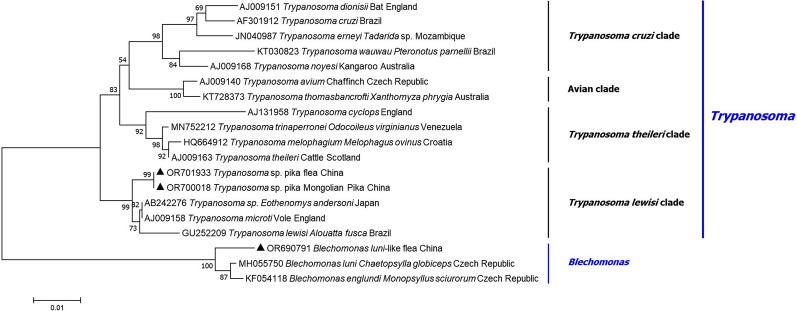
Molecular and phylogenetic analyses revealed a new genotype of the Trypanosoma lewisi clade that was found both in pika blood and flea samples. This genotype, which probably represents a new species, was provisionally designated as "Trypanosoma sp. pika". In addition, a novel genotype belonging to the genus Blechomonas of Trypanosomatidae was detected in fleas. On the basis of its molecular and phylogenetic properties, this genotype was named Blechomonas luni-like, because it was shown to be the closest related to B. luni compared with other flea-associated trypanosomatids.
To the best of our knowledge, this is the first study to report any trypanosomatid species in Mongolian pikas and their fleas. Further studies are needed to investigate the epidemiology of these protozoan parasites, as well as to evaluate their pathogenicity for humans or domestic animals.
在原生动物门动基体目锥虫科中,锥虫属包含了感染多种宿主的原生动物寄生虫,包括人类、家畜和野生动物。野生啮齿动物作为各种病原体的天然储存宿主,在锥虫科的进化和出现中起着重要作用。迄今为止,尚无有关兔形目(兔形目:兔科)的锥体虫感染的报道。
本研究在中国-蒙古边境,中国西北部采集了蒙古旱獭及其跳蚤样本。根据 18S 核糖体 RNA(18S rRNA)基因和甘油醛-3-磷酸脱氢酶(gGAPDH)基因,通过聚合酶链反应(PCR)和测序,对锥体虫科的存在进行了分析。还通过显微镜观察外周血涂片上的锥虫形态。
分子和系统发育分析显示,在旱獭血液和跳蚤样本中均发现了一种新的 Lewisi 锥虫群基因型。该基因型可能代表一个新物种,暂命名为“Trypanosoma sp. pika”。此外,在跳蚤中还检测到一种属于锥虫科 Blechomonas 属的新型基因型。根据其分子和系统发育特性,该基因型被命名为 Blechomonas luni-like,因为与其他与跳蚤相关的锥体虫相比,它与 B. luni 最为接近。
据我们所知,这是首次报道蒙古旱獭及其跳蚤中存在任何锥体虫种。需要进一步研究这些原生动物寄生虫的流行病学,并评估它们对人类或家畜的致病性。