Department of Emergency Medicine, Kaohsiung Chang Gung Memorial Hospital, Chang Gung University College of Medicine, Kaohsiung, Taiwan.
Division of Nephrology, Department of Internal Medicine, Kaohsiung Chang Gung Memorial Hospital and Chang Gung University College of Medicine, Kaohsiung, Taiwan.
Front Public Health. 2024 Mar 8;12:1340261. doi: 10.3389/fpubh.2024.1340261. eCollection 2024.
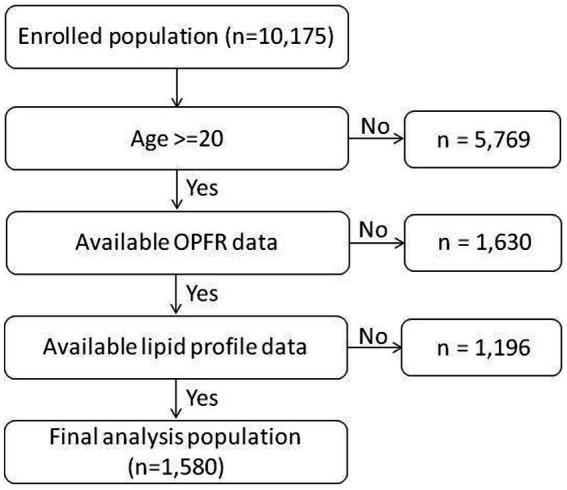
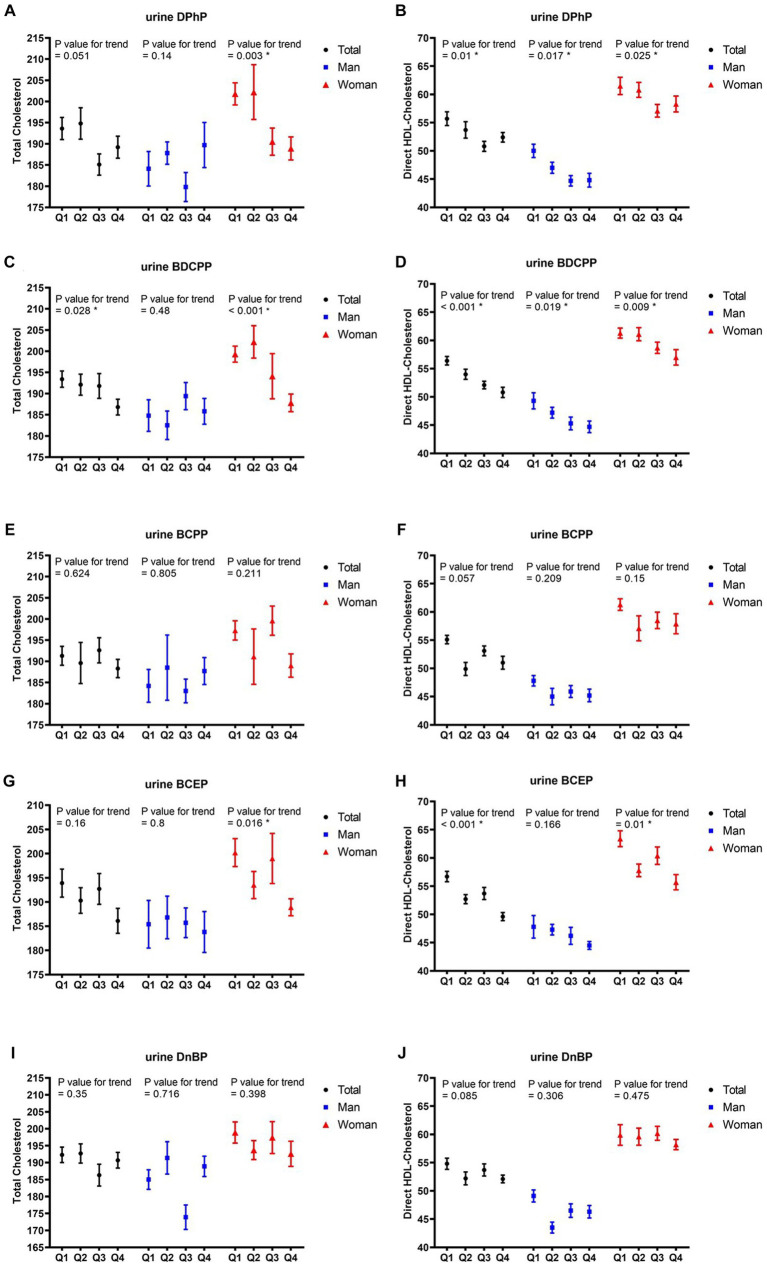
Organophosphate flame retardants (OPFRs) are emerging environmental pollutants that can be detected in water, dust, and biological organisms. Certain OPFRs can disrupt lipid metabolism in animal models and cell lines. However, the effects of OPFRs on human lipid metabolism remain unclear. We included 1,580 participants (≥20 years) from the 2013-2014 National Health and Nutrition Examination Survey (NHANES) to explore the relationship between OPFR exposure and lipid metabolism biomarkers. After adjusting for confounding factors, results showed that one-unit increases in the log levels of diphenyl phosphate (DPhP) (regression coefficient = -5.755; S.E. = 2.289; = 0.023) and log bis-(1-chloro-2-propyl) phosphate (BCPP) (regression coefficient = -4.637; S.E. = 2.019; = 0.036) were negatively associated with the levels of total cholesterol (TC) in all participants. One-unit increases in the levels of DPhP (regression coefficient = -2.292; S.E. = 0.802; = 0.012), log bis (1,3-dichloro-2-propyl) phosphate (BDCPP) (regression coefficient = -2.046; S.E. = 0.825; = 0.026), and log bis-2-chloroethyl phosphate (BCEP) (regression coefficient = -2.604; S.E. = 0.704; = 0.002) were negatively associated with the levels of high-density lipoprotein cholesterol (HDL-C). With increasing quartiles of urine BDCPP levels, the mean TC levels significantly decreased in all participants ( value for trend = 0.028), and quartile increases in the levels of DPhP ( value for trend = 0.01), BDCPP ( value for trend = 0.001), and BCEP ( value for trend<0.001) were negatively corelated with HDL-C, with approximately 5.9, 9.9, and 12.5% differences between the upper and lower quartiles. In conclusion, DPhP, BDCPP, and BCEP were negatively related to HDL-C concentration, whereas DPhP and BCPP levels were negatively associated with TC level. Thus, exposure to OPFRs may interfere with lipid metabolism.
有机磷阻燃剂(OPFRs)是新兴的环境污染物,可在水、灰尘和生物组织中检出。某些 OPFRs 可在动物模型和细胞系中扰乱脂代谢。然而,OPFRs 对人体脂代谢的影响尚不清楚。我们纳入了 2013-2014 年全国健康与营养调查(NHANES)中的 1580 名(≥20 岁)参与者,以探讨 OPFR 暴露与脂代谢生物标志物之间的关系。在调整混杂因素后,结果表明,DPhP(二苯基磷酸酯)和 BCPP(双(1-氯-2-丙基)磷酸酯)的 log 水平每增加一个单位,总胆固醇(TC)水平分别降低 5.755(回归系数;S.E. = 2.289;P = 0.023)和 4.637(回归系数;S.E. = 2.019;P = 0.036)。DPhP(回归系数;S.E. = 0.802;P = 0.012)、BDCPP(双(1,3-二氯-2-丙基)磷酸酯)(回归系数;S.E. = 0.825;P = 0.026)和 BCEP(双-2-氯乙基磷酸酯)(回归系数;S.E. = 0.704;P = 0.002)的 log 水平每增加一个单位,与高密度脂蛋白胆固醇(HDL-C)水平呈负相关。随着尿 BDCPP 水平 quartiles 的增加,所有参与者的 TC 水平显著降低(趋势值=0.028),DPhP(趋势值=0.01)、BDCPP(趋势值=0.001)和 BCEP(趋势值<0.001)的 quartiles 升高与 HDL-C 呈负相关,上下四分位之间的差异约为 5.9%、9.9%和 12.5%。总之,DPhP、BDCPP 和 BCEP 与 HDL-C 浓度呈负相关,而 DPhP 和 BCPP 水平与 TC 水平呈负相关。因此,OPFRs 的暴露可能会干扰脂代谢。