Alavinejad Pezhman, Hashemi Seyed Jalal, Behl Nitin, Hormati Ahmad, Elbasuny Abubakr, Daryani Naser Ebrahimi, Modarres Mehdi Pezeshgi, Arshadzadeh Masoud, Panahande Samira, Hang Dao Viet, Mahros Aya Mohammed, Parsi Abazar, Javaherizadeh Hazhir, Rehman Ata, Pawlak Katarzyna M, Ahmadi Mitra, Ahmed Mohammed Hussien, Farsi Farnaz, Arefi Mohammad, Quadri Afreen, Tran Quang Trung, Alborzi Foroogh, Amin Alavi Seyed Mohammad, Cheraghian Bahman, Ramezani Elmira, Gouda Mohammed Fathi, Saadati Babak, Quadri Ahmed Alam, Hirani Rahim, Maher Maha, Ghoneem Elsayed
Alimentary Tract Research Centre, Imam Khomeini Hospital Clinical Research Development Unit, The School of Medicine, Ahvaz Jundishapur University of Medical Sciences, Ahvaz, Iran.
Institute of Gastro and Liver Diseases, Fortis Hospital, Ludhiana, India.
EClinicalMedicine. 2024 Mar 15;70:102542. doi: 10.1016/j.eclinm.2024.102542. eCollection 2024 Apr.
The multifactorial nature of inflammatory bowel disease (IBD), which manifests differently in individuals creates a need for a better understanding of the behaviour and pattern of the disease due to environmental factors. The current study aimed to study the changes in IBD behaviour, presentation, and characteristics in patients over the past two decades with a goal of improving patients' diagnosis, management and outcomes.
During a 6-month period (1/02/2022-30/07/2022), the information of patients with IBD who attended IBD outpatient clinics of 11 referral centre's in six countries was collected, and based on the first time of diagnosis with IBD, they were allocated as group A (those who were diagnosed more than 15 years ago), group B (those who were diagnosed with IBD between 5 and 15 years ago) and group C (IBD cases who diagnosed in recent 5 years). Then the most prevalent subtypes and characters of the disease are evaluated and compared to make clear if the presenting pattern and behaviour of the disease has changed in the last 2 decades.
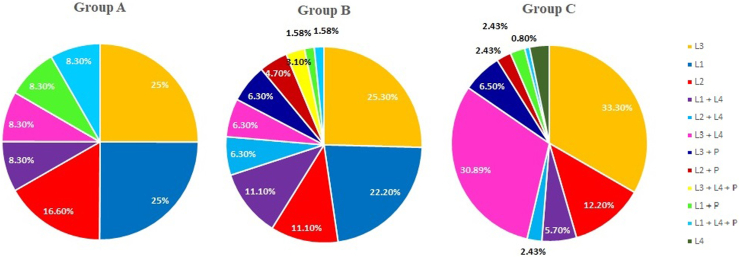
Overall 1430 patients with IBD including 1207 patients with ulcerative colitis (UC) (84.5%) and 205 patients with Crohn's disease (CD; 14.3%) included. Mean age of participants at the first time of diagnosis with IBD was 30 years. The extra-intestinal involvement of IBD in groups A and B was more prevalent in comparison with group C. Most of those in groups A & B had academic education but in group C, the most prevalent educational status was high school or diploma (P = 0.012). In contrast to groups A and B, the relative prevalence of medium socioeconomic level in group C had decreased (65%). Relative prevalence of UC subtypes was similar among groups A and B (extensive colitis as most prevalent) but in group C, the most prevalent subtype is left side colitis (38.17%). The most prevalent subtype of CD in groups A and B was ileocolic involvement while in group C, upper GI involvement is significantly increased. The rate of food sensitivity among groups A and B was more than group C (P = 0.00001). The relative prevalence of patients with no flare has increased with a steady slope (P < 0.00001). Relative prevalence of presenting symptoms among patients with UC in group C differs and nowadays the rate abdominal pain (70.7%) and bloating (43.9%) have increased and frequency of diarrhoea (67.4%) has decreased.
In the recent 5 years, the pattern of UC presentation has changed. The rate of upper GI involvement in CD and relative prevalence of patients with no disease flare increased and the rate of extra intestinal involvement decreased.
None.
炎症性肠病(IBD)具有多因素性质,在个体中的表现各异,这就需要更好地了解环境因素导致的该疾病的行为和模式。本研究旨在探讨过去二十年来IBD患者的病情行为、表现和特征的变化,以期改善患者的诊断、管理和治疗结果。
在6个月期间(2022年2月1日至2022年7月30日),收集了六个国家11个转诊中心IBD门诊就诊的IBD患者信息,并根据首次诊断为IBD的时间,将他们分为A组(15年以前诊断的患者)、B组(5至15年前诊断为IBD的患者)和C组(最近5年诊断的IBD病例)。然后评估并比较该疾病最常见的亚型和特征,以明确该疾病的表现模式和行为在过去20年中是否发生了变化。
共纳入1430例IBD患者,其中1207例为溃疡性结肠炎(UC)患者(84.5%),205例为克罗恩病(CD)患者(14.3%)。参与者首次诊断为IBD时的平均年龄为30岁。与C组相比,A组和B组IBD的肠外受累更为普遍。A组和B组中的大多数人接受过学术教育,但在C组中,最普遍的教育程度是高中或文凭(P = 0.012)。与A组和B组相比,C组中社会经济水平中等的相对患病率有所下降(65%)。UC亚型的相对患病率在A组和B组中相似(广泛性结肠炎最为普遍),但在C组中,最普遍的亚型是左侧结肠炎(38.17%)。A组和B组中CD最常见的亚型是回结肠受累,而在C组中,上消化道受累显著增加。A组和B组的食物敏感率高于C组(P = 0.00001)。无疾病发作患者的相对患病率呈稳定上升趋势(P < 0.00001)。C组UC患者的症状表现相对患病率有所不同,如今腹痛(70.7%)和腹胀(43.9%)的发生率增加,腹泻频率(67.4%)下降。
在最近5年中,UC的表现模式发生了变化。CD中上消化道受累的发生率和无疾病发作患者的相对患病率增加,肠外受累率下降。
无。