Manivannan Ajaykumar, Chin Wei Chien Benny, Gopalakrishnan Srilalitha, Wong Daniel K H, Schroepfer Thomas, Bouffanais Roland
Department of Mechanical Engineering, University of Ottawa, Ottawa, K1N 6N5, Canada.
Department of Geography, National University of Singapore, 117568, Singapore, Singapore.
Sci Rep. 2024 Mar 25;14(1):7021. doi: 10.1038/s41598-024-57475-3.
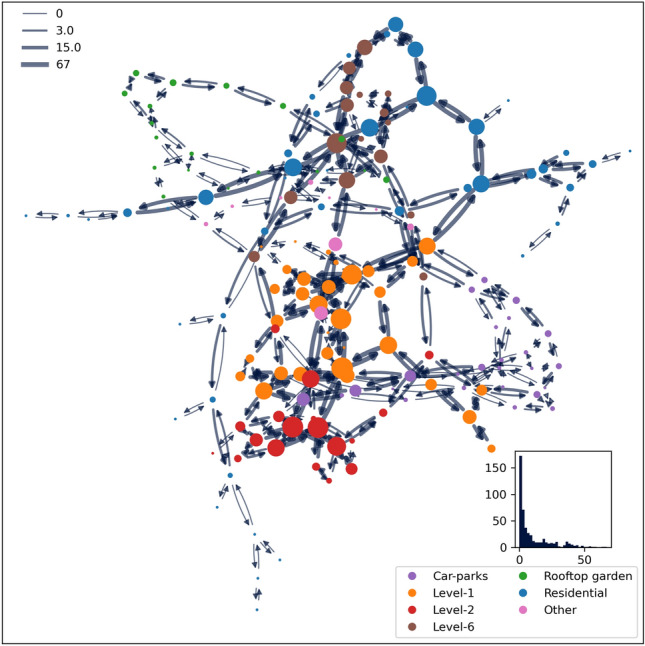
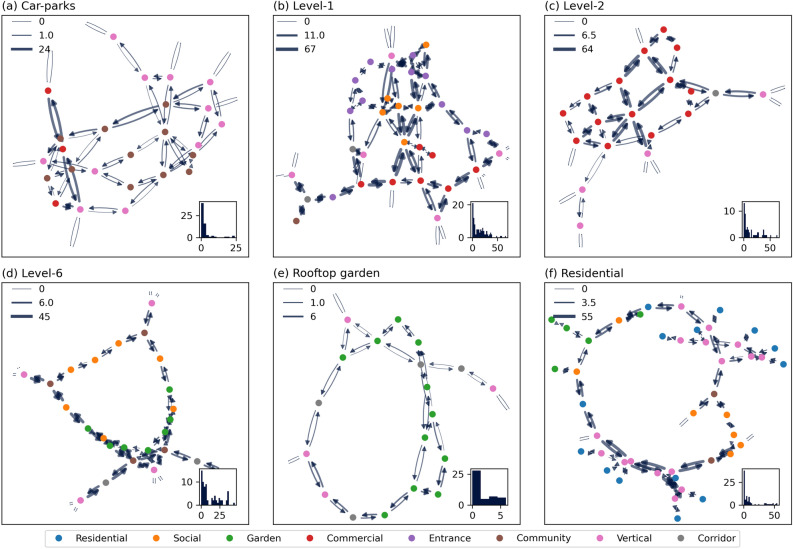
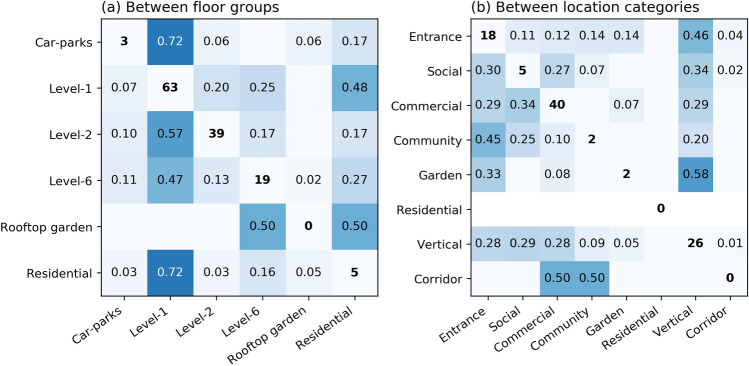
With the advent of distributed multi-sensory networks of devices, vast troves of real-time data can be gathered about our interactions with the built environment. These rich data sets can be mined to achieve improved and informed data-driven designs of buildings, neighborhoods, and potentially entire cities. Among those, integrated developments have the peculiarity of combining multiple functions within a compact space and, as such, behave as microcosms of a city that can help address the problem of urban sprawl and density. However, a general lack of data and framework about integrated developments hinders our ability to test design hypotheses about the complex interplay between heterogeneity in both space and function. Here, we apply a data-driven approach to analyze the joint influence of topology and function on user movement within a state-of-the-art integrated development in Singapore. Specifically, we leverage the network representation of the building and use movement data collected from 51 individuals over a month. We show evidence of correlation (40%) between the spatial network features and human movement at the building level. We are also able to quantify the relationship between the functional and spatial components of the integrated development through user movement. Previous studies have shown a 60% or higher correlation between the topology and human movement at the city or country scales. Our moderate correlation, therefore, implies that more factors influencing user movement are at play. The heterogeneity in the spatial function introduced trips with diverse origins and destinations. A further data-driven analysis integrating origins and destinations reveals both qualitative and quantitative means of studying the relationship between the built environment and the processes that take place in them.
随着分布式多传感器设备网络的出现,可以收集到大量关于我们与建筑环境交互的实时数据。这些丰富的数据集可以被挖掘,以实现对建筑、社区乃至整个城市的改进和基于数据的明智设计。其中,综合开发项目具有在紧凑空间内结合多种功能的特点,因此,它们就像城市的缩影,有助于解决城市蔓延和密度问题。然而,普遍缺乏关于综合开发项目的数据和框架,这阻碍了我们测试关于空间和功能异质性之间复杂相互作用的设计假设的能力。在这里,我们应用一种数据驱动的方法来分析拓扑结构和功能对新加坡一个先进综合开发项目中用户移动的联合影响。具体来说,我们利用建筑的网络表示,并使用在一个月内从51个人那里收集到的移动数据。我们展示了建筑层面空间网络特征与人类移动之间存在相关性(40%)的证据。我们还能够通过用户移动来量化综合开发项目功能和空间组成部分之间的关系。先前的研究表明,在城市或国家尺度上,拓扑结构与人类移动之间的相关性为60%或更高。因此,我们的中等相关性意味着有更多影响用户移动的因素在起作用。空间功能的异质性导致了具有不同起点和终点的出行。进一步整合起点和终点的基于数据的分析揭示了研究建筑环境与其中发生的过程之间关系的定性和定量方法。