Waseda Institute for Advanced Study, Waseda University, Tokyo, Japan.
Department of Molecular and Cellular Medicine, Center for Future Medical Research, Institute of Medical Science, Tokyo Medical University, Tokyo, Japan.
Cancer Sci. 2024 Jun;115(6):1726-1737. doi: 10.1111/cas.16161. Epub 2024 Mar 26.
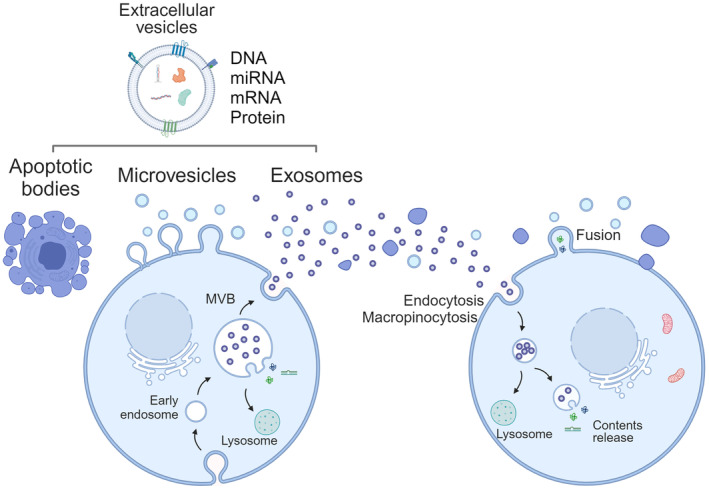
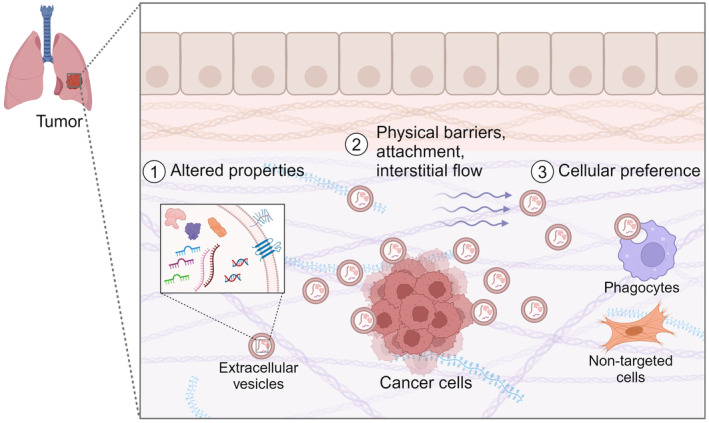
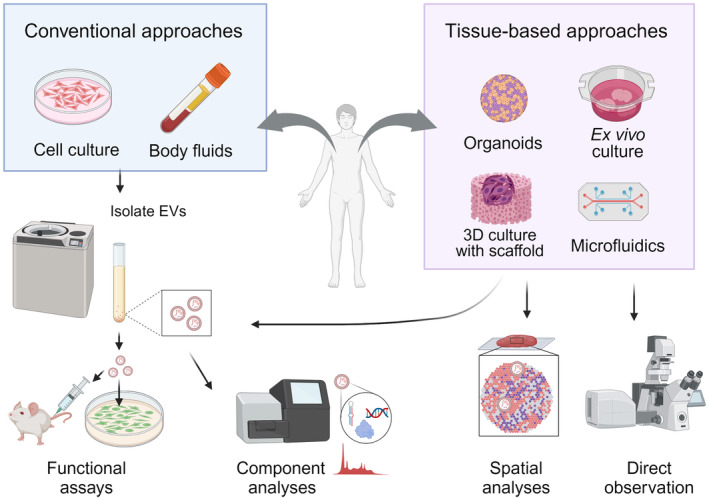
Tumor tissue is densely packed with cancer cells, non-cancerous cells, and ECM, forming functional structures. Cancer cells transfer extracellular vesicles (EVs) to modify surrounding normal cells into cancer-promoting cells, establishing a tumor-favorable environment together with other signaling molecules and structural components. Such tissue environments largely affect cancer cell properties, and so as EV-mediated cellular communications within tumor tissue. However, current research on EVs focuses on functional analysis of vesicles isolated from the liquid phase, including cell culture supernatants and blood draws, 2D-cultured cell assays, or systemic analyses on animal models for biodistribution. Therefore, we have a limited understanding of local EV transfer within tumor tissues. In this review, we discuss the need to study EVs in a physiological tissue context by summarizing the current findings on the impacts of tumor tissue environment on cancer EV properties and transfer and the techniques required for the analysis. Tumor tissue environment is likely to alter EV properties, pose physical barriers, interactions, and interstitial flows for the dynamics, and introduce varieties in the cell types taken up. Utilizing physiological experimental settings and spatial analyses, we need to tackle the remaining questions on physiological EV-mediated cancer-host cell interactions. Understanding cancer EV-mediated cellular communications in physiological tumor tissues will lead to developing interaction-targeting therapies and provide insight into EV-mediated non-cancerous cells and interspecies interactions.
肿瘤组织中密集分布着癌细胞、非癌细胞和细胞外基质,形成具有功能的结构。癌细胞将细胞外囊泡(EVs)转移到周围的正常细胞中,将其转化为促进癌症的细胞,与其他信号分子和结构成分一起建立有利于肿瘤的环境。这种组织环境在很大程度上影响着癌细胞的特性,以及肿瘤组织内 EV 介导的细胞通讯。然而,目前对 EV 的研究主要集中在从液相中分离出的囊泡的功能分析上,包括细胞培养上清液和血液采集、2D 培养细胞分析,或在动物模型上进行生物分布的系统分析。因此,我们对肿瘤组织内局部 EV 转移的了解有限。在这篇综述中,我们通过总结肿瘤组织环境对癌症 EV 特性和转移的影响,以及分析所需的技术,讨论了在生理组织背景下研究 EV 的必要性。肿瘤组织环境可能会改变 EV 的特性,对其动态形成物理障碍、相互作用和间质流,并引入不同的细胞类型。我们需要利用生理实验设置和空间分析来解决生理 EV 介导的癌症-宿主细胞相互作用中剩余的问题。了解生理肿瘤组织中 EV 介导的细胞通讯将有助于开发针对相互作用的治疗方法,并深入了解 EV 介导的非癌细胞和种间相互作用。