Perez Gloria I, Bernard Matthew P, Vocelle Daniel, Zarea Ahmed A, Saleh Najla A, Gagea Matthew A, Schneider Doug, Bauzon Maxine, Hermiston Terry, Kanada Masamitsu
Institute for Quantitative Health Science and Engineering (IQ), Michigan State University, East Lansing, MI 48824, USA.
College of Osteopathic Medicine, Michigan State University, East Lansing, MI 48824, USA.
Vaccines (Basel). 2023 Mar 13;11(3):639. doi: 10.3390/vaccines11030639.
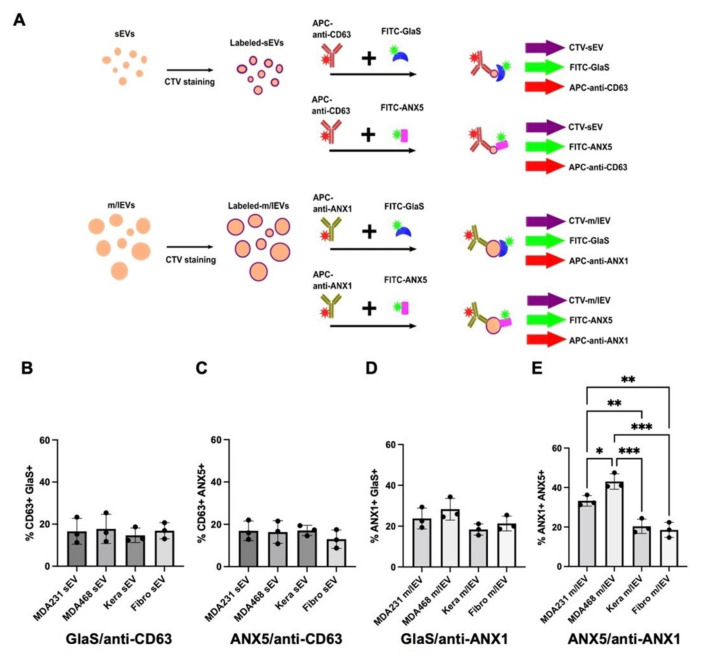
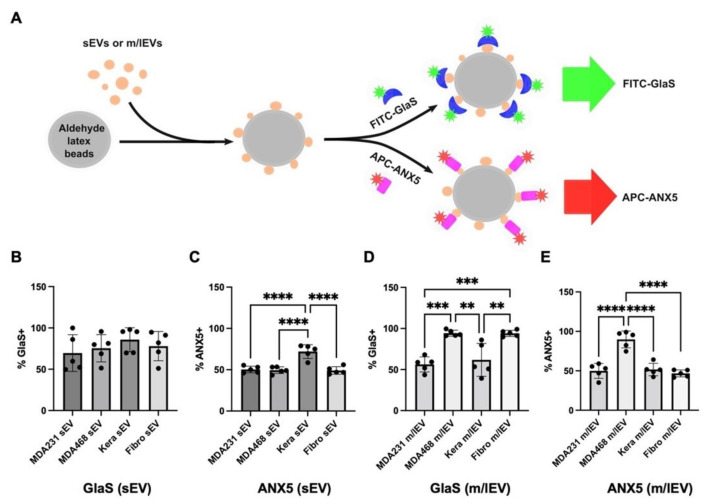
Under physiological conditions, phosphatidylserine (PS) predominantly localizes to the cytosolic leaflet of the plasma membrane of cells. During apoptosis, PS is exposed on the cell surface and serves as an "eat-me" signal for macrophages to prevent releasing self-immunogenic cellular components from dying cells which could potentially lead to autoimmunity. However, increasing evidence indicates that viable cells can also expose PS on their surface. Interestingly, tumor cell-derived extracellular vesicles (EVs) externalize PS. Recent studies have proposed PS-exposing EVs as a potential biomarker for the early detection of cancer and other diseases. However, there are confounding results regarding subtypes of PS-positive EVs, and knowledge of PS exposure on the EV surface requires further elucidation. In this study, we enriched small EVs (sEVs) and medium/large EVs (m/lEVs) from conditioned media of breast cancer cells (MDA-MB-231, MDA-MB-468) and non-cancerous cells (keratinocytes, fibroblasts). Since several PS-binding molecules are available to date, we compared recombinant proteins of annexin A5 and the carboxylated glutamic acid domain of Protein S (GlaS), also specific for PS, to detect PS-exposing EVs. Firstly, PS externalization in each EV fraction was analyzed using a bead-based EV assay, which combines EV capture using microbeads and analysis of PS-exposing EVs by flow cytometry. The bulk EV assay showed higher PS externalization in m/lEVs derived from MDA-MB-468 cells but not from MDA-MB-231 cells, while higher binding of GlaS was also observed in m/lEVs from fibroblasts. Second, using single EV flow cytometry, PS externalization was also analyzed on individual sEVs and m/lEVs. Significantly higher PS externalization was detected in m/lEVs (annexin A1) derived from cancer cells compared to m/lEVs (annexin A1) from non-cancerous cells. These results emphasize the significance of PS-exposing m/lEVs (annexin A1) as an undervalued EV subtype for early cancer detection and provide a better understanding of PS externalization in disease-associated EV subtypes.
在生理条件下,磷脂酰丝氨酸(PS)主要定位于细胞质膜的胞质小叶。在细胞凋亡过程中,PS暴露于细胞表面,并作为巨噬细胞的“吃掉我”信号,以防止死亡细胞释放可能导致自身免疫的自身免疫原性细胞成分。然而,越来越多的证据表明,活细胞也可以在其表面暴露PS。有趣的是,肿瘤细胞衍生的细胞外囊泡(EVs)会使PS外化。最近的研究提出,暴露PS的EVs作为癌症和其他疾病早期检测的潜在生物标志物。然而,关于PS阳性EVs亚型的结果存在混淆,并且对EV表面PS暴露的了解需要进一步阐明。在本研究中,我们从乳腺癌细胞(MDA-MB-231、MDA-MB-468)和非癌细胞(角质形成细胞、成纤维细胞)的条件培养基中富集了小EVs(sEVs)和中/大EVs(m/lEVs)。由于目前有几种PS结合分子,我们比较了膜联蛋白A5的重组蛋白和同样对PS具有特异性的蛋白S的羧化谷氨酸结构域(GlaS),以检测暴露PS的EVs。首先,使用基于磁珠的EV检测法分析每个EV组分中的PS外化,该方法结合了使用微珠捕获EV和通过流式细胞术分析暴露PS的EVs。大量EV检测显示,来自MDA-MB-468细胞而非MDA-MB-231细胞的m/lEVs中PS外化程度更高,同时在成纤维细胞的m/lEVs中也观察到GlaS的结合更高。其次,使用单个EV流式细胞术,还对单个sEVs和m/lEVs的PS外化进行了分析。与来自非癌细胞的m/lEVs(膜联蛋白A1)相比,在来自癌细胞的m/lEVs(膜联蛋白A1)中检测到显著更高的PS外化。这些结果强调了暴露PS的m/lEVs(膜联蛋白A1)作为早期癌症检测中被低估的EV亚型的重要性,并为更好地理解疾病相关EV亚型中的PS外化提供了依据。